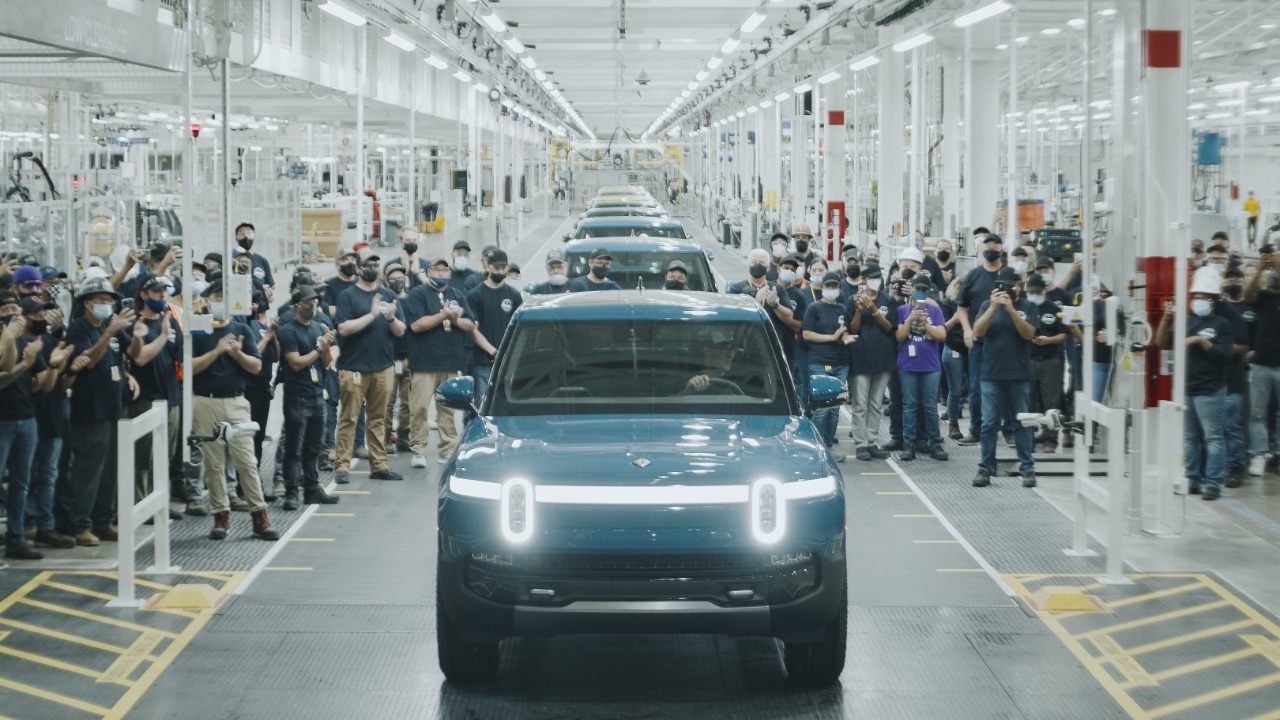
An investor has publicly urged Rivian Automotive to consider acquiring Tesla, arguing that the electric vehicle pioneer’s declining brand strength and aging product lineup create a rare opening for a smaller competitor to absorb a larger one. The proposal, while provocative, arrives at a moment when Tesla’s brand value has dropped sharply and Rivian has been building financial stability through government-backed loans and a joint venture with Volkswagen. Whether Rivian could realistically execute such a deal is far from settled, but the suggestion itself signals how dramatically the competitive dynamics in the EV market have shifted.
Tesla’s $15 Billion Brand Decline
The foundation of the acquisition argument rests on Tesla’s eroding market position. Researchers found that Tesla’s brand value shed $15 billion in 2024, a steep decline for a company that once commanded unquestioned dominance in the EV sector. That loss did not happen overnight. It reflects an aging vehicle lineup that has gone years without a major new consumer model, combined with growing public fatigue around the controversies tied to Elon Musk, who remains at the helm of the company.
The brand erosion matters because Tesla’s valuation has long been built on perception as much as production. Investors have priced Tesla not just as an automaker but as a technology platform, and that premium depends on consumer enthusiasm and trust. When brand value contracts by billions, it puts pressure on the stock price and weakens the company’s ability to attract new buyers in an increasingly crowded EV market. For a rival like Rivian, that gap between Tesla’s still-massive market capitalization and its declining brand health could represent an asymmetry worth exploiting.
Rivian’s Financial Position and Funding Pipeline
Any serious discussion of Rivian acquiring Tesla requires a hard look at whether Rivian has the resources to even attempt such a move. The company’s Q1 2025 shareholder letter filed with the SEC lays out its financial position, liquidity, and forward funding expectations. That document references capital from the Volkswagen joint venture as well as a Department of Energy loan designated for Rivian’s Georgia manufacturing facility. Together, these funding sources give Rivian a financial runway that most EV startups simply do not have.
The Volkswagen partnership is especially significant. It is not just a cash infusion but a strategic alliance that gives Rivian access to one of the world’s largest automakers’ supply chain and engineering expertise. The DOE loan, meanwhile, signals federal confidence in Rivian’s expansion plans. Still, having a funded balance sheet and having enough capital to absorb a company of Tesla’s scale are two very different things. Rivian remains a fraction of Tesla’s size by revenue, production volume, and global footprint. The shareholder letter establishes financial stability, not acquisition-ready war chest levels of liquidity.
A Year of Focused Execution at Rivian
Rivian’s leadership has framed its recent trajectory as one of disciplined progress rather than aggressive expansion. In the company’s Q4 2025 shareholder letter, the company described 2025 as “a year of focused execution” in which it “laid the foundation” for growth through advances across its hardware, software, and autonomy teams. That language suggests a company investing in internal capability rather than shopping for external acquisitions.
The emphasis on software and autonomy is where the competitive overlap with Tesla becomes most interesting. Tesla’s lead in autonomous driving technology has long been cited as one of its strongest competitive moats. If Rivian’s integrated teams are making genuine progress on self-driving systems, that could erode one of the key reasons investors have assigned Tesla such a high premium. A Rivian that can match or approach Tesla’s autonomy capabilities while also offering newer vehicle designs and a cleaner brand image presents a different kind of threat than a simple acquisition bid. It suggests Rivian could compete for Tesla’s customers without ever buying the company.
Why the Acquisition Pitch Falls Short
The investor’s call for Rivian to acquire Tesla makes for a compelling headline, but the practical barriers are enormous. Tesla, despite its brand struggles, still operates multiple factories across the United States, Europe, and Asia. It delivers vehicles at a scale that dwarfs Rivian’s output. Absorbing that manufacturing footprint, along with Tesla’s workforce, supply contracts, and service network, would require capital and operational capacity that Rivian has not demonstrated it possesses. The shareholder letters filed with the SEC confirm Rivian’s improving financial health, but they do not describe a company ready to take on a target of Tesla’s complexity.
There is also the question of what Rivian would actually gain. Tesla’s brand is weakening, and its vehicle lineup is aging. The Cybertruck has drawn mixed consumer reception. The Model S and Model X are well past their design peaks. What Tesla does have is manufacturing scale, a Supercharger network, and its autonomy data. But acquiring those assets means also acquiring Tesla’s liabilities, including its high executive compensation structures, ongoing regulatory scrutiny, and the reputational baggage tied to Musk’s public profile. For Rivian, the risk of absorbing those problems could easily outweigh the benefits of gaining Tesla’s infrastructure.
What This Signals for the EV Market
The fact that an investor is even floating the idea of a smaller EV maker buying Tesla tells a story about how the competitive balance in the industry has shifted. Five years ago, no one would have taken such a proposal seriously. Tesla was the undisputed leader, and companies like Rivian were still trying to prove they could deliver vehicles at all. The shift reflects both Tesla’s missteps and the maturation of its competitors. Rivian now has vehicles on the road, a joint venture with a global automaker, federal loan backing, and a stated strategy built around software and autonomy. It is no longer a startup in the traditional sense.
More From The Daily Overview
*This article was researched with the help of AI, with human editors creating the final content.

Grant Mercer covers market dynamics, business trends, and the economic forces driving growth across industries. His analysis connects macro movements with real-world implications for investors, entrepreneurs, and professionals. Through his work at The Daily Overview, Grant helps readers understand how markets function and where opportunities may emerge.

