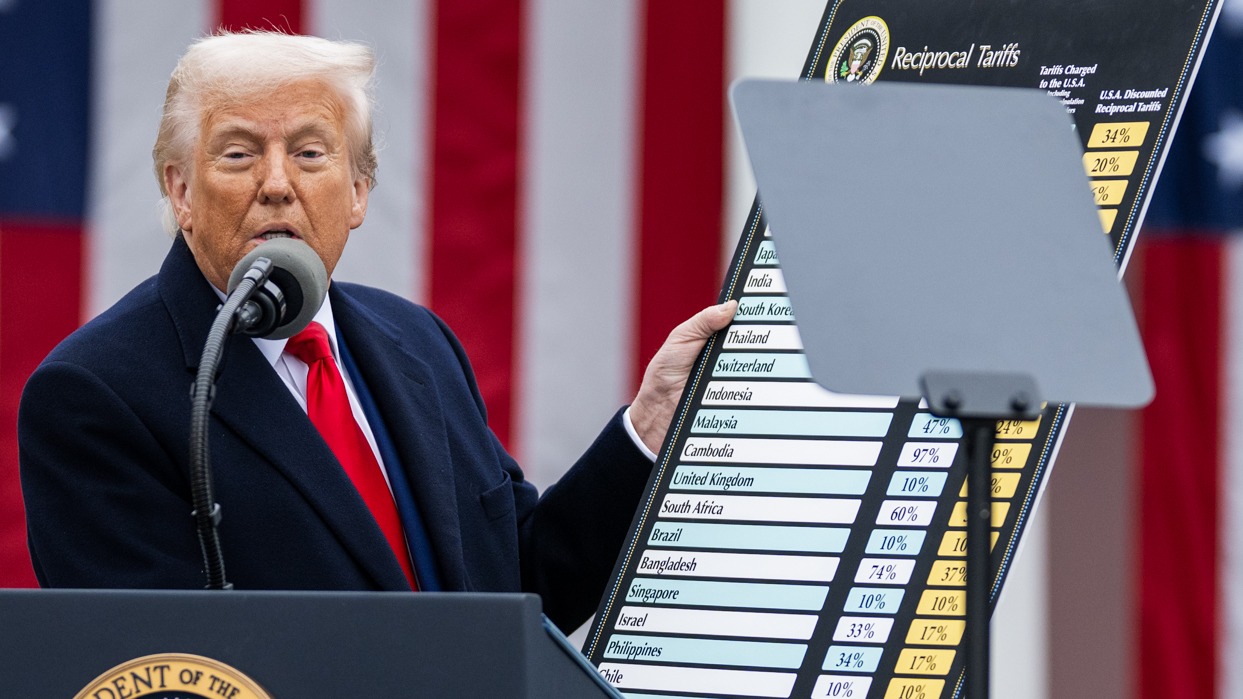
Wall Street is quietly wagering that the Supreme Court will clip President Donald Trump’s tariff powers, ease a major source of uncertainty, and leave the real economy to prove it can grow without emergency trade protection. The bets are visible in prediction markets, sector positioning, and research notes that treat a rollback of Trump’s signature levies as the base case rather than a tail risk. If those expectations are wrong, investors may discover they have been trading a legal story as if it were an economic inevitability.
The stakes go far beyond a single court decision. Trump’s tariff regime has reshaped supply chains, raised costs for households, and become a test of how far a president can stretch emergency authority in the name of economic security. A ruling that narrows that authority could reset the balance between the White House, Congress, and the courts on trade, while forcing markets to confront how much of the recent rally rests on legal optimism rather than hard earnings power.
Prediction markets are pricing in a Supreme Court rebuke
The cleanest window into investor expectations sits in the niche world of event contracts, where traders can buy and sell binary outcomes tied to Washington. On platforms such as Kalshi, contracts tied to the fate of Trump’s tariffs have drawn in speculators who are effectively voting with their wallets on how the justices will rule. Jan reports describe how Traders on prediction platforms Kalshi and Polymarket are assigning low odds that the Supreme Court will fully uphold President Donald Trump’s tariff authority, a sign that market participants see legal risk skewed against the White House.
Jan coverage of these markets notes that Prediction market Traders on Kalshi and Polymarket are betting against Trump’s tariffs as a Supreme Court ruling looms, with contracts implying that the nation’s highest court is unlikely to rule in favor of the current regime of levies. Those odds, which translate sentiment into tradable market prices, suggest that many investors expect the Supreme Court to at least narrow the use of emergency powers that Trump invoked to impose duties without new legislation. The pricing on these prediction contracts has become a reference point for hedge funds and macro desks trying to gauge consensus on the legal outcome.
Legal stakes: IEEPA, emergency powers and a slow-moving Court
Behind those wagers sits a complex legal fight over how far a president can go when invoking the International Emergency Economic powers Act. The case now before the justices will determine whether Trump can rely on International Emergency Economic authority to impose tariffs without congressional approval, a question that goes to the heart of the separation of powers in trade policy. Jan analysis notes that the Court’s decision, which could be announced as early as a Friday, will clarify how closely any future tariffs must adhere to IEEPA’s national emergency framework and whether similar moves would face tighter scrutiny in the future, especially if the justices view Trump’s actions as stretching the statute’s intent.
The Supreme Court moved unusually quickly to hear the dispute, scheduling arguments in early Nov, yet it has still not issued a ruling three months later. Reporting by Mark Sherman and Lindsay Whitehurst of the Associated Press describes how The Supreme Court has not decided on Trump’s tariffs even after rapidly scheduled arguments, underscoring how the case has taken on added urgency because the consequences of the Trump administration’s policy are playing out in real time. One account notes that the tariffs case is among 202 matters on the Court’s docket, a reminder that even high-profile economic disputes must compete with a crowded calendar as the justices weigh how broadly to write any opinion that could reshape the use of emergency economic tools. Those dynamics have left markets in limbo, waiting for clarity from International Emergency Economic litigation even as stock indexes trade near record highs.
Wall Street’s split view: legal risk vs economic impact
Even as prediction markets lean toward a partial defeat for Trump, traditional Wall Street research is more cautious about how much the ruling will actually change the tariff landscape. Jan commentary on What markets expect from the Supreme Court’s ruling on Trump’s tariffs highlights that some strategists see a decision striking down parts of the regime as a tailwind for equities, particularly for import-heavy sectors that have labored under higher costs. Others warn that Trump could pursue alternative routes to maintain levies, for example by leaning on different statutory authorities, which would blunt the immediate boost that a legal setback might otherwise deliver to risk assets. That tension has left Markets bracing for volatility around the announcement while still treating the broader trade stance as relatively sticky.
Research from Morgan adds another layer of nuance. Jan Market analysis from J.P. Morgan suggested the Supreme Court’s decision would probably have very little impact on overall tariff levels, particularly if additional tariffs follow through other channels even after a legal rebuke. In that view, the ruling matters more for how investors price policy uncertainty than for the actual duties paid at the border. I see that logic echoed in a separate critique of the prevailing institutional thesis, which argues that The Premise Is False when investors assume that a favorable legal outcome will automatically deliver supply chain stabilization and a clean growth dividend. That argument, laid out in a detailed examination of how Wall Street has positioned for a Supreme Court ruling, warns that portfolios tilted toward trade-sensitive manufacturing and global cyclicals may be underestimating the risk that Trump’s broader economic agenda keeps pressure on cross-border commerce regardless of what the justices decide, a point that resonates through Premise Is False critique.
Tariffs, households and the real economy’s burden
While traders focus on legal odds, the economic footprint of Trump’s tariffs is already visible in household budgets and corporate balance sheets. Jan analysis of Tariffs and trade uncertainty finds that in his first year, Trump expanded sweeping tariffs on imports from nearly every country in the world, a move that raised costs across a wide range of consumer goods. One estimate cited in that work calculates that the tariff regime has cost the average household roughly $1,700 annually, a figure that captures both direct price increases and knock-on effects as companies pass along higher input costs. For families buying imported electronics, appliances, or even cars with global supply chains, the levies have functioned like a stealth tax layered on top of inflation.
On the business side, importers are still grappling with a maze of overlapping duties and compliance questions that will not vanish overnight even if the Supreme Court trims Trump’s authority. Jan guidance to supply managers warns that What constitutes “doing business” with Iran has not been clearly defined in the context of sanctions and tariffs, leaving companies uncertain about whether new duties would stack on top of existing measures or replace them. That same analysis notes that key tariff flashpoints cannot be ignored because the current levies could be upheld, modified or invalidated, and each scenario carries different implications for contracts, pricing, and sourcing strategies. In practice, that means logistics teams and CFOs must prepare for multiple outcomes rather than assuming a clean legal victory will immediately normalize trade flows, a reality that keeps the focus on operational resilience rather than courtroom drama as described in Tariff flashpoints.
Policy signals from Washington and scenarios if tariffs fall
More From TheDailyOverview
*This article was researched with the help of AI, with human editors creating the final content.

Grant Mercer covers market dynamics, business trends, and the economic forces driving growth across industries. His analysis connects macro movements with real-world implications for investors, entrepreneurs, and professionals. Through his work at The Daily Overview, Grant helps readers understand how markets function and where opportunities may emerge.

