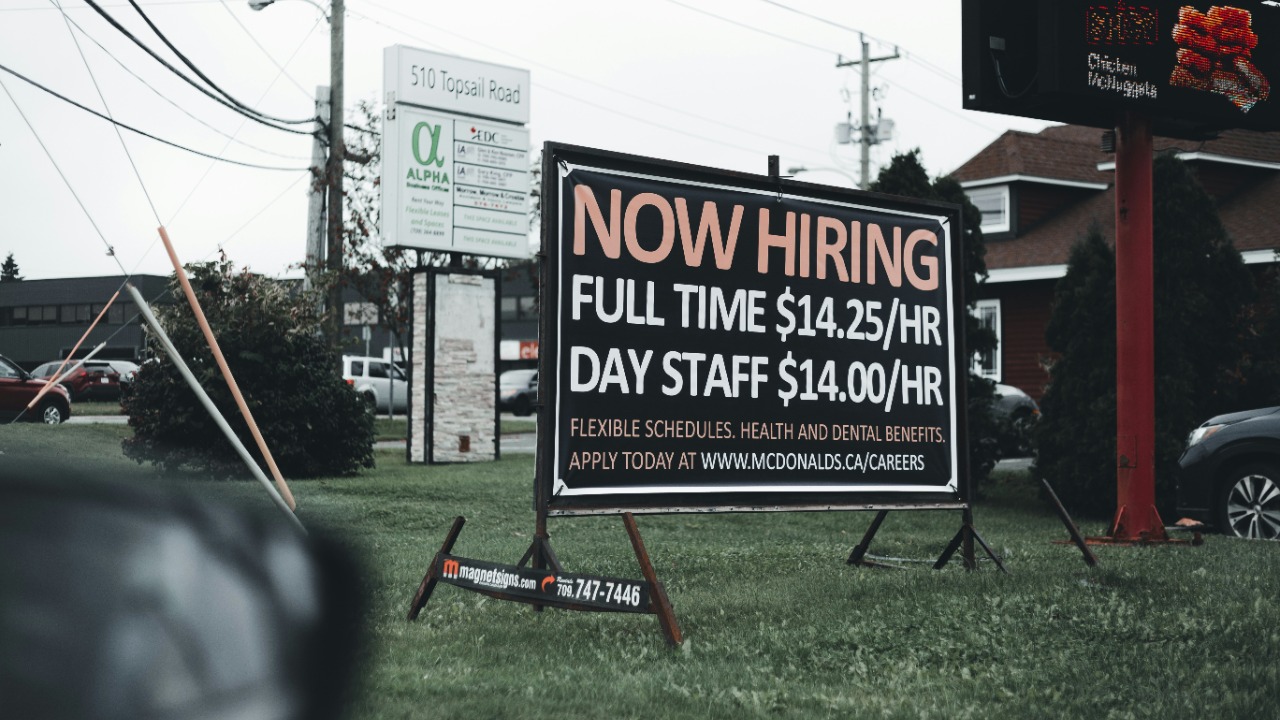
America’s once red-hot labor market is cooling fast. Job openings have fallen to levels not seen in years, hiring has slowed, and the balance of power between workers and employers is shifting back toward the middle. The headline numbers still look solid at a glance, but beneath the surface the engine of job creation is clearly losing speed.
What is emerging is not a classic jobs crash, at least not yet, but a slow bleed in demand for labor that leaves job seekers with fewer options and employers more cautious about expanding. As openings slide toward a five-year low and hiring momentum dies down, the risk grows that a soft landing could tip into something rougher.
The numbers behind the slide in openings
The clearest sign of the turn comes from the government’s Job Openings and Labor Turnover Survey, or JOLTS, which tracks how many positions employers are trying to fill. According to the official Latest Numbers, the Latest Job Openings Level stood at 7,146,000 in Nov, giving a Latest Job Openings Rate of 4.3%. Those figures mark a sharp retreat from the peak of the post-pandemic hiring boom and put vacancies near their lowest point in roughly five years, outside a brief dip early in the recovery.
Private data tell the same story in slightly different language. One widely watched series on Job Openings for Total Nonfarm, known as JTSJOL, shows vacancies drifting down steadily from their highs in Dec 2021 through Nov 2025. A companion table on Job Openings: Total Nonfarm (JTSJOR) confirms that the rate was 4.3 in Nov 2025 and 4.3 in Oct, underscoring how the vacancy share of the labor force has plateaued at a lower level. For a labor market that once featured nearly two openings for every unemployed worker, that is a dramatic comedown.
From worker’s market to fragile balance
One of the most striking shifts is how much less leverage job seekers now have. Earlier in the expansion, there were far more openings than unemployed people, which let workers hop between employers and demand higher pay. By Nov, that ratio had fallen to 0.91 job openings for every unemployed person, according to one detailed analysis of the JOLTS data, the lowest level since March 2021 and a clear sign that the pendulum is swinging back toward employers. The same report notes that hiring dropped by 253,000 positions in that month, a reminder that fewer postings are translating into fewer people actually being brought on board, even as There are still millions of Americans looking for work, as described in the Jan coverage of the trend.
Economists often talk about the labor market as a game of musical chairs, and that metaphor now fits uncomfortably well. In its November 2025 JOLTS Report, one research group described the situation as “Musical Chairs, but the Music Has Stopped,” noting that Job openings fell to 7.1 m in November from higher levels earlier in the year and warning that the slowdown in churn could sap wage growth and broader economic momentum. That JOLTS Report, titled Musical Chairs, but the Music Has Stopped, underscores how a cooler market can feel stable on the surface while quietly eroding workers’ bargaining power.
Sector splits and the “second lowest in five years” warning
Aggregate numbers can hide a lot of pain, and the latest readings show a labor market that is increasingly uneven. One detailed breakdown of the government data notes that Job openings have fallen to the 2nd lowest level in 5 years, with only a single month in that span showing fewer advertised positions. But outside that month, it was the lowest in nearly five years, a sobering benchmark for anyone who grew used to “help wanted” signs on every block. The same report points out that Open jobs in November fell sharply in shipping and warehousing and in government, while they rose in retail and construction, illustrating how some sectors are still scrambling for staff even as others quietly shed roles, as captured in the But account of the shift.
Another pass through the same data, framed as AP AUDIO, emphasizes that Job openings slide to 2nd lowest level in 5 years as hiring remains sluggish and that Open jobs in Novembe were particularly weak in industries that had overexpanded during the pandemic boom. That analysis notes that some employers are trimming vacancies rather than resorting to mass layoffs, a pattern that helps explain why unemployment has not spiked even as demand for labor cools. It also highlights that sectors like shipping, warehousing, and parts of the public sector have already shed jobs in previous months, a trend that could spread if consumer spending slows further, as detailed in the AUDIO summary of the latest Job and Open figures.
Why hiring momentum is fading
Behind the cooler numbers lies a mix of policy uncertainty and economic fatigue. Hiring has clearly lost momentum, hobbled by uncertainty over President Donald Trump’s tariffs and the lingering effects of earlier interest rate hikes that made borrowing more expensive for businesses. One recent assessment of weekly jobless claims notes that Hiring has clearly lost momentum even as unemployment claims remain at a historically healthy level, suggesting that companies are pulling back on new positions rather than aggressively cutting existing staff. That tension, between fewer opportunities and still-low layoffs, is central to understanding the current slowdown, as described in the Dec analysis of claims data.
Looking ahead, forecasters expect those headwinds to persist. A set of labor market Key Takeaways for 2026 argues that the United States is on track for slow job growth in the year ahead, with Tariff-related uncertainty and weaker global demand weighing on hiring plans. That outlook suggests that the current lull is not just a statistical blip but part of a broader transition from a stimulus-fueled boom to a more restrained, policy-constrained expansion. For workers, that likely means fewer signing bonuses, slower wage gains, and a tougher search, especially in interest-sensitive sectors like manufacturing and logistics.
What the slowdown means for workers and the economy
For individual job seekers, the shift from abundance to scarcity is already changing behavior. With fewer postings and more competition per role, workers are less likely to quit without another offer in hand, and employers can be choosier about skills and experience. Official labor statistics from the Bureau of Labor Statistics show that quits have eased from their highs, consistent with a market where people feel less confident about jumping ship. At the same time, the Latest Job Openings Level of 7,146,000 and the Latest Job Openings Rate of 4.3% in Nov, as reported in the JOLTS Latest Numbers, still reflect a historically elevated demand for labor compared with the pre-pandemic era, which means the market has cooled but not frozen.
For the broader economy, the decline in openings is both a warning and, potentially, a pressure valve. Data compiled on Job Offers in the United States show that vacancies decreased to 7146 Thousand in November from higher levels in October of 2025, while separate figures indicate that Job openings in the US fell by 303,000 to 7.146 m in November 2025, the lowest since September 2024 and well below market expectations, as detailed in the Job summary of that 14‑month low. A cooler labor market can help ease inflation by slowing wage growth, but if openings keep sliding and hiring continues to weaken, the risk is that a gentle deceleration turns into a stall. For now, the data point to a fragile balance: fewer chairs in the game of musical chairs, but the music, while quieter, has not yet stopped entirely.
More From The Daily Overview

Grant Mercer covers market dynamics, business trends, and the economic forces driving growth across industries. His analysis connects macro movements with real-world implications for investors, entrepreneurs, and professionals. Through his work at The Daily Overview, Grant helps readers understand how markets function and where opportunities may emerge.

