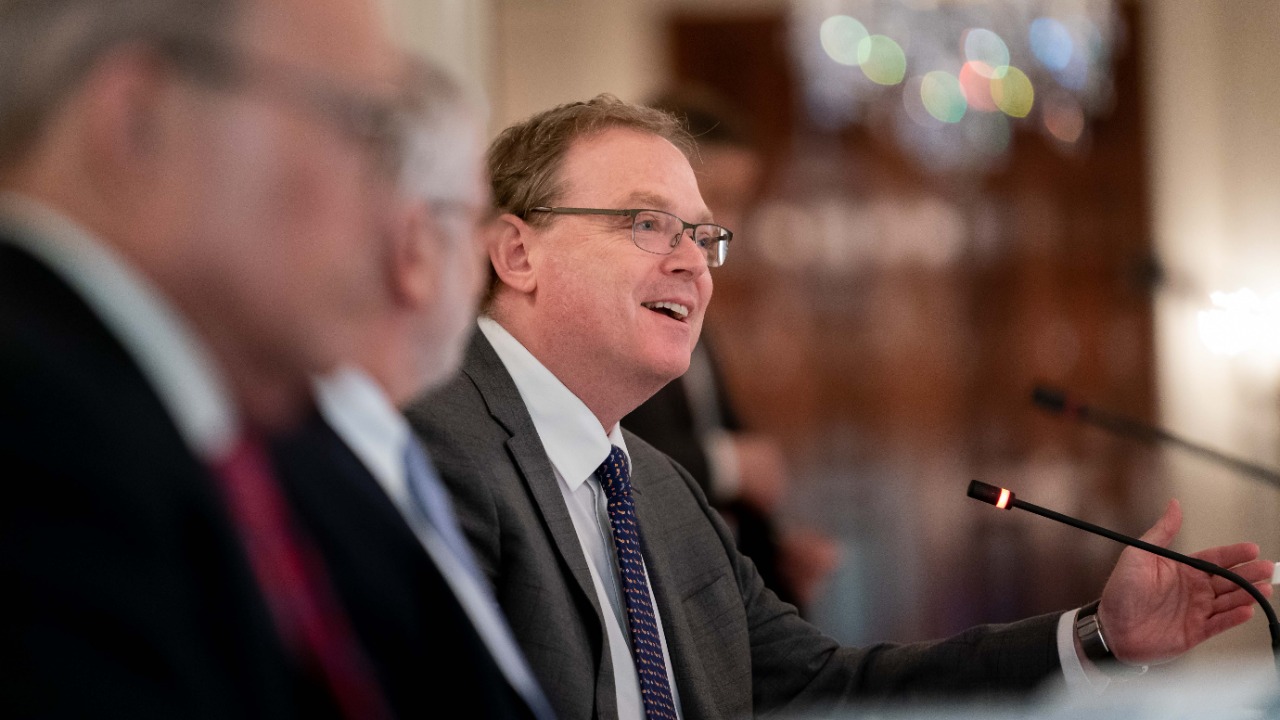
Kevin Hassett is no longer just a name on the long list of potential central bankers in Washington; he is openly signaling that he is prepared to take the gavel at the Federal Reserve if President Donald Trump calls. His public comments, combined with a flurry of reporting that casts him as the leading contender, have turned a once-speculative audition into a very real test of how far the White House wants to reshape monetary policy.
As markets, lawmakers, and global counterparts watch for clarity on the next Fed chair, Hassett’s willingness to step in has become a central part of the story. The question is no longer whether he would accept the job, but what his elevation would mean for interest rates, inflation, and the balance of power between the White House and the central bank.
Hassett signals he is ready to serve
Kevin Hassett has moved from guarded silence to explicit readiness, telling interviewers that he would be “happy to serve” if chosen to lead the Federal Reserve. That shift matters, because it removes any ambiguity about his intentions and positions him as a candidate who is not only under consideration but also fully prepared to accept the role. His comments underscore that he sees the Fed chairmanship as a natural extension of his work as a senior economic adviser in the Trump administration, rather than a departure from his current responsibilities.
In public remarks highlighted in recent coverage, Hassett framed his openness to the job as a duty rather than a personal ambition, stressing that if the president asked, he would step up to guide monetary policy at a delicate moment for the economy. That posture, reported in detail in an interview where he said he would be “happy to serve if chosen as Fed chair,” has been cited as a clear signal that he is not merely being floated by allies but is actively in the mix as a willing nominee, a stance captured in coverage of the White House economic adviser’s comments.
Trump says his Fed choice is made
While Hassett has been signaling his readiness, President Donald Trump has been sending his own message: the decision on who will lead the Federal Reserve has already been made. In recent remarks, Trump said he had settled on a candidate, even as he declined to reveal the name publicly. That declaration has intensified speculation around Hassett, since it suggests the process has moved from open casting call to final selection, with only the formal announcement still pending.
Trump’s statement that he has made his choice, reported in coverage of his comments on the next Fed leader, has been interpreted by markets as a sign that the White House is close to ending the uncertainty that has hung over interest rate expectations. Investors and policymakers have been parsing every hint from the president, who has a history of publicly pressuring the central bank, and his assertion that the decision is done has only sharpened focus on the small circle of finalists, including the economic adviser widely seen as a frontrunner, as described in reports on Trump saying he has made his choice to lead the Federal Reserve.
How Hassett became the frontrunner
Hassett’s emergence as the leading candidate did not happen overnight; it reflects months of quiet vetting, public tryouts, and ideological alignment with the Trump economic agenda. Earlier reporting described him as moving to the front of the pack after a series of meetings and media appearances that showcased his views on inflation, growth, and the Fed’s role in supporting the administration’s priorities. His background as a former chair of the Council of Economic Advisers and his close ties to Trump’s economic team have made him a natural favorite in a field that has included more traditional central bankers.
Accounts of the selection process have repeatedly pointed to Hassett as the candidate who best matches Trump’s desire for a Fed chair who is both loyal and publicly supportive of the White House’s economic narrative. One detailed report described how he “emerges as frontrunner” in the internal audition, noting that he has impressed key decision makers with his willingness to challenge the Fed’s recent tightening bias and his emphasis on growth-friendly policy, a dynamic laid out in coverage of how Hassett emerges as frontrunner in Trump’s Fed search.
Bloomberg report and the market reaction
The sense that Hassett is now the favorite was turbocharged when a Bloomberg News report, cited by other outlets, said he had emerged as the frontrunner to be Trump’s next Fed chair. That report, which drew on people familiar with the internal deliberations, effectively confirmed what had been building in the background: that the White House was coalescing around Hassett as its preferred choice. Once that story circulated, traders and analysts began to price in the possibility of a more politically attuned central bank, with implications for bond yields and the dollar.
Coverage of the Bloomberg account emphasized that the report did not amount to a formal nomination, but it did signal that other contenders had likely fallen behind. Markets tend to react quickly to credible hints about Fed leadership, and the suggestion that Hassett was now the leading candidate prompted fresh debate about how his appointment might shift the path of interest rates. The report that he had emerged as frontrunner to be Trump’s next Fed chair crystallized that conversation, giving investors a clearer figure to model against future policy decisions.
The Sunday show audition
Hassett’s rise has played out not only in closed-door meetings but also on the country’s most-watched political talk shows, where he has effectively auditioned for the Fed job in front of a national audience. In a recent Sunday appearance, he fielded questions about inflation, interest rates, and the Fed’s independence, using the platform to present himself as a steady hand who respects the institution while also arguing that monetary policy should be more responsive to growth concerns. The performance was as much about reassuring markets as it was about impressing the president.
Those televised exchanges have been dissected by analysts looking for clues about how Hassett would behave as chair. In one widely shared segment, he discussed the outlook for rates and the balance between fighting inflation and avoiding an unnecessary slowdown, offering a preview of the arguments he might bring to the Federal Open Market Committee. The appearance, captured in a Sunday show interview, reinforced the sense that he is comfortable in the spotlight and willing to defend a more growth-oriented stance in public, a trait that could matter if he faces criticism from markets or Congress.
What Hassett’s policy instincts reveal
Hassett’s public comments over the past year provide a window into how he might steer the Fed if he becomes chair. He has consistently emphasized the risks of tightening policy too aggressively in an environment where inflation is easing and growth remains fragile, arguing that the central bank should avoid choking off a recovery that has not yet fully reached workers on the margins. That perspective aligns with the Trump administration’s preference for lower rates and a more accommodative stance, especially heading into politically sensitive periods.
In a recent discussion focused on his potential role at the central bank, Hassett outlined how he would approach the Fed’s dual mandate, stressing the importance of both price stability and maximum employment. He suggested that the central bank should be cautious about overreacting to short-term data and instead keep an eye on longer-term trends in wages and productivity. Those remarks, featured in a segment examining “Kevin Hassett now Fed chair” scenarios, gave observers a clearer sense of his instincts, as seen in a video analysis of how Hassett might act as Fed chair.
Signals from the White House and the markets
Inside the White House, officials have been careful not to pre-announce the president’s decision, but their public comments have hinted at what they expect from the next Fed leader. One senior economic adviser recently said that markets are already bracing for a new chair, suggesting that investors have begun to adjust their expectations for interest rates and inflation under fresh leadership. That observation reflects a broader recognition that the identity of the chair can shape everything from mortgage costs to corporate borrowing.
The same adviser indicated that the administration believes markets are looking for clarity and consistency, not surprise rate hikes or sudden shifts in guidance. That framing dovetails with the idea that a candidate like Hassett, who is closely aligned with the White House’s economic message, could provide a more predictable link between fiscal and monetary policy. The comment that “markets expect new Fed chair,” captured in a live discussion of the administration’s outlook, underscored how investors are already gaming out the implications of a change at the top, as reflected in coverage of a White House economic advisor saying markets expect a new Fed chair.
The broader audition: podcasts, interviews, and public vetting
Beyond television, Hassett has used podcasts and extended interviews to flesh out his views in a more conversational setting, effectively turning the media circuit into a rolling audition for the Fed job. In one in-depth audio conversation, he walked through his thinking on how the central bank misjudged inflation dynamics in recent years and what lessons he would apply if he were in charge. That kind of long-form discussion allows him to demonstrate both technical fluency and a willingness to challenge past orthodoxy, qualities that appeal to a White House eager to put its stamp on the Fed.
These appearances also serve another purpose: they give markets and lawmakers a chance to test how Hassett responds under pressure and whether he can explain complex policy choices in plain language. In a recent podcast episode that focused explicitly on his status as a leading candidate, he fielded questions about the Fed’s communication strategy, the role of forward guidance, and the risks of politicizing rate decisions. The conversation, framed around how he emerges as frontrunner in a Fed chair audition, highlighted both his confidence and the scrutiny he faces as the potential next face of American monetary policy.
The Trump–Hassett relationship and what it means for Fed independence
Any assessment of Hassett’s candidacy has to grapple with his relationship with President Trump, who has repeatedly criticized the Fed in the past and made clear that he wants a chair more aligned with his economic instincts. Hassett has been a loyal and visible member of Trump’s economic team, defending the administration’s policies on television and in print, and that loyalty is part of what makes him attractive to the president. At the same time, it raises questions about how he would navigate the Fed’s tradition of independence if he were installed as chair.
Reporting on the Trump–Hassett dynamic has noted that the president values advisers who share his skepticism of aggressive rate hikes and who are willing to challenge what he sees as an overly cautious central bank. Analysts have pointed out that a Hassett-led Fed could face early tests if markets doubt its willingness to resist political pressure, especially in moments when inflation data might argue for tighter policy. A detailed examination of their relationship and its implications for the central bank’s autonomy described how Hassett’s closeness to Trump could reshape expectations around the Fed’s decision making, a theme explored in coverage of Hassett’s ties to Trump and the Fed.
What comes next for the Fed and for Hassett
With Trump signaling that his choice is made and Hassett openly stating that he is ready to serve, the process now hinges on timing and confirmation politics. A formal nomination would trigger hearings where senators could probe his views on everything from balance sheet reduction to digital currencies, and where he would have to reassure skeptics that he can separate his past role as a political adviser from the demands of leading an independent central bank. The markets, already primed by weeks of leaks and hints, would quickly move to price in his likely policy path.
Until the White House makes the announcement, Hassett remains in a kind of public limbo, simultaneously a senior adviser and a presumed central banker in waiting. His recent media appearances, including a widely viewed interview that dissected his potential leadership style and policy priorities, have only deepened the sense that he is preparing for a larger stage. In one such conversation, available as a video discussion of his economic outlook, he spoke as someone already thinking in terms of the Fed’s long-term strategy rather than day-to-day political messaging. Whether that preparation culminates in the chairmanship will depend on the final call from the Oval Office and the verdict of the Senate, but his message is unmistakable: if asked, he is ready to take the job.
More From TheDailyOverview
- Tennessee loses $2.6B megafactory and faces major layoffs
- Retired But Want To Work? Try These 18 Jobs for Seniors That Pay Weekly
- What to do with your pennies after the U.S. stops minting them
- Home Depot CEO warns of a troubling customer trend in stores

Grant Mercer covers market dynamics, business trends, and the economic forces driving growth across industries. His analysis connects macro movements with real-world implications for investors, entrepreneurs, and professionals. Through his work at The Daily Overview, Grant helps readers understand how markets function and where opportunities may emerge.

