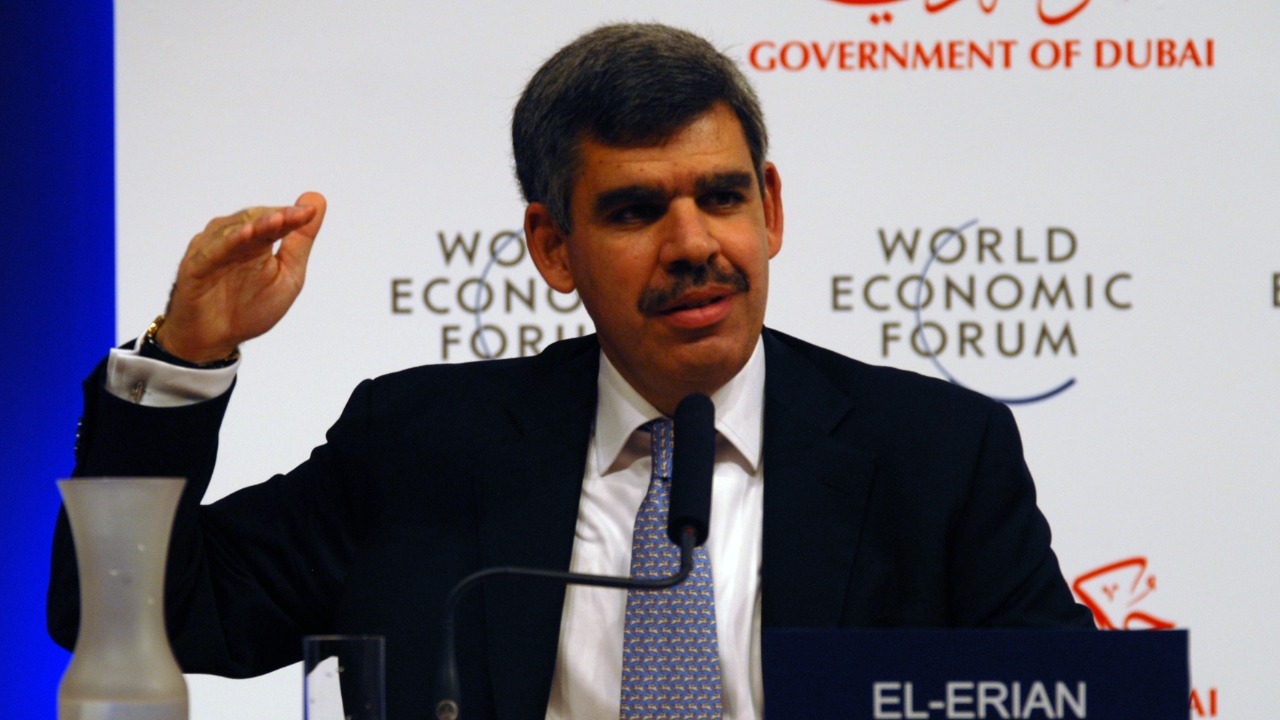
The dollar is supposed to be the world’s ultimate safe asset, yet its recent performance has looked surprisingly soft for a currency backed by the largest economy and deepest capital markets on the planet. Mohamed El-Erian has been warning that this apparent mismatch between U.S. strength and dollar behavior is not a fluke, but a signal that the global monetary order is shifting in ways investors can no longer ignore. I see his argument as a layered one: the greenback is not collapsing, but its grip on the system is loosening at the margins, and that slow erosion matters.
Why a “not weak” U.S. economy can still have a soft currency
El-Erian’s starting point is that the domestic backdrop does not fully explain the dollar’s lackluster tone. He has described the U.S. economy as “weakening, but not weak,” a crucial distinction that suggests growth is slowing from a strong base rather than tipping into outright recession. In that context, he has said he was surprised that the currency hardly appreciated even as the United States continued to play a central role in global demand and finance, a point he underscored in a conversation on Jun 26, 2025, when discussing On the American role in the world economy. If growth is cooling but still outpacing many peers, a textbook model would predict at least some currency strength, not the hesitant trading ranges that have frustrated dollar bulls.
To me, that disconnect points to forces beyond the usual cycle of interest rates and GDP. When a “not weak” economy fails to translate into a clearly stronger exchange rate, it suggests investors are weighing structural issues such as fiscal sustainability, political risk and the long term credibility of institutions. El-Erian’s emphasis on the nuance between weakening and weak hints at his broader thesis: the dollar’s problem is less about today’s data and more about tomorrow’s confidence. The fact that he can describe solid underlying activity while still flagging a surprisingly flat currency is an early sign that the old automatic link between U.S. outperformance and dollar dominance is fraying at the edges.
Global fragmentation and the slow erosion of dominance
El-Erian has also been explicit that the world around the dollar is changing in ways that chip away at its unrivaled status. He has warned that what he calls Global Fragmentation Will Weaken The Dollar, arguing that the rise of competing economic blocs, new payment systems and regional alliances is gradually reducing the need for a single, all purpose reserve currency. In that analysis, delivered on Oct 28, 2025, he linked the dollar’s future to a world where trade and capital flows are increasingly routed around Washington and New York, including through hubs such as Sharjah that feature in his discussion of Gulf News and the broader Middle East. Fragmentation does not mean an overnight replacement of the greenback, but it does mean more countries are experimenting with alternatives.
I read that as a warning about complacency. For decades, the dollar’s dominance has rested on a combination of economic scale, deep markets and habit. El-Erian’s fragmentation argument suggests that habit is now being challenged by technology and geopolitics, from bilateral energy deals in non dollar currencies to regional financial arrangements that bypass traditional clearing channels. When he frames the issue as “Global Fragmentation Will Weaken The Dollar, Dominance, Erian Cautions,” he is effectively saying that the currency’s power is being diluted not by a single rival, but by a patchwork of partial substitutes. The result is a world where the dollar still sits at the center, yet faces more competition at the margins than at any point in the modern era.
Central bank independence and the credibility premium
Another pillar of El-Erian’s thinking is the idea that the dollar’s strength has always depended on more than just economic size, it has also relied on institutional credibility. In a discussion released on Oct 6, 2025, he highlighted how the U.S. monetary system benefits from the fact that the central bank is independent, but he also noted that this independence has been challenged in recent years, a tension explored in detail in a video on why the U.S. dollar has been weakening. When markets start to doubt that the Federal Reserve can act without political interference, the currency loses part of the “credibility premium” that has historically drawn global savings into U.S. assets during times of stress.
From my perspective, this is where domestic politics and exchange rates intersect most directly. If investors believe that short term electoral pressures could sway interest rate decisions or financial regulation, they will demand a higher risk premium to hold dollar assets, or diversify more aggressively into other currencies and gold. El-Erian’s focus on the central bank’s independence is a reminder that the dollar’s value is not just a function of yields, but of trust in the rules of the game. The more that trust is questioned, the easier it becomes for global fragmentation and alternative payment systems to gain traction, even if the U.S. economy itself remains relatively resilient.
The end of the “free lunch” era for the greenback
El-Erian’s concerns dovetail with a growing body of market research that sees the dollar entering a more challenging phase. Analysts who study long term currency cycles have argued that the period when the United States could borrow cheaply and run persistent deficits without much market penalty may be fading, with one detailed assessment on Oct 8, 2025, concluding that the “free lunch” period for the dollar may be ending. That work notes that depreciation is likely in the years ahead as U.S. economic growth normalizes and other regions deepen their capital markets, eroding the greenback’s unique role as the only truly global safe asset.
I see this as the macro backdrop to El-Erian’s more qualitative warnings. If the dollar is no longer guaranteed to rally in every crisis, and if investors start to question its reliability in future shocks, then the United States loses some of the quiet advantages that have underpinned its fiscal and geopolitical reach. The phrase “free lunch” captures the idea that the country has long been able to fund itself on exceptionally favorable terms because the rest of the world needed its currency. As that need becomes less absolute, the cost of policy mistakes rises. El-Erian’s message, read alongside this research, is that the dollar is shifting from an unquestioned anchor to a strong but scrutinized asset, and that shift helps explain why it can look weak even when the domestic data do not scream crisis.
Short term softness, long term reserve status
El-Erian has been careful, however, not to predict an imminent collapse of the dollar’s reserve role. In an earlier essay dated Aug 11, 2020, he reflected on the currency’s status and recalled a principle from his university days, writing “As for the dollar’s role as a reserve currency, I am reminded of a simple principle I learned at university: it is har…” before going on to argue that it is hard to dislodge an incumbent reserve at a time of rising global challenges, a point he developed in As for the the dollar’s long term prospects. That perspective is crucial: he sees depreciation and declining dominance at the margin, not a sudden replacement by another single currency.
In my reading, this distinction between short term weakness and long term incumbency is what keeps his analysis grounded. The dollar can lose value against a basket of peers, or see its share of global reserves slip, while still remaining the primary unit for trade invoicing, debt issuance and central bank holdings. El-Erian’s point is that the direction of travel matters. If the world is moving from a system where the dollar is overwhelmingly dominant to one where it is merely first among several important currencies, then investors, policymakers and companies need to adjust their assumptions. That adjustment is already visible in the way multinational firms manage their cash, the currencies they choose for bond offerings and the hedging strategies they deploy to protect earnings.
Investor anxiety and what a weaker dollar signals
Beyond El-Erian’s own commentary, market behavior suggests that global investors are already reacting to the same forces he describes. Research published on May 8, 2025, argued that the dollar’s slide reflects deeper concerns among international buyers, noting that the currency’s decline is about More Than Tariffs and that the story is really Behind the US Dollar, Decline, Here. Analysts in that work pointed to worries over U.S. fiscal trajectories, political polarization and the perception that Washington is more willing to weaponize financial sanctions, all of which encourage some countries to look for ways to reduce their exposure to the greenback even if they are not ready to abandon it.
From where I sit, this is the practical expression of El-Erian’s thesis. A softer dollar is not just a chart pattern, it is a barometer of how the world feels about U.S. stewardship of the system. When investors see rising debt, contested institutions and a more fragmented geopolitical landscape, they naturally hedge their bets. El-Erian’s explanation for why the currency looks weak, despite a “not weak” economy, is that the dollar is now being priced as a powerful but imperfect asset in a world that is no longer willing to grant it an automatic premium. That does not spell the end of its reign, but it does mark the beginning of a more demanding era in which the United States has to earn, rather than assume, the trust that underpins its money.
More From TheDailyOverview
- Dave Ramsey says these two simple questions show whether you’re rich or poor
- Retired But Want To Work? Try These 18 Jobs for Seniors That Pay Weekly
- IRS raises capital gains thresholds for 2026 and what’s new
- 12 ways to make $5,000 fast that actually work

Grant Mercer covers market dynamics, business trends, and the economic forces driving growth across industries. His analysis connects macro movements with real-world implications for investors, entrepreneurs, and professionals. Through his work at The Daily Overview, Grant helps readers understand how markets function and where opportunities may emerge.

