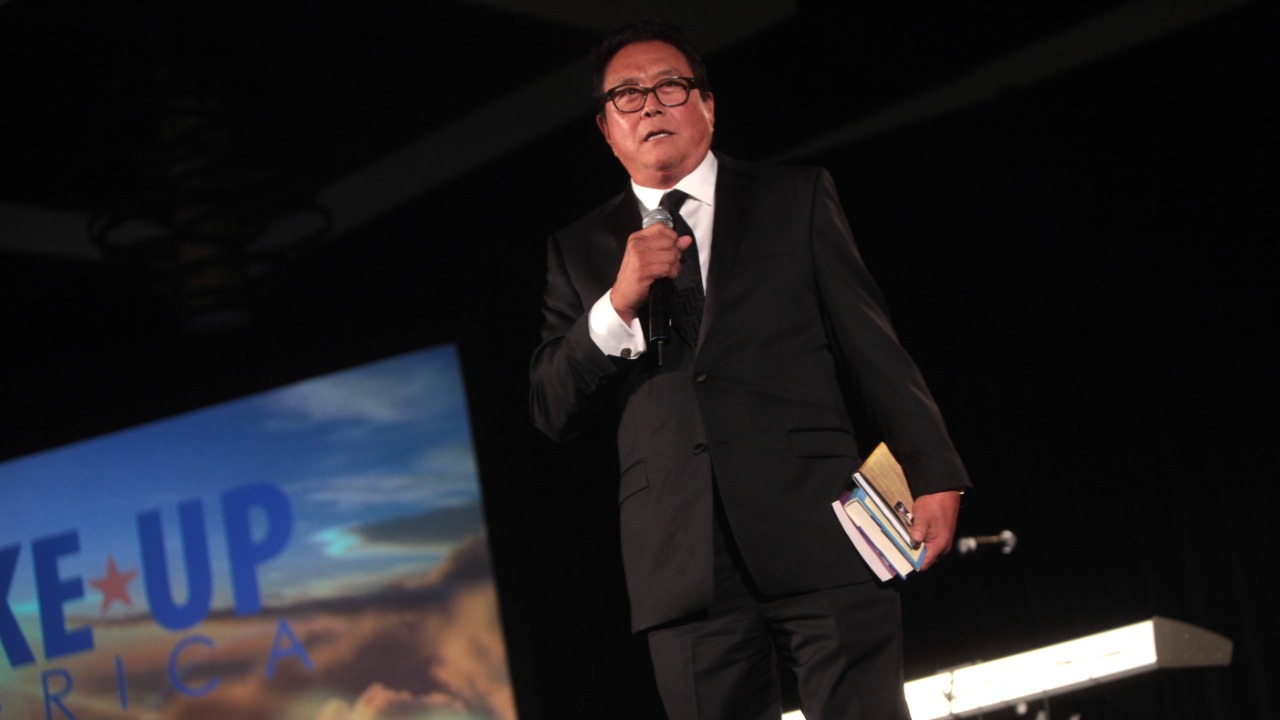
Bitcoin’s latest rout has reopened one of the sharpest divides in modern investing: whether crypto is a dangerous speculation or a once-in-a-generation monetary reset. As roughly $400 billion in market value evaporated in a single week, Robert Kiyosaki chose not to retreat but to publicly confront Warren Buffett’s long‑standing skepticism and argue that digital assets are still the future.
The clash between the “Rich Dad Poor Dad” author and the Berkshire Hathaway legend is not just a personality drama, it is a live test of two competing playbooks as volatility returns with a vengeance. I see their standoff as a window into how retail investors are being pulled between fear of another crash and the lure of buying what Kiyosaki insists is “people’s money” at a discount.
Buffett’s crypto disdain meets Kiyosaki’s ‘people’s money’ pitch
Warren Buffett has spent years warning that speculative assets offer no real utility, and he has been especially blunt about Bitcoin, which he has described as “rat poison” and lumped in with what he sees as “Wall Street‑manufactured” products. That stance resurfaced in fresh criticism of digital tokens and other non‑productive assets, prompting a new round of pushback from Robert Kiyosaki, who has built his own following by urging everyday savers to escape what he sees as a fragile, debt‑soaked financial system. Reporting on the renewed feud notes that the Rich Dad Poor Dad author has reignited his long‑running argument with Warren Buffett over where the real risks now sit.
Kiyosaki’s latest salvo goes beyond a generic defense of crypto and directly challenges what he sees as Buffett’s blind spot about monetary debasement and the concentration of power in traditional finance. In an X post highlighted in recent coverage, he framed Bitcoin as “people’s money,” a decentralized alternative that stands in contrast to the centralized control of banks and governments that he has criticized for years. One report on Nov 17, 2025, describes how Robert Kiyosaki Challenges Warren Buffett on crypto and explicitly Declares Bitcoin as People’s Money, positioning the token as a grassroots alternative to the “rat poison” label.
A $400 billion wipeout tests conviction on both sides
The timing of Kiyosaki’s rebuttal could hardly be more provocative, coming just as the digital asset market has suffered one of its sharpest pullbacks of the year. Over the span of a week, a brutal sell‑off erased nearly $400 billion in total crypto market capitalization, a drawdown that hit everything from marquee coins to smaller tokens and left few corners of the sector untouched. Coverage of the slump notes that the $400 billion plunge over the last week has dragged the value of digital assets down toward the $1.5 trillion area as of Friday morning, underscoring how quickly sentiment can flip.
Behind the headline numbers, the mechanics of the sell‑off matter for how investors interpret the clash between Buffett and Kiyosaki. Reporting on the trading backdrop explains that the latest slump has been driven primarily by spot selling, including redemptions from large exchange‑traded funds, along with fading demand from momentum traders who had chased earlier gains. That dynamic has put particular pressure on liquidity providers and intermediaries, with one analysis noting that Bitcoin plunge hits market makers in a fragile trading landscape, amplifying price swings and reinforcing Buffett’s argument that crypto markets can seize up just when retail investors most need stability.
Kiyosaki’s strategy: sell strength, buy blood in the streets
What makes Kiyosaki’s stance more than rhetoric is that he has been actively trading around his conviction, not simply holding and hoping. Recent reporting details how he locked in substantial gains by selling a portion of his Bitcoin exposure into prior strength, then signaled that he intends to use the resulting cash flow to accumulate again on weakness. One account on Nov 21, 2025, notes that he sold $2.25 million worth of Bitcoin, then stated, “I am still very bullish and optimistic on Bitcoin and will begin acquiring more with my positive cash flow,” a move that aligns with his long‑standing preference for cycling profits from paper gains into what he considers hard assets. That sale and his follow‑up comments are laid out in coverage of how Robert Kiyosaki sells $2.25M in Bitcoin and reiterates his commitment to hard‑asset investing.
Additional reporting and community discussion reinforce that this was not a change of heart but a tactical move consistent with his broader philosophy. A separate summary on Nov 20, 2025, notes that he has told followers he is still very bullish and optimistic on Bitcoin and plans to start buying again using the cash flow from his other ventures, a pattern that mirrors the “cash‑flow first, asset accumulation second” playbook he has promoted for years. That framing appears in a widely shared discussion of how the Rich Dad Poor Dad author just sold 2.25 million in Bitcoin and still plans to buy more, which many commenters described as classic rich dad strategy rather than a retreat from crypto.
Calling US stocks ‘counterfeit’ while Bitcoin sinks
Kiyosaki has not limited his critique to Buffett’s view of crypto, he has also taken direct aim at the asset class that made Berkshire Hathaway CEO Warren Buffett a household name. In his latest comments, he has urged followers to consider whether it is time to buy Bitcoin’s plunge and sell what he calls “counterfeit” US stocks, a phrase that encapsulates his belief that equity valuations are propped up by cheap money and financial engineering rather than underlying productivity. Coverage dated Nov 21, 2025, describes how Robert Kiyosaki slams Buffett’s take on crypto even as Bitcoin wipes out $400B in 1 week, framing the moment as an opportunity to rotate away from what he sees as inflated equities.
That same reporting underscores how sharply Kiyosaki’s worldview diverges from Buffett’s patient, cash‑flow‑driven stock picking. While Buffett has built Berkshire Hathaway CEO Warren Buffett’s reputation on buying durable businesses at reasonable prices and holding them for decades, Kiyosaki is telling his audience that the real danger now lies in clinging to dollar‑denominated assets as governments run persistent deficits. A second slice of the same coverage on Nov 21, 2025, highlights how he has been one of the most vocal supporters of Bitcoin, even as he acknowledges that the token has just wiped out $400 in market value in a week, and asks whether it is Time to buy BTC and sell those “counterfeit” US stocks.
Retail investors caught between two playbooks
For individual investors watching their screens flicker red, the Kiyosaki‑Buffett split is less an abstract debate and more a practical fork in the road. On one side is Buffett’s insistence that assets should generate cash flows that can be valued with some discipline, a view that treats Bitcoin as a speculative token whose price depends entirely on what the next buyer will pay. On the other is Kiyosaki’s argument that in a world of swelling government debt and financial repression, the greater risk is staying fully exposed to fiat‑denominated instruments and traditional indexes. Recent coverage of their back‑and‑forth notes that the View on Crypto that Kiyosaki is promoting is explicitly framed as a counterweight to Warren Buffett’s scepticism about Bitcoin and other Wall Street‑manufactured assets.
In practice, most savers do not have to choose a pure version of either doctrine, but they do need to understand the trade‑offs. Crypto’s violent swings, illustrated by the recent $400 billion wipeout, are a reminder that even assets marketed as digital gold can behave more like high‑beta tech stocks than safe havens when liquidity dries up. At the same time, the concentration of wealth in legacy indexes and the sheer scale of monetary and fiscal intervention have given Kiyosaki’s warnings about systemic fragility a wider audience than they might have had a decade ago. For those trying to navigate between these poles, one basic step is to recognize the limits of any single data feed or price chart, a point underscored by the disclaimer that Google Finance provides on its own market information, which stresses that figures are delayed and not intended as personalized investment advice.
More From TheDailyOverview
- Dave Ramsey says these two simple questions show whether you’re rich or poor
- Retired But Want To Work? Try These 18 Jobs for Seniors That Pay Weekly
- IRS raises capital gains thresholds for 2026 and what’s new
- 12 ways to make $5,000 fast that actually work

Grant Mercer covers market dynamics, business trends, and the economic forces driving growth across industries. His analysis connects macro movements with real-world implications for investors, entrepreneurs, and professionals. Through his work at The Daily Overview, Grant helps readers understand how markets function and where opportunities may emerge.

