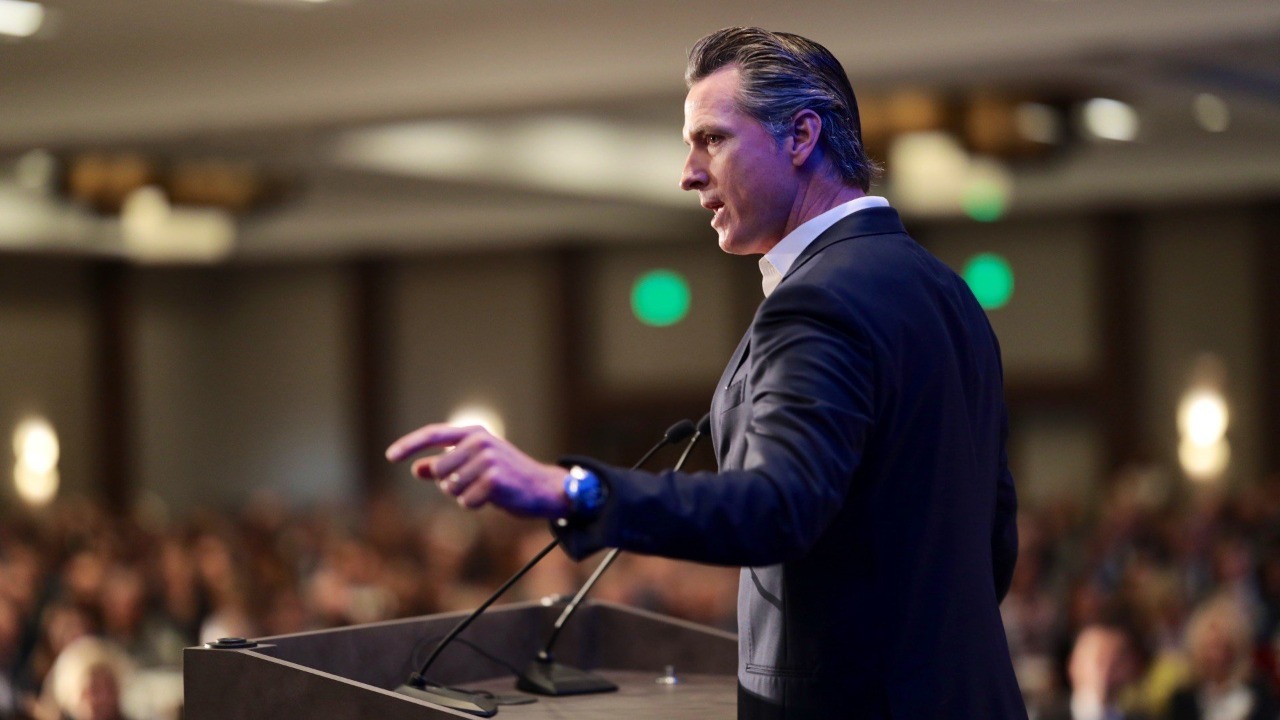
California Governor Gavin Newsom is trying to slam the brakes on a proposed wealth tax that targets the fortunes of the state’s richest residents, warning it could drive capital and companies out of the state. He has branded the measure “nonsense” and signaled he is prepared to fight it aggressively if it reaches voters, setting up a high-stakes clash over how far a blue state can go in taxing extreme wealth without undermining its own economic base.
At the center of the fight is a one-time levy on billionaires that supporters frame as a way to make the ultra-wealthy pay more, and critics see as a risky experiment with California’s fiscal future. The proposal has not yet qualified for the ballot, but the political and economic arguments around it are already testing the limits of Democratic unity and the state’s reputation as a hub for innovation and high-end investment.
Inside the one-time wealth tax proposal
The measure would impose a one-off charge on the net worth of the richest Californians, a sharp departure from the state’s traditional focus on income rather than assets. According to the official Proposal, the plan is a One Time Wealth Tax on Billionaires, requiring Billionaires living in California on January 1, 2026 to pay a single assessment on their worldwide holdings. The design is meant to capture fortunes that have grown rapidly in value, especially in tech and finance, but that often generate relatively modest taxable income year to year.
Supporters argue that California’s extreme inequality justifies a targeted levy on those with the greatest ability to pay, and they frame the measure as a corrective to a tax system that has struggled to keep up with modern forms of wealth. The official analysis notes that Billionaires in California would be expected to pay more to do so under the One Time Wealth Tax, a feature backers see as a way to raise substantial revenue without touching middle class households. They also contend that a one-time structure, rather than an annual wealth tax, reduces the risk of ongoing capital flight while still extracting a meaningful contribution from the very top.
Newsom’s economic warning shot
Newsom has responded with unusually blunt language for a governor who has often embraced progressive branding, calling the wealth tax concept “really damaging” and warning that it could prompt billionaires to move money and businesses out of the state. In public comments highlighted by While the initiative has not yet qualified for the ballot, he has argued that California’s status as a high-cost, high-tax jurisdiction already tests the patience of mobile capital. From his perspective, layering a new wealth-based levy on top of existing obligations risks tipping that balance and accelerating an exodus of high earners and their companies.
His critique is rooted in a broader skepticism about state-level wealth taxes, a position he has held for years. Reporting on the proposed billionaires’ tax notes that Newsom has long opposed such levies, arguing they would be disadvantageous for the world’s fourth-largest economy and could become a template for other states in ways he considers harmful. He has framed the debate not just as a question of fairness, but as a test of whether California can remain competitive with lower-tax rivals like Texas and Florida while still funding expansive social programs.
Progressives, unions and the ballot fight ahead
The wealth tax push is not coming from the governor’s office, but from a coalition of progressive activists and labor allies who see a rare opportunity to rewrite the state’s tax code from the top down. A key backer is the Service Employees Inte, with reporting noting that the proposed tax is backed by the Service Employees Inte and other left-leaning groups that have long pushed for higher levies on the wealthy. Their strategy relies on California’s initiative system, which allows well-organized campaigns to bypass the legislature and take complex tax questions directly to voters.
To get there, organizers must first gather nearly 900,000 valid signatures, a threshold spelled out in coverage that notes, “Should the proposal receive enough signatures, nearly 900,000, it will appear on the state ballot in November.” That same reporting underscores that Should the measure qualify and then win voter approval, it would take effect once approved by California voters, locking in the One Time Wealth Tax on Billionaires as a voter-mandated change rather than a legislative experiment. The signature drive itself will be an early test of how much grassroots energy exists for taxing extreme wealth in a state that already leans heavily on high earners.
Newsom versus his own party’s left flank
Newsom’s opposition has opened a visible rift inside the Democratic coalition, pitting a governor with national ambitions against activists and elected officials who want California to lead on aggressive redistribution. Detailed accounts of the debate note that the proposal has created a deep rift between Newsom and prominent members of his party’s progressive wing, including Vermont Sen, with one report describing how Vermont Sen Bernie Sanders and others see the tax as a model for national policy. For these figures, California’s size and wealth make it the ideal proving ground for a new approach to taxing billionaires, and they view Newsom’s resistance as a capitulation to corporate interests.
The governor, for his part, has not softened his tone. Coverage of his recent remarks notes that Newsom and his office have repeatedly spoken out against the tax, including at a New York Times Dealbook Summit event, where Newsom and his aides emphasized the risk of driving away some of California’s most prominent billionaires. He has cast himself as a defender of working families who would ultimately bear the cost if the state’s tax base erodes, arguing that a shrinking pool of wealthy taxpayers would either force cuts to services or higher taxes on everyone else.
National ambitions, billionaire backlash and the 50-state frame
Newsom’s stance is not just about California’s internal balance sheet, it is also about how the state is perceived nationally and how he positions himself within the Democratic Party. In one widely noted appearance, he warned that a proposed measure in California seeks to tax billionaires’ wealth, but the effort may cause the state to lose billions in future revenue and undermine its ability to compete, with one account summarizing his view as “A proposed measure in California seeks to tax billionaires’ wealth. But the effort may cause the state to lose billions in future revenue before we can talk about 50 states.” That framing makes clear he is thinking beyond Sacramento, worried that a misstep at home could weaken the case for progressive governance in other parts of the country.
At the same time, his rhetoric has drawn fire from the left, with critics accusing him of acting as a “billionaires’ errand boy” and siding with tech moguls over teachers and nurses. One account of his remarks at a California Conference for Women event notes that Newsom blasted the proposed massive wealth tax as debilitating to the Calif economy, even as fellow lefties ripped him for defending the ultra-rich. That tension underscores the political gamble he is making: betting that voters will ultimately reward a governor who prioritizes economic stability over symbolic victories, even if it means a very public break with parts of his own base.
More From TheDailyOverview

Grant Mercer covers market dynamics, business trends, and the economic forces driving growth across industries. His analysis connects macro movements with real-world implications for investors, entrepreneurs, and professionals. Through his work at The Daily Overview, Grant helps readers understand how markets function and where opportunities may emerge.

