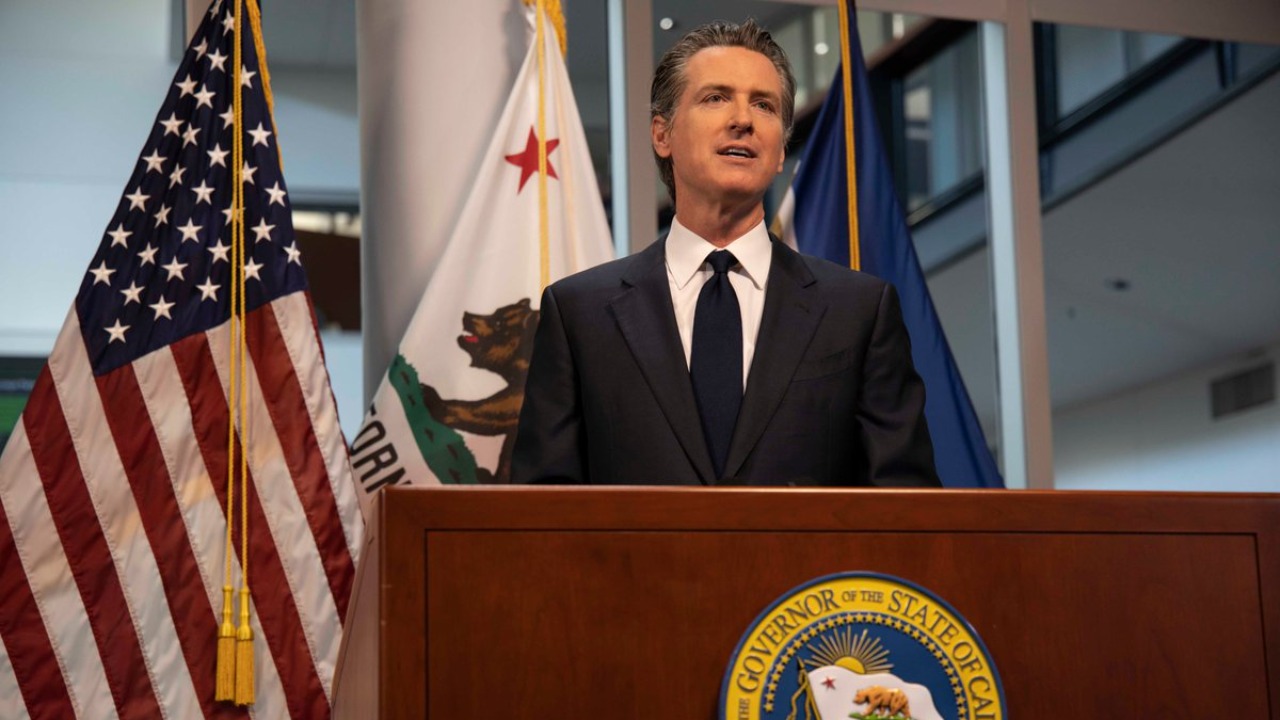
California’s budget is sliding back into the red, and the numbers are getting harder for Governor Gavin Newsom to explain away as a temporary rough patch. After years of ambitious spending and optimistic revenue forecasts, the state is now staring at a deepening deficit that reflects structural choices as much as economic headwinds. The question is no longer whether there is a shortfall, but how much of it is baked into the way Sacramento now does business.
Newsom has framed his recent budgets as both bold and balanced, promising to protect core programs while tightening belts around the edges. Yet the state’s own fiscal watchdogs now warn that spending commitments are outpacing realistic revenue, leaving California on track for multiyear gaps that will force harder decisions than the governor has so far been willing to make.
Deficits keep growing even as revenues recover
California’s fiscal story is often told as a boom-and-bust cycle driven by volatile capital gains, but the latest projections show something more troubling: persistent deficits even as tax receipts rebound. The state’s nonpartisan analysts reported on Nov 18, 2025 that the 2026-27 budget faces an $18 Billion Budget Problem in 2026‑27, a sign that the gap is not simply the product of one bad year. Their Executive Summary, pointedly titled “Not Safe to Bet Artificial Intelligence (AI) Fueled Exuberance Is Sustainable. Both the California,” underscores that the state cannot count on another tech windfall to paper over structural imbalances.
That warning lands after what will be the fourth fiscal year in a row of deficits, a streak that began even before the latest forecast. On Nov 18, 2025, analysts noted that They largely blamed Trump for the shortfall, arguing that the threat of sweeping federal tax changes under President Donald Trump has rattled high-income taxpayers and complicated revenue planning. But even if Washington is part of the story, the state’s own choices on how fast to grow ongoing spending are now the main driver of the red ink.
Newsom’s big budgets and the promise of balance
Governor Newsom has repeatedly presented his spending plans as both expansive and fiscally responsible, a balancing act that is getting harder to sustain. When Governor Newsom sent his 2025-26 budget plan to the Legislature on Jan 9, 2025, he touted a fiscal blueprint totaling $322.3 billion, including $228.9 billion in the main spending plan that lawmakers actually vote on. That scale reflects the governor’s belief that the state can sustain a large government footprint even as it navigates revenue swings.
Just days earlier, on Jan 5, 2025, Governor Gavin Newsom had stood in Stanislaus County, California, promoting his California Jobs First tour and previewing what he described as a “balanced budget and a more efficient government.” In that appearance, he promised that the full budget release, accompanied by detailed documents, would follow on Friday, January 10, 2025, as part of a broader push to show that A balanced budget and a more efficient government could coexist with his “new bold economic vision.” The rhetoric of balance, however, sits uncomfortably beside the state’s growing reliance on temporary fixes and one-time maneuvers.
Spending growth outpaces a cooling economy
The core problem is that California’s spending trajectory has been set to grow faster than the underlying economy, a mismatch that was flagged well before the latest shortfall. In a Nov 19, 2024 fiscal outlook, state analysts warned that “Faster Than Normal Spending Growth” was contributing to the state’s multiyear deficits, even as they noted that Revenues Run Ahead of Broader Economy. That report also highlighted that the State, Job Market and Consumer Spending Remain Lackluster, a combination that makes it risky to lock in new ongoing commitments.
Independent budget experts have been blunt about the structural nature of the gap. On Feb 14, 2024, one analysis concluded that the main reason for the budget problem is that state revenue collections have been coming in much lower than previously expected, in part because the state delayed the deadline for 2022 taxes to November 2023. That delay distorted the timing of receipts and masked underlying weakness, leaving policymakers to confront a shortfall that, as Feb analysis put it, was rooted in softer income and capital gains rather than a sudden collapse. Against that backdrop, the decision to keep ratcheting up baseline spending looks less like prudence and more like a gamble.
Short-term fixes, long-term gaps
Newsom has tried to answer critics by pointing to cuts and efficiencies, but many of those moves are one-time trims that do not fundamentally reset the state’s obligations. In his revised 2024-25 plan, Governor Newsom promoted a strategy branded as CUTTING, SPENDING, MAKING, GOVERNMENT, LEANER, highlighting that his revised balanced state budget cut one-time spending by $19.1 and promised to make government leaner by cutting bureaucratic red tape and reducing redundancies. Those steps help on the margins, but they do not erase the cost of programs that grow automatically year after year.
By May 9, 2024, the governor was again emphasizing belt-tightening, saying that Governor Newsom’s revised balanced state budget cuts one-time spending by $19.1 billion and ongoing spending by $13.7, while also pledging to protect “Rainy Day” reserves. Those figures are significant, but they also underscore how large the underlying commitments have become: even after cutting billions in one-time allocations, the state still faces a chronic mismatch between what it spends and what it reliably takes in.
Deficit politics and the blame game
As the numbers have worsened, the politics around the deficit have grown sharper. On May 13, 2025, Newsom acknowledged that California faces an additional $12-billion budget deficit, with The Newsom administration predicting that the gap would force schools and local governments to trim back their overspending. That admission, detailed in coverage that noted how California faces an additional $12‑billion budget deficit, Newsom says, undercut the governor’s earlier insistence that his cuts and reserves strategy had largely stabilized the situation.
At the same time, Newsom’s allies have tried to frame the shortfall as the product of forces outside Sacramento’s control. In commentary published on May 19, 2025, analysts noted that Newsom is obviously hoping that by making budget cuts now to narrow the state’s chronic gap between income and outgo, he can avoid more painful choices later, in part by leaning on borrowed money and various bookkeeping gimmicks. That strategy may buy time, but it also risks leaving his successor with fewer options and a more entrenched structural deficit.
What “still in the red” means for Californians
For residents, the phrase “still in the red” is no longer an abstraction. A Nov 19, 2025 report framed the situation bluntly, noting that California is still in the red with another big budget deficit projected for next year. That projection means that programs residents rely on, from public schools to homelessness services, will be competing for shrinking slices of a constrained pie, even as costs for housing, health care and infrastructure continue to climb.
The stakes are particularly high in a state as large and complex as California, where regional economies and local governments depend heavily on state funding formulas. When the governor trims one-time grants or delays promised expansions, counties and cities are left to decide whether to backfill with their own dollars or scale back services. Over time, that dynamic can deepen inequalities between wealthier communities that can absorb the hit and poorer areas that cannot.
The structural test ahead for Newsom’s legacy
As Newsom moves deeper into his final years in office, the deficit is becoming a central test of his fiscal legacy. Supporters point to his early moves to build reserves and his willingness to cut one-time spending as evidence that he has tried to prepare for downturns. Critics counter that he expanded ongoing programs too quickly, betting that a hot tech market and high-income taxpayers would keep filling the coffers even as warning signs flashed in the broader economy.
What is clear from the state’s own fiscal outlooks is that the problem is now structural, not episodic. The combination of faster-than-normal spending growth, a cooling job market and consumer spending that “Remain Lackluster,” and a political reluctance to reset expectations has left California with a chronic gap that cannot be closed with accounting maneuvers alone. Whether Newsom chooses deeper program cuts, new taxes, or a mix of both, the decisions he makes in the next budget cycle will determine whether the state finally aligns its ambitions with its revenues, or continues to drift further into a deficit of its own design.
More From TheDailyOverview
- Dave Ramsey warns to stop 401(k) contributions
- 11 night jobs you can do from home (not exciting but steady)
- Small U.S. cities ready to boom next
- 19 things boomers should never sell no matter what

Grant Mercer covers market dynamics, business trends, and the economic forces driving growth across industries. His analysis connects macro movements with real-world implications for investors, entrepreneurs, and professionals. Through his work at The Daily Overview, Grant helps readers understand how markets function and where opportunities may emerge.

