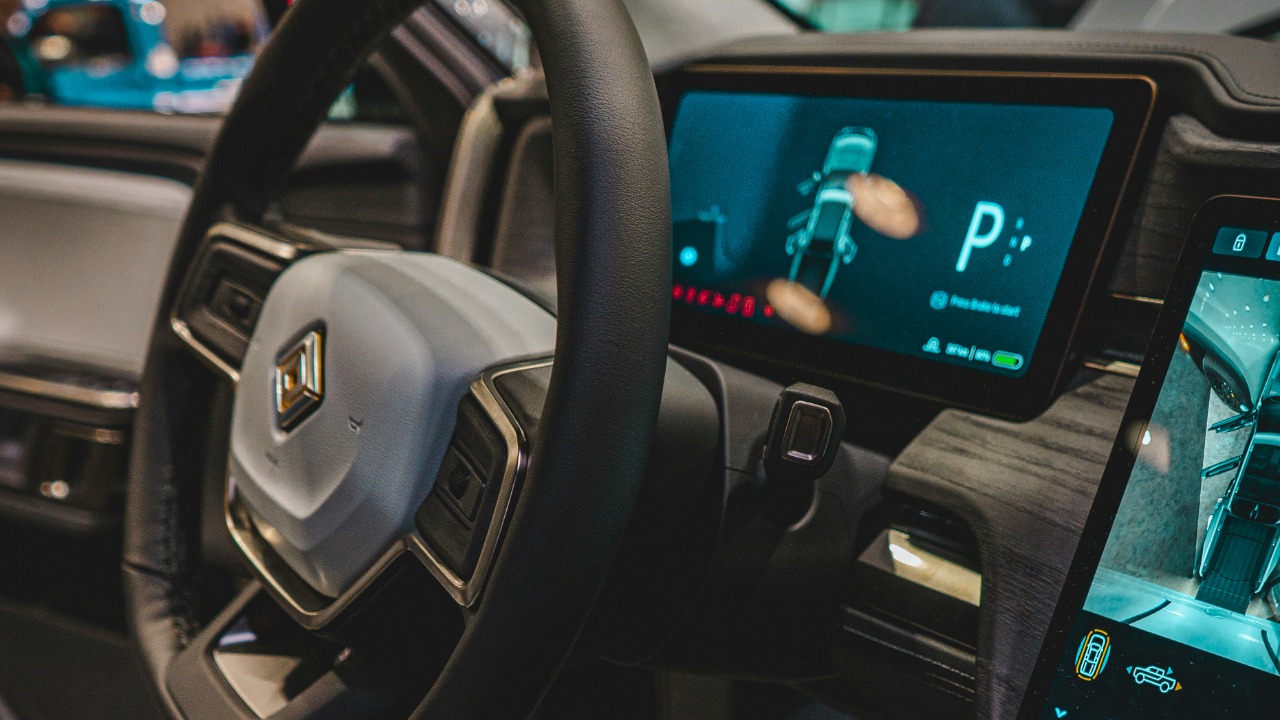
Rivian is no longer content to be the outdoorsy alternative in the electric-vehicle market. It is rebuilding its entire technology stack around artificial intelligence, betting that smarter software and custom silicon will matter more than raw horsepower in the next phase of the EV race. That strategy puts the company in direct competition with Tesla on autonomy, data, and in-car intelligence rather than just on range and design.
The stakes are existential. Rivian is still a young automaker in a capital-intensive industry, and its path to profitability runs through higher-margin software and services layered on top of its trucks and SUVs. By doubling down on AI, it is trying to turn every Rivian on the road into both a rolling sensor rig and a subscription platform, even as investors debate whether that long-term vision can overcome short-term EV headwinds.
Rivian’s AI-first survival plan
Rivian has framed its recent Autonomy and AI Day as a turning point, positioning artificial intelligence as the core of its survival strategy rather than a side project. At the event, the company used Autonomy and AI Day to showcase a major push into self-driving technology, unveiling a custom computing platform and a suite of software features that it argues will eventually support hands-free and fully autonomous driving across its lineup, a shift that At the center of its long-term roadmap. The company is explicit that this is not just about driver convenience, but about building a recurring revenue engine on top of its vehicles.
That ambition comes as analysts warn that Rivian faces “too many short-term challenges” and a delayed payoff from its autonomy investments, even as some acknowledge that its long-term strategy is commercially sound. One assessment of Rivian cut a price target to 10 dollars from 13 dollars while still noting that the company’s plan to lean on software and services could eventually help it cut into Tesla’s franchise, a tension that underscores how precarious the next few years could be for Rivian as it spends heavily on AI before those investments translate into cash flow.
Custom chips and a Tesla-style autonomy platform
The centerpiece of Rivian’s AI bet is a new in-house processor designed to replace Nvidia hardware and give the company tighter control over its autonomy stack. At Autonomy and AI Day in Palo Alto, the company introduced an in-house AI chip that it says will power its next-generation driver-assistance system and is explicitly intended to rival Tesla’s Full Self-Driving, a move detailed when Home News Markets Equity Rivian Unveils In a custom design that mirrors Tesla’s decision to build its own silicon. By owning the chip, Rivian can optimize power consumption, latency, and cost in ways that are difficult when relying on off-the-shelf components.
Rivian is also copying parts of Tesla’s broader playbook, from vertical integration to software subscriptions, while trying to convince investors that its stock deserves a re-rating. Analysts point out that while Rivian has always traded at a discount to Tesla, barring a brief period following its listing, the current gap is unusually wide even as Rivian adopts a similar strategy of building its own autonomy hardware and pushing toward robotaxi-style services, at a time when Tesla has already launched and commenced robotaxi operations, a comparison that has become central to arguments about whether While Rivian can close the valuation gap.
Hands-free driving, data, and the AI feedback loop
Hardware is only part of the story. Rivian is rapidly expanding its hands-free driving capabilities, treating every mile driven as training data for its AI models. Chief Executive RJ Scaringe has described how, as more Rivians are on the road, more real-world data will be generated to train the company’s AI model that powers its driver-assistance features, and he has framed the company’s approach to building self-driving as rooted in a deep understanding of the physics and behavior behind autonomous vehicles, a philosophy he outlined when he said that once drivers start seeing the system handle more scenarios, they will be more willing to pay for hands-off and fully autonomous features, a vision captured in his comments about how more Rivians on the road feed a virtuous cycle of better AI.
That data-centric strategy is also at the heart of Rivian’s broader business model. Senior reporter Sean O’Kane, who attended the company’s Autonomy & AI Day in Palo Alto, described how Rivian is building a subscription layer on top of its vehicles, including autonomy packages that could cost 2,500 dollars upfront or 49.99 dollars per month, a structure that echoes Tesla’s software pricing and underscores how much of Rivian’s future revenue could come from recurring services rather than hardware alone, a point that emerged as Senior observers noted that the company’s survival plan involves more than cars.
Lidar, sensors, and a deliberate break from Tesla’s camera-only path
Where Rivian is not copying Tesla is in its choice of sensors. The company has committed to adding lidar to its autonomy platform starting in 2026, a clear rejection of Tesla’s camera-only philosophy. Rivian has argued that Tesla’s cameras are not enough for the level of redundancy and safety it wants in its second-generation R1 vehicles, and it has said that Rivian Will Add Lidar as part of a broader sensor suite that includes radar and cameras, a decision that reflects its belief that more diverse inputs will make its AI systems more robust, a stance captured in reporting that Rivian Will Add Lidar and that Tesla’s Cameras Aren, Enough for its goals.
The Rivian CEO has been explicit that this marks a different path than Tesla, even as he chases similar autonomy milestones. He has said that after its Gen 3 autonomy platform, the EV startup will be working on achieving the autonomy needed for commercial services and that the company is choosing a different path than Tesla by adding lidar to its autonomy platform, a choice he framed as essential to competing in the robotaxi space and to convincing regulators and customers that its system is safe enough for widespread deployment, a message that The Rivian CEO tied directly to the evolution of its Gen platforms.
From AI assistant to the “first AI car”
Rivian is not limiting AI to what happens outside the windshield. Inside the cabin, it is developing a proprietary AI assistant that aims to become a key selling point in the EV market by personalizing the driving experience and reducing reliance on third-party software. The company has promoted the idea that a proprietary #AI assistant could help the company differentiate its vehicles, reduce reliance on third parties, and create a new layer of services that feel more like a smartphone ecosystem than a traditional infotainment system, a vision that has been teased in materials describing how A proprietary #AI assistant might reshape the daily relationship between driver and car.
Externally, Rivian is positioning its vehicles as contenders to be the first truly AI-native cars on the road. Company leaders have argued that electric vehicles are coming of age at the same time as artificial intelligence, and that this overlap creates a chance to design vehicles where AI is foundational rather than bolted on. They have outlined plans for AI-powered autonomy and in-car intelligence that could reach customers starting in 2026, describing how Rivian is trying to beat Tesla to the first AI car by integrating custom chips, sensor-rich hardware, and cloud-trained models into a single platform that will begin appearing on the road starting in 2026, a narrative captured in analysis of Dec plans for that milestone.
Investor skepticism and the long road to catching Tesla
For all the technical ambition, markets remain divided on whether Rivian’s AI push is enough to offset the broader slump in electric vehicles. Some coverage of the company’s first Autonomy and AI Day noted that Rivian’s AI and autonomy announcements impressed on a technical level but were not enough to offset concerns about its EV business, even as Rivian CEO RJ Scaringe used the event to argue that the company’s autonomy unit widens its lead on Tesla in certain aspects of software and user experience, a contrast that emerged as Follow coverage weighed the promise of AI against production and demand challenges.
Rivian’s latest roadmap underscores how aggressively it is stepping into Tesla’s territory. On a Thursday earlier this month, Rivian unveiled a plan to make its cars fully autonomous and AI-powered, including a silicon computing platform, expanded driver-assistance features, and a new, lower-priced model that will be Rivian’s cheapest car to date, a package that signaled how Rivian on Thursday stepped deeper into Tesla’s turf on both technology and price. Whether that is enough to close the gap with a far larger rival is still uncertain, but the direction of travel is clear: Rivian is betting that in the next phase of the EV wars, the companies that win will be the ones that treat AI not as a feature, but as the operating system for the entire business.
More From TheDailyOverview

Grant Mercer covers market dynamics, business trends, and the economic forces driving growth across industries. His analysis connects macro movements with real-world implications for investors, entrepreneurs, and professionals. Through his work at The Daily Overview, Grant helps readers understand how markets function and where opportunities may emerge.

