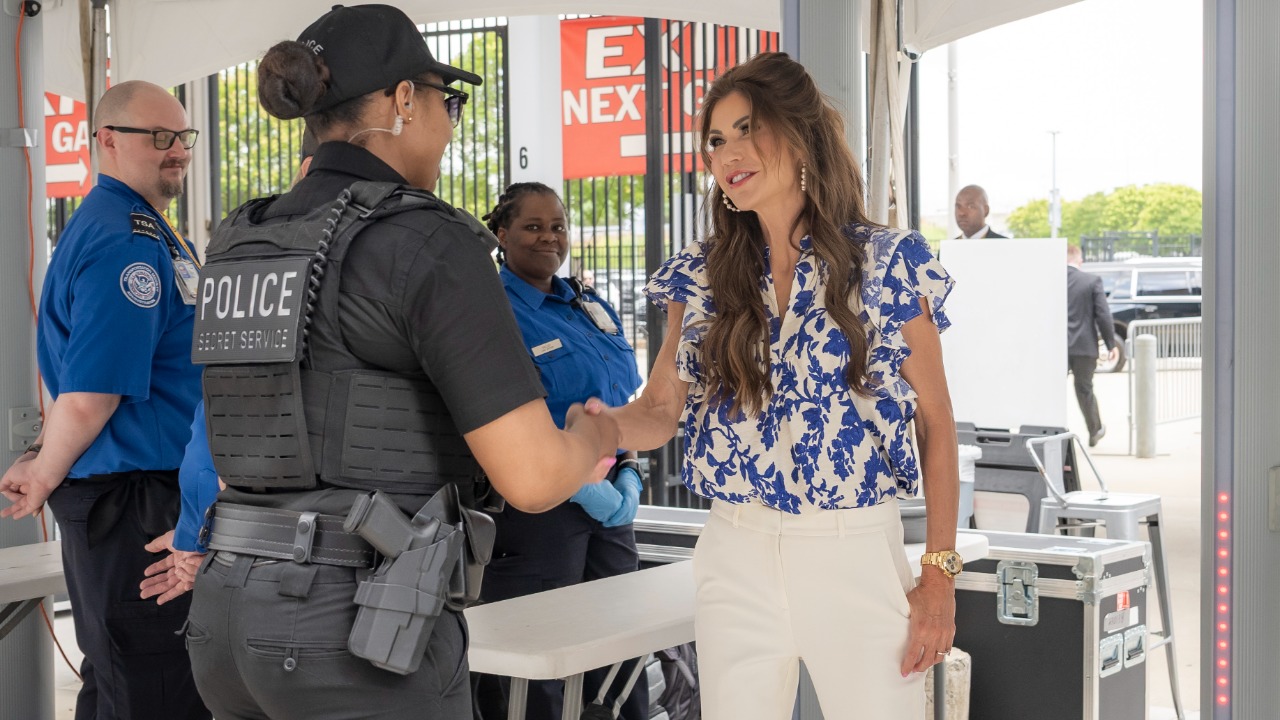
At Tampa International Airport, a routine morning of security lines and rolling suitcases turned into a made-for-television moment when Kristi Noem arrived with oversized checks and a promise of five-figure rewards. The Secretary of Homeland Security handed select Transportation Security Administration officers $10,000 bonuses, turning a typically anonymous frontline workforce into the center of a national conversation about pay, politics, and public service. The spectacle was brief, but the questions it raised about who gets rewarded, and why, will linger far longer than the applause in the terminal.
The surprise payout on the concourse
When Kristi Noem stepped into the terminal at Tampa International Airport, the choreography was unmistakable: cameras, a podium, and a row of uniformed Transportation Security Administration officers waiting to be recognized. The Secretary of Homeland Security used the airport backdrop to spotlight what she framed as exceptional service, personally presenting $10,000 bonus checks to a group of local screeners who had become stand-ins for a much larger federal workforce. The event was staged in the middle of a working airport, with travelers and staff looking on as the security checkpoint briefly doubled as a political stage.
According to local reporting, Noem’s appearance at Tampa International Airport was not a quiet internal ceremony but a publicized stop that featured a press conference alongside local TSA employees and a clear focus on the size of the checks. Coverage of the event emphasized that the bonuses were set at $10,000 per officer, a figure large enough to command attention in any workplace, let alone a federal agency known for modest pay scales. By choosing a bustling hub like Tampa International Airport as the setting, Noem ensured that the message of gratitude, and the visual of five-figure rewards, would travel far beyond the departure gates.
Who got the money, and who did not
The most striking detail of the Tampa event was not just the size of the checks but the narrow circle of people who received them. Only a small group of TSA officers walked away with $10,000 bonuses, even though thousands of their colleagues nationwide perform similar duties under similar pressures. That selectivity turned what might have been a straightforward morale boost into a pointed statement about merit, recognition, and the politics of scarcity inside the federal workforce.
Local accounts from Tampa made clear that the gesture was limited in scope. One report noted that Only about 100 TSA officers were singled out for $10,000 checks at Tampa International Airport, a tiny fraction of the workforce that kept security lines moving through the entire government shutdown and beyond. Another account focused on a smaller subset, noting that Sixteen Transportation Security Administr officers in Tampa received $10,000 bonus checks as a reward for what Noem described as “doing good work.” The contrast between the small group of recipients and the much larger pool of eligible workers is at the heart of the debate over whether this was a fair recognition of excellence or a politically curated spotlight.
Noem’s broader bonus strategy
The Tampa checks did not come out of nowhere. They are part of a broader pattern in which Kristi Noem has used targeted financial rewards to highlight what she calls “above and beyond” service inside the Department of Homeland Security. Earlier this year, she rolled out similar $10,000 bonuses for TSA officers in other cities, framing the payments as a way to honor those who kept critical infrastructure running during periods of intense political and operational strain. The Tampa event, in that sense, was both a continuation of an existing strategy and an escalation, given the size of the audience and the political attention now attached to the move.
In a previous appearance in Houston, the department described how Secretary Noem Gives TSA Officers $10,000 Bonus for Above and Beyond Service During Democrats, explicitly tying the payments to what she saw as extraordinary dedication during a period of partisan gridlock. The official account of that event noted that Secretary Noem Gives TSA Officers a $10,000 Bonus for Above and Beyond Service During Democrats, presenting the checks as a reward for service to the American people. By replicating that model in Tampa, Noem signaled that she intends to keep using high-dollar, high-visibility bonuses as a signature tool of her leadership at Homeland Security.
Why Tampa, and why now
Choosing Tampa as the stage for the latest round of bonuses was not a random decision. Tampa International Airport is a major hub in a fast-growing region, with a steady flow of domestic and international travelers and a local economy that depends heavily on tourism and business travel. By spotlighting TSA officers in Tampa, Noem aligned herself with a city that has become a symbol of post-pandemic growth and a key node in the country’s aviation network, while also tapping into a local audience that is acutely aware of how security staffing affects daily life.
Reports from the scene described how the Secretary of Homeland Security presented bonuses to Tampa TSA workers in TAMPA, underscoring the city’s role as a showcase for federal security operations. One account noted that the U.S. Secretary of Homeland Secur used the visit to highlight Tampa TSA officers as an example of frontline workers who kept airports functioning smoothly during periods of intense travel demand. By timing the event in Dec, at the start of the busy holiday travel season, Noem ensured that the message of gratitude would resonate with both travelers and local officials who rely on a stable, visible federal presence at the airport.
The politics of rewarding “above and beyond”
On its face, handing out $10,000 checks to TSA officers sounds like a straightforward gesture of appreciation. In practice, it is deeply political. Noem has repeatedly framed these bonuses as a response to what she calls “Above and Beyond Service During Democrats,” a phrase that casts the payments as a corrective to perceived neglect under previous leadership. By tying the money to a narrative about partisan failure and renewed respect for law enforcement, she has turned what could have been a quiet internal reward into a public argument about how federal workers should be treated and who deserves credit for supporting them.
The official description of the Houston event, which is now echoed in Tampa, makes that framing explicit. The department’s own language, preserved in the Bonus for Above and Beyond Service During Democrats description, presents the $10,000 payments as a reward for enduring a period when, in Noem’s telling, TSA officers were asked to do more with less. By repeating that storyline in Tampa, she reinforced a broader political message: that her administration is willing to put real money behind its praise for frontline security workers, and that those workers are being recognized not just for their daily duties but for their resilience during a specific partisan era.
Morale boost or morale minefield
For the officers who received them, the $10,000 checks are life changing. A single five-figure bonus can wipe out credit card debt, cover a semester of community college tuition, or make a down payment on a used 2022 Toyota RAV4. In a workforce where many employees start at salaries that barely outpace local housing costs, a sudden infusion of cash is more than symbolic. It is a tangible acknowledgment that the long shifts, the holiday overtime, and the constant scrutiny at the checkpoint have real value.
Yet selective generosity can also create tension inside any workplace, and TSA is no exception. When Sixteen Transportation Security Administr officers in Tampa are singled out for $10,000 bonus checks, their colleagues who worked the same checkpoints, on the same days, under the same pressures, are left to wonder why their efforts did not qualify as “doing good work.” The fact that Only about 100 TSA officers at Tampa International Airport were recognized with $10,000 checks, even though many more kept security lines moving through the entire government shutdown, risks turning a morale boost for some into a morale minefield for others who feel overlooked.
How the bonuses fit into TSA’s long-running pay problem
The Tampa event also sits atop a much older story about TSA pay and working conditions. Since its creation after the September 11 attacks, the agency has struggled to recruit and retain officers, in part because its pay scales lagged behind other federal law enforcement jobs. Even with recent reforms that brought TSA salaries closer to the General Schedule system, many officers still juggle second jobs, long commutes, or shared housing to make ends meet. In that context, a one-time $10,000 bonus is both a powerful symbol and a reminder of how far base pay has to go.
Earlier this year, the department’s own communications highlighted how TSA officers in Houston were rewarded with $10,000 bonuses for what was described as above and beyond service to the American people, a narrative that has now been extended to Tampa. The official language in the Breadcrumb and Home sections of that announcement underscores how the department wants these payments to be seen as a reward for exceptional dedication, not a substitute for structural pay reform. Still, for many officers watching from the sidelines, the question is whether such high-profile bonuses will be followed by broader, more predictable improvements in pay and benefits, or whether they will remain rare windfalls tied to political moments.
Optics at the checkpoint
There is also the matter of how the Tampa event looked to the traveling public. For passengers accustomed to seeing TSA officers as faceless enforcers of rules about laptops and liquids, watching those same officers receive oversized checks from a cabinet secretary can be jarring. The spectacle reframes the checkpoint as a place where national politics, labor policy, and everyday travel collide. It invites travelers to see the people who inspect their bags not just as rule enforcers but as workers whose livelihoods depend on decisions made far from the conveyor belt.
The choice of venue amplified that effect. Tampa International Airport is not just a transportation hub but a civic symbol, a place that appears in tourism ads and economic development pitches. By staging the bonus ceremony there, Noem effectively turned the airport into a backdrop for a broader message about federal workers and public safety. The location’s prominence is underscored by its presence in national mapping and information tools, where Tampa International Airport appears alongside other major hubs in resources like place data that catalog key infrastructure. That visibility means the images from the concourse, of uniformed officers holding $10,000 checks, will shape how many Americans think about TSA long after their own flights have landed.
What comes after the cameras leave
Once the microphones are packed up and the last oversized check is handed out, the real test of Noem’s bonus strategy will be what changes, if anything, for the broader TSA workforce. A one-time $10,000 payment can transform a few lives, but it does not by itself resolve chronic staffing shortages, high turnover, or the daily grind of screening thousands of passengers under tight time pressure. For that, officers and their unions have long argued, the agency needs sustained investment in pay, training, and equipment, not just headline-grabbing rewards for a select few.
In Tampa, the Secretary of Homeland Security’s decision to present bonuses to Tampa TSA workers in a public, televised setting signals that she sees political value in being seen as a champion of frontline security staff. The earlier Houston event, where Secretary Noem Gives TSA Officers $10,000 Bonus for Above and Beyond Service During Democrats, suggests that this is not a one-off gesture but part of a broader narrative about restoring respect for federal workers. Whether that narrative translates into lasting improvements for the thousands of TSA officers who did not receive $10,000 checks at Tampa International Airport remains, for now, Unverified based on available sources.
More From TheDailyOverview

Grant Mercer covers market dynamics, business trends, and the economic forces driving growth across industries. His analysis connects macro movements with real-world implications for investors, entrepreneurs, and professionals. Through his work at The Daily Overview, Grant helps readers understand how markets function and where opportunities may emerge.