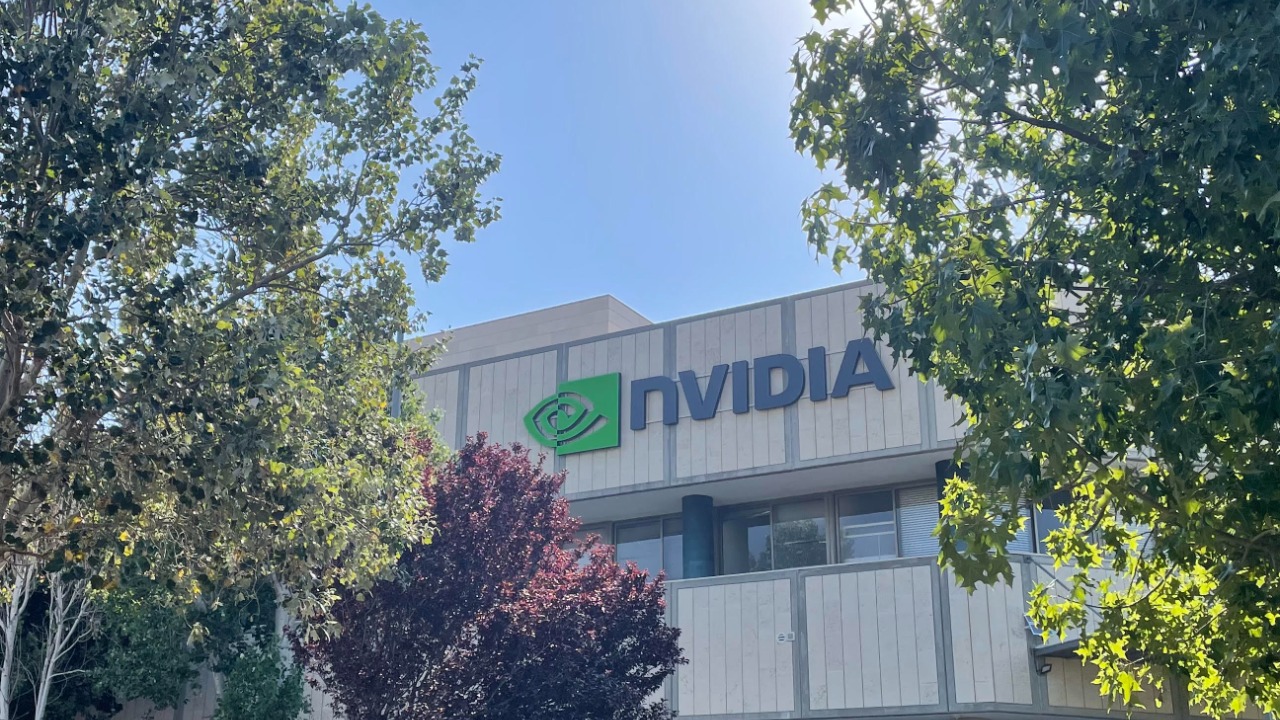
The race to build the infrastructure behind artificial intelligence has turned a handful of chip specialists into market barometers, and Nvidia sits squarely at the center of that storm. As demand for AI training and inference explodes, one of Nvidia’s closest partners has suddenly become a focal point for investors trying to gauge how far this cycle can run.
I see the surge in this Nvidia ally as a sign that the market is no longer just betting on individual chips, but on the full industrial stack required to power AI “factories” at global scale. From memory and lithography to foundry services and cloud operators, the latest moves across the supply chain suggest that the AI buildout is still in its early innings, even as valuations stretch and volatility rises.
Nvidia’s rally sets the tone for AI hardware
Nvidia’s own stock performance has framed the AI trade from the first sessions of the year, with the company quickly reasserting itself as the market’s bellwether for advanced computing. On the first trading day of the year, Nvidia Sparks a broader semiconductor rally as investors focused on fresh China orders and what some on Wall Street have dubbed the Rubin Revolution, a reference to the company’s next-generation architecture. That early jolt signaled that, despite concerns about saturation in some corners of tech, capital markets still see AI accelerators as the defining growth engine for the sector.
The momentum did not stop there. Later in the month, NVIDIA Sets the Pace for the broader market again, with a 2.95% Surge Propels Markets to fresh Record Highs as traders leaned into the idea that AI spending could remain resilient even if other IT budgets slow. I read that move less as a speculative spike and more as confirmation that institutional investors are treating Nvidia as the proxy for AI infrastructure demand, using its daily tape as a real-time referendum on the durability of the boom.
The CoreWeave connection: Nvidia’s AI ally steps into the spotlight
Behind Nvidia’s headline-grabbing chips, a new class of infrastructure providers is emerging as critical partners, and that is where its AI ally comes in. Cloud specialist CoreWeave, which has long positioned itself as a tailor-made platform for GPU-heavy workloads, has deepened its relationship with Nvidia in a way that effectively turns it into a leveraged play on the same demand curve. Nvidia and CoreWeave, Inc, which now trades on NASDAQ under the ticker CRWV, recently announced an expanded collaboration that will see the two companies accelerate the buildout of what they describe as AI factories, with Nvidia providing the silicon and CoreWeave focusing on the data center shell and orchestration layer.
In practical terms, the new agreement means Nvidia, Inc is committing more of its cutting-edge accelerators to a partner that is willing to design entire facilities around those chips, while CoreWeave gains preferred access to scarce hardware and engineering support. The companies framed the deal as a way to move faster on large-scale deployments, with CoreWeave taking on more responsibility for the physical shell to build AI factories and Nvidia doubling down on its role as the core technology provider. I see that structure as a clear signal that Nvidia is leaning on specialized allies to translate chip demand into full-stack capacity, effectively extending its reach without owning every data center on its own balance sheet.
Memory, lithography and the hidden bottlenecks
For all the attention on GPUs, the AI surge is increasingly constrained by other parts of the hardware stack, starting with memory. High bandwidth memory has become the lifeblood of modern AI systems, and earlier this month the market learned that AI memory is effectively sold out, with Three primary memory vendors, Micron, Hynix and Samsung Electronics, controlling nearly the entire RAM market. One executive described the resulting spike in memory prices as “unprecedented,” a word that underscores just how tight the supply and demand balance has become for the components that sit next to Nvidia’s chips inside servers.
Those shortages ripple directly into the economics of AI factories, including the facilities that CoreWeave is racing to build. When Micron and its peers struggle to keep up, every incremental GPU becomes harder to monetize because it cannot reach full performance without enough high bandwidth RAM. That is one reason I view memory suppliers as quiet beneficiaries of Nvidia’s boom, a point reinforced by analysis that groups Micron and Nvidia together as the kings of AI stocks, noting that Its cash-generating abilities have been amplified by the favorable demand environment and that both companies are now in a position to influence supply in a big way on the issue.
ASML, Intel and the race to manufacture AI silicon
Upstream from memory, the tools required to manufacture Nvidia’s most advanced chips are also in the spotlight, and here Dutch equipment maker ASML has become indispensable. The company’s High NA EUV systems, which rely on EUV light to pattern ever smaller features on silicon wafers, are widely seen as essential to keeping Nvidia’s performance roadmap on track. Recent reporting on High NA EUV technology makes clear that Nvidia’s AI boom could not have happened without ASML’s lithography tools, and that the same equipment will be needed to sustain the surge into 2026 and beyond.
At the same time, traditional chipmakers are scrambling to reposition themselves as foundry partners for AI leaders. Intel, which trades on NASDAQ under the symbol INTC, has been a particular focus after reports that it could manufacture chips for Nvidia and Apple through its contract foundry business. Investors responded quickly, sending Intel (INTC +11.04%) higher and pushing its stock to $48 by the close of trading on Wednesday, a move that highlighted how much value the market assigns to any credible role in the AI supply chain. I interpret that jump, documented in coverage of Intel, as a reminder that Nvidia’s allies now include not just cloud partners like CoreWeave but also manufacturing rivals that see more upside in cooperation than in direct competition.
Wall Street’s AI calculus: forecasts, volatility and opportunity
Even as the physical infrastructure races to catch up, the financial narrative around Nvidia and its ecosystem is evolving quickly. Analysts tracking the company’s earnings outlook note that the consensus forecast is up 60% YOY in early January, implying roughly 40% upside from current levels if Nvidia delivers at the high end of expectations. That kind of step change in projected profitability, highlighted in research on YOY revisions, helps explain why institutional investors are still increasing their holdings in 2026 despite the stock’s massive run.
Yet the path has hardly been straight up. On Jan 8, coverage of NASDAQ: NVDA pointed out that Nvidia slid as traders weighed eye-popping AI demand forecasts against questions over valuation and Chi exposure, even as the company’s long-term prospects were described as strong as ever. That tension between near-term froth and long-term conviction is also visible in broader sector commentary, including a note that groups Micron and Nvidia as the kings of AI stocks and argues that Its cash-generating abilities give it room to navigate cyclical swings. I see these crosscurrents as a healthy sign that the market is at least attempting to price risk, rather than blindly extrapolating recent gains.
More From TheDailyOverview
*This article was researched with the help of AI, with human editors creating the final content.

Grant Mercer covers market dynamics, business trends, and the economic forces driving growth across industries. His analysis connects macro movements with real-world implications for investors, entrepreneurs, and professionals. Through his work at The Daily Overview, Grant helps readers understand how markets function and where opportunities may emerge.