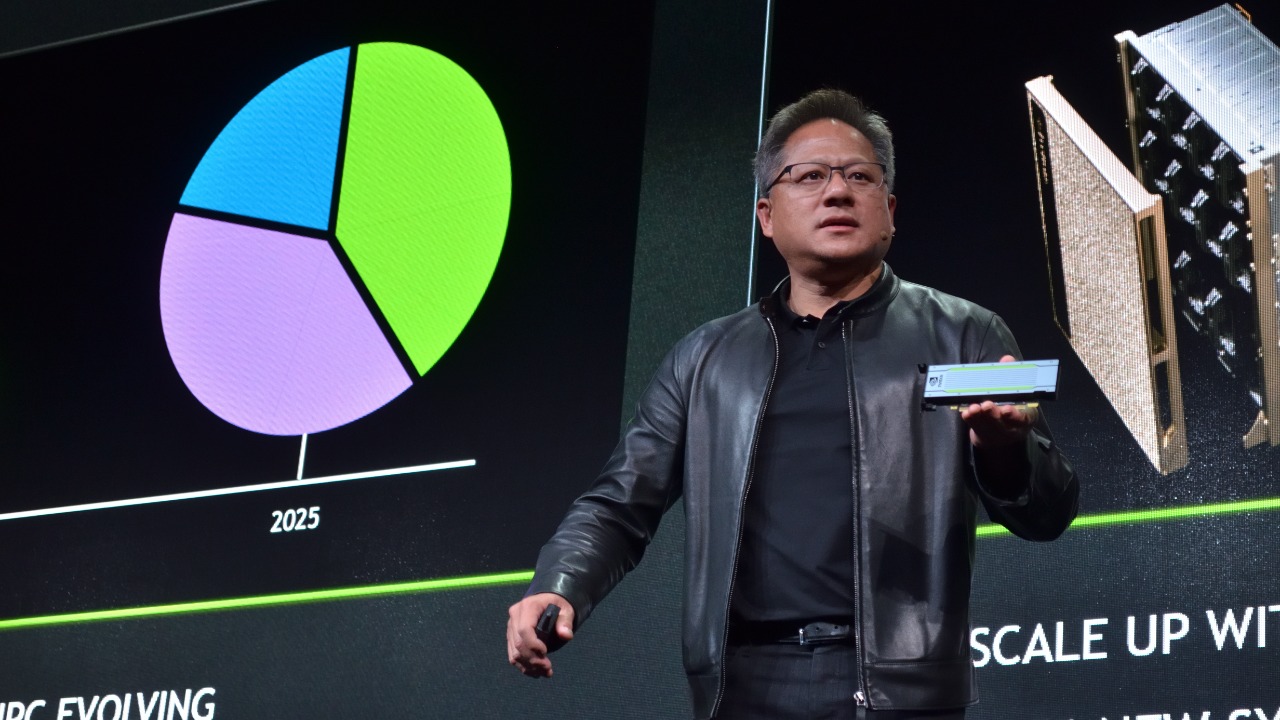
Artificial intelligence is often framed as a job destroyer, but Nvidia chief executive Jensen Huang is betting on a different outcome. He argues that as AI spreads through every industry, work will not disappear so much as it will be reshaped, leaving people with more to do, not less, even as specific tasks are automated. That vision, which comes from the leader of the company supplying many of the world’s AI chips, carries real weight in the debate over how automation will transform everyday jobs.
Huang’s view is not that AI will gently coexist with today’s roles, but that it will push workers into new responsibilities, new tools and, in many cases, entirely new occupations. I see his comments as part reassurance and part warning: the technology may expand economic opportunity, but only for those individuals, companies and governments that move quickly to adapt skills, regulations and business models to a more automated economy.
Huang’s busy future of work
When Huang talks about AI making people “busier,” he is pushing back on the idea that automation will leave large parts of the workforce idle. His argument is that as software takes over repetitive chores, organizations will raise their expectations for what humans deliver, from more personalized services to faster product cycles and more ambitious research. In that sense, AI becomes a productivity multiplier that encourages companies to tackle projects that were previously too complex or too expensive, which in turn creates fresh demand for human judgment, creativity and oversight that machines cannot fully replace, according to Huang’s recent remarks.
Huang has also framed AI as a “co-pilot” that sits alongside workers rather than a rival that pushes them out of the cockpit. He has pointed to tools that draft code, summarize documents or generate designs as examples of systems that compress the time spent on low-level work, freeing people to focus on higher value decisions and relationships. In his view, that shift does not shorten the workday so much as it changes what fills it, a pattern that echoes earlier waves of automation in manufacturing and services that eliminated some tasks but ultimately expanded total output and employment, as reflected in his comments on AI-driven productivity.
From job loss fears to job redesign
Public anxiety about AI often centers on outright job loss, especially in white-collar fields that once felt insulated from automation. Huang does not dismiss that risk, but he tends to reframe it as a question of job redesign rather than simple replacement. He has argued that roles built entirely around routine information processing are the most exposed, while positions that blend technical skills with interpersonal work, domain expertise or complex problem solving are more likely to evolve than vanish. That distinction aligns with research showing that generative AI is particularly strong at pattern recognition and language tasks, which can restructure office work even when headcounts remain stable, a trend highlighted in analyses of white-collar automation.
In practice, that means many employees will see their job descriptions rewritten around AI tools rather than find themselves immediately unemployed. Customer support agents might supervise chatbots and handle only the thorniest cases, marketers might orchestrate campaigns that AI systems draft and test, and software engineers might spend more time on architecture and less on boilerplate code. Huang has suggested that this kind of augmentation can raise both productivity and wages for those who adapt, but he has also acknowledged that workers and companies that fail to reskill could be left behind, a tension that surfaces in reporting on AI reshaping workplace roles.
Why Nvidia’s stance matters for the AI economy
Huang’s optimism about a busier, AI-augmented workforce is not just philosophical, it is tightly linked to Nvidia’s business model and the broader AI investment cycle. Nvidia sells the graphics processing units and related systems that power large language models and other advanced AI workloads, and the company has seen demand surge as cloud providers, enterprises and governments race to build out infrastructure. When Huang argues that AI will expand work rather than shrink it, he is effectively making the case that this hardware buildout will support a durable wave of new applications and services, not a short-lived automation bubble, a narrative reinforced by coverage of Nvidia’s AI demand outlook.
That perspective also helps explain why Nvidia is investing heavily in software ecosystems, developer tools and industry-specific platforms, from healthcare imaging to automotive systems. Huang has said that the real value of AI comes when organizations embed it deeply into workflows, which requires far more than raw compute. By positioning Nvidia as a partner in that transformation, he is betting that companies will keep layering AI into logistics, design, finance and customer experience, each step creating new tasks for employees to manage, interpret and refine AI output. Reporting on Nvidia’s push into sector-focused AI platforms underscores how closely the company’s growth story is tied to the idea that AI will permeate, rather than hollow out, everyday work.
Skills, training and the risk of being left behind
If AI is going to make people busier instead of redundant, the bottleneck becomes skills rather than raw labor demand. Huang has repeatedly emphasized the need for rapid upskilling, arguing that workers should learn to treat AI tools as part of their daily toolkit in the same way they once adopted spreadsheets or web browsers. That means basic literacy in prompting, data interpretation and model limitations, even for people who are not professional engineers. Studies on AI adoption in offices show that employees who receive targeted training are more likely to report productivity gains and job satisfaction, while those left to figure out tools on their own often feel overwhelmed, a pattern documented in surveys of AI-related reskilling.
Governments and educational institutions are starting to respond, but the pace is uneven. Some universities are weaving AI into core curricula for business, law and medicine, while others are still debating basic policies on tools like ChatGPT. On the policy side, a few countries have launched national AI training initiatives for small businesses and public-sector workers, yet large segments of the workforce still lack access to structured learning. Huang’s argument that AI will expand work therefore comes with an implicit caveat: without aggressive investment in training, the technology could deepen inequality between those who can harness it and those who cannot, a concern echoed in research on AI and skills gaps.
Balancing productivity gains with worker protections
Even if AI ultimately increases the volume and variety of work, that does not automatically translate into better conditions for workers. Productivity gains can be captured by shareholders or used to justify higher performance targets without corresponding pay or support. Huang tends to focus on the upside, arguing that AI-enabled productivity can fuel economic growth and new industries, but labor advocates warn that without updated protections, monitoring tools and algorithmic management could intensify pressure on employees. Studies of AI deployment in logistics and call centers have already documented cases where automated systems track performance in granular detail, sometimes in ways that workers describe as intrusive, as shown in reporting on AI-driven workplace surveillance.
Regulators are beginning to grapple with these tensions, exploring rules around transparency, data use and accountability when AI systems influence hiring, scheduling or evaluation. The European Union’s AI Act, for example, places stricter requirements on high-risk workplace applications, while agencies in the United States have signaled that existing labor and civil rights laws apply to algorithmic decision making. For Huang’s vision of a busier, AI-augmented workforce to be broadly positive, companies will need to pair adoption with clear guardrails, worker input and fair distribution of the gains, a balance that early policy debates on responsible AI use are only beginning to define.
What a busier AI era means for everyday workers
For individual workers, Huang’s message boils down to a mix of opportunity and urgency. If he is right that AI will expand the scope of what organizations attempt, then people who learn to collaborate with these systems could find themselves at the center of more ambitious projects, from personalized education programs to faster drug discovery pipelines. That could mean richer careers for software developers who master AI frameworks, for designers who integrate generative tools into their process, or for nurses who use decision support systems to manage larger patient loads more safely, examples that align with case studies of AI-enhanced professional roles.
The flip side is that passivity is a risky strategy. As AI tools become standard in productivity suites, customer platforms and internal systems, workers who resist or lack access to training may find their skills devalued even if their job titles do not immediately disappear. Huang’s assertion that AI will make everyone busier should therefore be read less as a guarantee of security and more as a forecast of rising expectations. In my view, the safest path through that transition is to treat AI literacy as a core competency, much like digital literacy in earlier decades, a conclusion supported by forward-looking analyses of AI and the future of work.
More From TheDailyOverview
- Dave Ramsey warns to stop 401(k) contributions
- 11 night jobs you can do from home (not exciting but steady)
- Small U.S. cities ready to boom next
- 19 things boomers should never sell no matter what

Grant Mercer covers market dynamics, business trends, and the economic forces driving growth across industries. His analysis connects macro movements with real-world implications for investors, entrepreneurs, and professionals. Through his work at The Daily Overview, Grant helps readers understand how markets function and where opportunities may emerge.