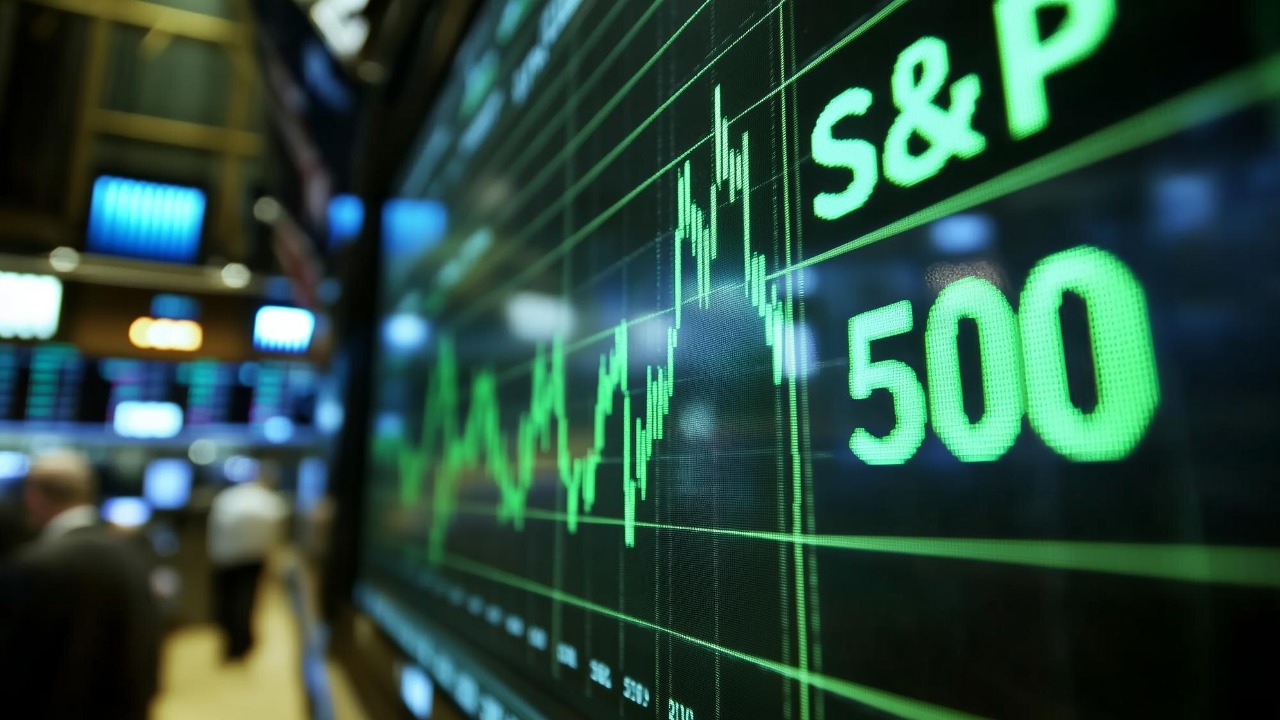
Turning a modest annual contribution into seven figures is not a fantasy, it is a math problem. If you put $1,000 a year into a low-cost fund that tracks the S&P 500 and let compounding do the heavy lifting, the real question is not whether your money can grow, but how long it might take to cross the $1 million mark. The answer depends on the market’s long run, your time horizon, and how consistently you stick to the plan.
To understand that path, you have to start with what the S&P 500 has actually delivered over decades, then translate those averages into concrete timelines. From there, it becomes easier to see how a small annual habit can snowball, why the first $100,000 feels so slow, and what levers you can pull to reach $1 million faster without betting your future on lucky stock picks.
What history really says about S&P 500 returns
Any projection about turning $1,000 a year into $1 million rests on one core assumption, the long term return of the S&P 500. Over many decades, the index has produced a roughly double digit average annual gain, including dividends, which is why it is widely used as a shorthand for “the stock market.” Researcher and writer Vikki Velasquez has noted that the S&P 500 is often treated as a benchmark for diversified U.S. equity performance, and that long history of compounding is what makes it a powerful tool for patient investors who want broad S&P 500 diversification.
Over the past 100 years, the average stock market return has been around 10% annually, based on the S&P 500 market index, which is why many long term calculators default to that figure. That 10% is not a promise, it is a historical average that smooths out booms, busts, and everything in between. When I talk about how long it might take $1,000 a year to grow into $1 million, I am leaning on that century scale perspective, not on any single hot streak or crash.
Why “average” returns hide a lot of volatility
Even if the long run average hovers near 10%, the path to that number is anything but smooth. Over shorter stretches, the S&P 500 can swing wildly, with some five year windows delivering spectacular gains and others barely breaking even. Data on historical performance shows that the annualized yearly return for the S&P 500 over the last 20 years, including dividends, has been closer to 8.413%, which is a reminder that recent history can look different from the century scale average yearly return.
That gap between 10% over 100 years and 8.413% over the last two decades matters when you are projecting how long it will take to hit $1 million. If your actual experience looks more like the lower figure, your timeline stretches out, even if the long term story is still positive. When I run scenarios, I tend to look at a range of plausible returns, not a single point estimate, because the difference between 7%, 8.413%, and 10% compounded over decades can mean arriving at your goal years earlier or later than you expected.
Translating averages into a $1,000 per year plan
Once you have a sense of historical returns, you can plug them into a simple savings plan. If you invest $1,000 every year into an S&P 500 index fund and the market delivers something close to its long term average, compounding will eventually do most of the work. At a 10% annual return, $1,000 a year grows to roughly $164,000 after 30 years, about $442,000 after 40 years, and just under $1.2 million after 50 years. Those are not guarantees, but they show how a relatively small yearly contribution can, over half a century, cross the million dollar line.
If you assume a more conservative 8.413% return, closer to the recent 20 year experience, the math changes. At that rate, $1,000 a year grows to around $137,000 after 30 years, about $314,000 after 40 years, and roughly $730,000 after 50 years. To reach $1 million at 8.413%, you would need closer to 55 years of steady investing. The lesson is straightforward: with $1,000 a year, time is your main lever, and the difference between starting in your early 20s and your mid 30s can be the difference between hitting seven figures and falling short.
How the first $100,000 sets the pace
Before you ever see six or seven figures in your account, you have to grind through the slow early years. Many investors fixate on the first $100,000 because it feels like the hardest milestone. With a $1,000 annual contribution and a reasonable return, that first six figure mark can take decades, which is why some analysts emphasize that the early phase is more about building the habit than watching the balance. One widely cited benchmark pegs an “Average annual return: 7%” for a balanced long term portfolio, and at that rate, it takes roughly 34 years of $1,000 contributions to cross $100,000, assuming you never miss a year and your investments compound at that Average annual return: 7%.
Once you clear that first $100,000, the math starts to tilt in your favor. At 7%, a $100,000 balance generates about $7,000 in growth in a single year, which is seven times your $1,000 contribution. That is the psychological turning point where compounding becomes more important than your new deposits. From there, each additional decade of staying invested matters more than squeezing out a slightly higher contribution, which is why patient investors often focus on staying in the market rather than trying to time it.
What $10,000 and $100,000 examples reveal about compounding
To see how compounding scales, it helps to look at larger one time investments. If you put $10,000 into an S&P 500 ETF and simply wait, the long term growth can be striking. Analyses of historical performance show that people often use the S&P 500 as a yardstick for investing success, and that a single $10,000 lump sum left alone for 25 years at a typical index level return can grow several times over, illustrating how a broad market fund tracking the 500 largest U.S. companies can turn time into compounding power.
Scale that idea up to $100,000 and the effect is even more dramatic. At a 10% annual return, $100,000 becomes about $672,000 after 20 years without any additional contributions. That is why many seasoned investors talk about “getting the snowball big enough” so that market growth does the heavy lifting. For someone putting in $1,000 a year, these examples are a reminder that the goal is not just to reach $1 million, but to get to the point where your existing balance is growing by more than you can reasonably save out of pocket.
How long to $1 million at different return assumptions
When you combine the $1,000 annual contribution with realistic return ranges, the timelines to $1 million come into focus. At a 10% annual return, you would need roughly 50 years of consistent investing to cross seven figures with $1,000 a year. At 8.413%, the horizon stretches closer to 55 years. At 7%, the target drifts even further out, to around 60 years or more. These are back of the envelope figures, but they illustrate that with a small yearly contribution, the journey to $1 million is measured in decades, not in quick wins.
Those timelines also highlight the power of starting early. If you begin investing $1,000 a year in your early 20s and the market delivers something close to its long term average, you have a realistic shot at seeing $1 million in your lifetime. If you wait until your 40s, the same contribution level is unlikely to get you there without a much higher return or a longer working life. That is why many financial planners encourage young workers to prioritize getting money into an S&P 500 index fund as soon as they can, even if the amount feels trivial at first.
Why the S&P 500 is the default yardstick
There is a reason so many of these projections revolve around the S&P 500 rather than a handful of individual stocks. The index represents a broad slice of the U.S. economy, and its long term performance has become a shorthand for “owning the market.” Analysts often describe the S&P 500 as a core building block for diversified portfolios, and researcher Vikki Velasquez has underscored how investors use it as a reference point when they evaluate other strategies, from active stock picking to sector specific bets.
Over the past 100 years, the average stock market return of around 10% annually, based on the S&P 500 market index, has turned it into a natural benchmark for long term savers. That history is why many educational tools and retirement calculators plug in a 10% figure when modeling future growth, even though actual results can be much higher or much lower in any given decade. When I talk about putting $1,000 a year into “the market,” I am really talking about using a low cost fund that tracks this index as a simple, transparent way to capture that broad 100 year, 10% pattern.
What “average stock market return” really means for you
It is tempting to treat the phrase “average stock market return” as a promise, but it is really a statistical summary of a very bumpy ride. Over long stretches, the S&P 500 has delivered an average annual return in the high single digits to low double digits, depending on the exact window you choose. One detailed review of historical data notes that the average stock market return of the S&P 500 is often cited as a baseline for planning, while also warning that individual years can be much higher or much lower than that average stock market return.
For someone putting in $1,000 a year, that nuance matters. If you happen to start investing right before a long bull market, your path to $1 million could be shorter than the historical averages suggest. If your early years coincide with a flat or negative stretch, you might feel like you are treading water even as you dutifully add money. The key is to understand that the “average” is something you only see if you stay invested across multiple market cycles, which is why consistency often matters more than trying to guess which years will be good or bad.
How to tilt the odds in your favor without chasing miracles
While you cannot control market returns, you can control how much you invest, how early you start, and how much you pay in fees. If $1,000 a year is all you can spare today, one way to accelerate your path to $1 million is to commit to gradual increases, for example bumping your contribution by 3% each year or whenever you get a raise. Even small step ups can shave years off your timeline, especially if they happen early in your investing life when compounding has more time to work.
You can also improve your odds by sticking with broad, low cost index funds rather than chasing hot tips. The S&P 500 has a long history of producing double digit yearly returns, and the annualized yearly return for the S&P 500 over the last 20 years, including dividends, at 8.413% shows that simply owning the market has been a powerful strategy for patient investors who reinvest their gains. When you combine that kind of disciplined exposure with a steady contribution plan, even a modest $1,000 a year can, over a working lifetime, put the $1 million mark within reach for ordinary savers who are willing to let time and compounding do their work.
More From TheDailyOverview
- Tennessee loses $2.6B megafactory and faces major layoffs
- Retired But Want To Work? Try These 18 Jobs for Seniors That Pay Weekly
- What to do with your pennies after the U.S. stops minting them
- Home Depot CEO warns of a troubling customer trend in stores

Cole Whitaker focuses on the fundamentals of money management, helping readers make smarter decisions around income, spending, saving, and long-term financial stability. His writing emphasizes clarity, discipline, and practical systems that work in real life. At The Daily Overview, Cole breaks down personal finance topics into straightforward guidance readers can apply immediately.
