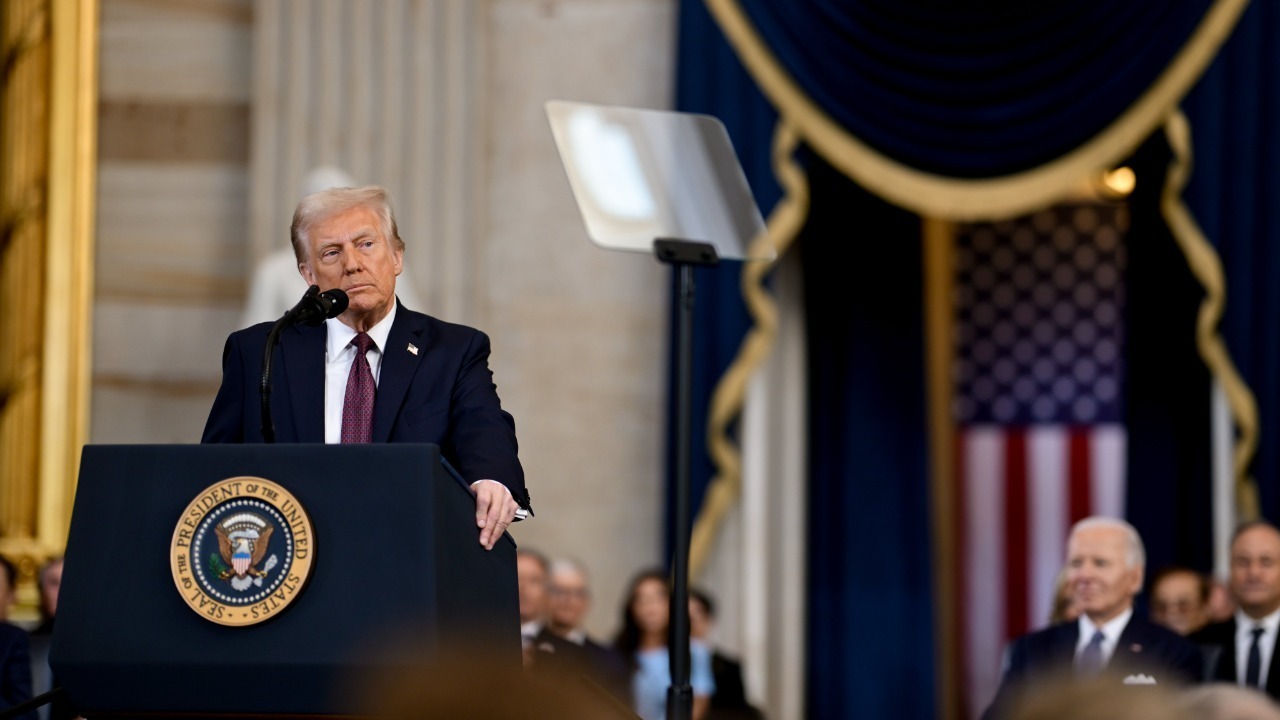
President Donald Trump has opened a new front in his war on what he casts as financial engineering in the defense sector, and the first companies in the crosshairs are RTX and Anduril. An executive order targeting executive pay, dividends, and stock buybacks at “underperforming” contractors has collided with years of shareholder friendly policies, igniting a fight over who should control the industry’s cash and how fast weapons should roll off the line.
The clash is not just about optics. It goes to the core of how the Pentagon, Wall Street, and a new generation of defense-tech firms think about risk, capacity, and reward, and it is already reshaping incentives for giants like RTX and fast-rising players like Anduril.
The White House rewrites the rules for “underperforming” contractors
The White House has used its latest executive order to fuse industrial policy with national security, tying financial behavior directly to access to federal contracts. According to Highlights from the order, Jan directives from The White House aim to accelerate defense procurement and expand production capacity while tightening scrutiny on how contractors deploy their cash. The policy effectively tells major suppliers that if they want to keep winning work, they must prioritize plants, equipment, and munitions lines over shareholder distributions.
At the heart of the move is a set of core prohibitions that link financial discipline to performance metrics. The same Core Policy and analysis notes that contractors deemed to be lagging on delivery or capacity face limits on stock buybacks, dividends, and executive compensation. In practice, that gives the administration leverage to label a company “underperforming” if it shows insufficient production speed or investment, then use that label to force a reordering of priorities that favors throughput over financial engineering.
Trump’s public pressure campaign sets the stage
The executive order did not emerge in a vacuum, it followed a very public campaign by President Donald Trump to shame defense executives into changing course. Earlier this month, President Donald Trump used Truth Social to argue that defense companies should cap executive pay, invest more in plants and equipment, and stop giving directors and shareholders what he described as excessive rewards at the expense of the military and allies. That message framed high pay and aggressive capital returns as a direct threat to readiness, not just a corporate governance issue.
The rhetoric quickly became personal. An hour after his initial post, President Trump followed up with a second message that singled out Raytheon, now known as RTX, accusing the company of prioritizing buybacks over weapons output and warning that new limits on executive pay would “chill” the markets only for those who had been overpaid. That second salvo, captured in detail in coverage of President Trump and RTX, signaled that the administration was prepared to call out individual firms by name and link their boardroom decisions to national security outcomes.
Inside the executive order: caps, triggers, and “underperforming” labels
The formal policy architecture arrived when Jan guidance titled President Trump Issues described an order that prioritizes and accelerates production of critical weapons systems while restricting stock buybacks and executive compensation for contractors labeled underperforming. The order directs agencies to identify companies that are not meeting delivery or production benchmarks and to take action that can include conditioning contract awards on changes to pay and capital allocation. It is a blunt instrument, but one that gives procurement officials a new tool to push for more capacity.
Legal analyses of The Order emphasize that the President tied these restrictions to delivery and production metrics, not just accounting ratios, which means contractors must now treat throughput as a compliance obligation rather than a commercial choice. Another advisory on Executive Order notes that President Donald Trump issued the directive to “prioritize and accelerate defense procurement and increased production capacity,” and that when selecting a potential solution, the Department of Defense is now instructed to consider the financial condition of the contractor, including its history of buybacks, dividends, and executive pay. In other words, balance sheet choices have become bid evaluation criteria.
RTX and Anduril feel the immediate heat
RTX and Anduril have become the emblematic cases of how this policy shift lands on very different types of defense firms. Reporting on Defense companies notes that RTX completed a 10 billion dollar stock repurchase program that was explicitly tied to adjusted earnings per share, a classic Wall Street friendly move that now looks politically toxic. That same coverage points out that Anduril, a younger defense technology company, is being scrutinized not for past buybacks but for how its rapid growth and private valuation intersect with the new expectations on reinvestment and capacity.
Separate analysis of how President Donald Trump signed the executive order explains that the measure zeroes in on pay packages at large defense contractors that have been judged to prioritize cash flow or earnings per share over production. In that framing, RTX’s history as one of the sector’s most aggressive spenders on shareholders, described in a piece on how Kiel Porter and Nicola White of Bloomberg News chronicled the company’s response, makes it a natural target. Anduril, by contrast, is being watched as a bellwether for whether venture backed defense startups will be pushed to adopt more traditional, capacity first capital strategies as they scale into major Pentagon suppliers.
From social media blasts to contract threats
The pressure on RTX escalated from social media criticism to explicit threats to its government business. Coverage of how President Donald Trump threatened to stop doing business with RTX Corp unless the maker of Patriot missile systems halted buybacks and dividends underscores how personal the confrontation has become. By tying RTX Corp’s access to future contracts for systems like Patriot to its willingness to redirect cash toward more upfront spending on production, the administration is using the full weight of federal procurement to force a change in corporate behavior.
Inside RTX, that threat appears to have triggered a strategic retreat from public confrontation. The Bloomberg account of how executives’ phones lit up after the President’s posts describes RTX deciding that the “winning move is not to play,” effectively choosing to keep a low profile while it reassesses its capital plans in light of the new rules. For Anduril, which has built its brand on being a bold, outspoken disruptor, the lesson is stark: in the current environment, even a privately held defense company must calibrate its public posture and financial strategy to avoid being tagged as misaligned with the White House’s priorities on weapons output and investment.
More From The Daily Overview

Silas Redman writes about the structure of modern banking, financial regulations, and the rules that govern money movement. His work examines how institutions, policies, and compliance frameworks affect individuals and businesses alike. At The Daily Overview, Silas aims to help readers better understand the systems operating behind everyday financial decisions.

