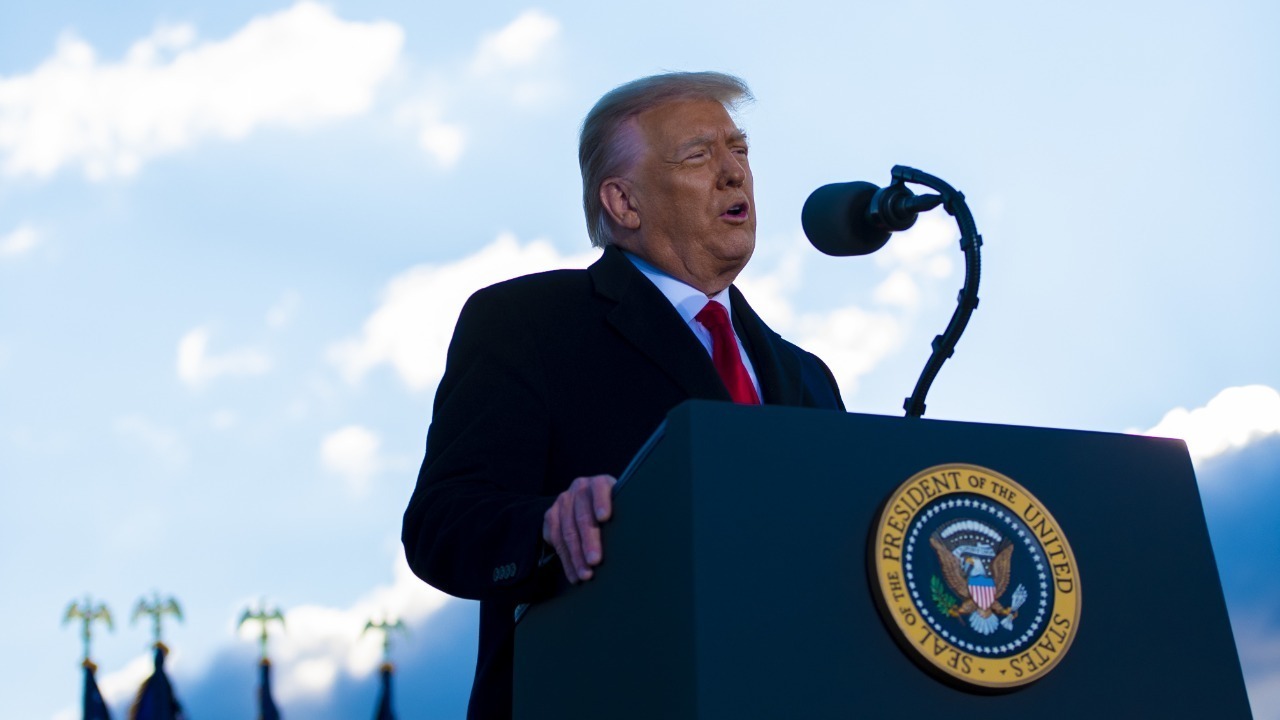
President Donald Trump’s boast that he now has “complete control” of the nation’s capital has crystallized a long‑brewing fight over who really governs Washington. The clash is not just rhetorical, it is playing out in federal orders, budget riders and even the fate of Washington, D.C.’s public golf courses. At stake is whether the capital remains a semi‑autonomous city with local priorities or a presidential showcase remade in Trump’s image.
Senators from both parties are now pressing for answers on how far that control extends, zeroing in on a Trump‑driven takeover of municipal golf facilities as a vivid symbol of federal overreach. Their pushback lands in a city where Trump has already moved to centralize policing, reshape spending and test the limits of the Home Rule framework that has governed Washington for decades.
From inauguration vows to a capital under command
When Donald Trump returned to the presidency, he framed his second tenure as a mandate to reorder the country’s institutions, and nowhere was that more literal than in Washington. On Inauguration Day, coverage from WASHINGTON described Donald Trump as a leader who had survived impeachments, criminal indictments and a pair of assassination attempts and then set out to reshape the country’s institutions once again, a mission that naturally began in the capital itself, as reported in WASHINGTON. That framing helps explain why Trump now speaks so casually about having total command of the city, treating Washington not as a community of residents but as the physical seat of his power.
That instinct quickly translated into policy. Earlier in his term, President Trump signed an executive order that facilitated a federal takeover of the District of Columbia’s core governing functions, consolidating authority over agencies such as the Metropolitan Police Department (MPD) under the White House, according to accounts of how President Trump moved on the District of Columbia. Around the same time, a video titled “Trump Threatens Federal Takeover of Washington D.C. | Home Rule Act Under Review” captured how the administration openly weighed changes to the Home Rule Act, signaling that the long‑standing compromise that gave local leaders limited autonomy was now under review, as reflected in the clip labeled Trump Threatens Federal.
Law and order as a pathway to centralized power
Trump’s claim of near‑total authority over the capital has been built in part on a law‑and‑order narrative that casts Washington as uniquely unsafe and ungovernable without federal muscle. In an August memorandum, The Memorandum directed the Secretary of Defense to mobilize the District of Columbia National Guard to address what the administration described as an epidemic of crime and to restore public safety in the city, a move that effectively put local security under direct presidential control, as detailed in the White House fact sheet on The Memorandum. By treating the District of Columbia National Guard as a standing instrument of domestic policing rather than an emergency resource, Trump blurred the line between federal oversight and direct rule.
Congress has also been drawn into this security‑first framing. When President Donald J. Trump signed H.R. 6938 into law, the Commerce, Justice, Science and related agencies bill became a vehicle for reshaping how federal dollars flow into Washington, D.C., with language that tied funding to public safety and “responsible resource management” in the capital, according to the description of how, in Washington, Today President Donald Trump enacted the measure, which included Commerce and other departments, in a release from Washington. I read that as part of a broader pattern: by embedding capital‑specific conditions into national appropriations, the administration is quietly tightening its grip on how the city is run.
Golf courses as a test case for “complete control”
The most tangible flashpoint in this power struggle is surprisingly pastoral: Washington’s public golf courses. Earlier this month, Jan lawmakers began speaking out against the Trump administration’s takeover of Washington, D.C.’s municipal golf courses, warning that the move concentrated control of public land in the hands of the president and his allies and sidelined local voices, according to reporting that described how Lawmakers are speaking out against the Trump‑driven changes in Lawmakers. Senators have framed the golf deal as a microcosm of a larger problem: if the White House can unilaterally rework recreational spaces that belong to District residents, what else can it seize under the banner of federal stewardship.
Critics say the arrangement is not just about control but about self‑interest. In Jan, Trump’s self‑serving takeover of D.C. public golf was described as bad news for all, with opponents arguing that They also called out environmental concerns regarding the development and warned that long‑planned community improvements could come to a halt indefinitely, as detailed in coverage that highlighted how Trump’s self‑serving takeover would reshape the courses. I see why senators seized on this example: it is easier to dramatize the stakes of federal overreach when you can point to bulldozers on a fairway than to obscure budget riders in a committee report.
Senators erupt, citing overreach and broken process
The political backlash has been swift. In Jan, Senators publicly demanded answers as Trump claimed he had “complete control of our nation’s capital, Washington D.C.,” arguing that such language betrayed a misunderstanding of shared governance and democratic accountability, a concern captured in a letter that warned The Trump Administration seems to feel they have complete control of our nation’s capital, Washington D.C., when in reality, we are supposed to focus on the American people, as reported by The Trump Administration. That rebuke goes beyond golf; it is a direct challenge to the president’s assertion that the capital is effectively his domain.
Other lawmakers have zeroed in on how the golf takeover unfolded. In Jan, Senators called Trump’s takeover of D.C. golf courses “overreach” and demanded answers, with one account noting that KNBR summarized their concern that the federal government had moved to end an existing lease after a trust defaulted on the lease, clearing the way for Trump’s allies to step in, as described in coverage of how Senators reacted. Separately, a detailed account noted that in late 2025, Interior notified NLT it was in default but, according to the nonprofit, it did not clearly specify the violations or explain why the decision to end the lease was made, raising questions about whether the process was engineered to produce a particular outcome, as outlined in a report on how Interior dealt with NLT. Taken together, these accounts fuel the senators’ suspicion that the administration is using regulatory levers to reward allies and tighten its grip on the city’s assets.
Symbolism, stakes and what comes next for Washington
The fight over golf is not happening in a vacuum. On the ground, the transformation is visible: Jan images showed Golfers playing hole six as trucks unloaded debris and soil from the demolition of the White House’s East Wing, a jarring juxtaposition that underscored how Trump’s imprint on Washington’s landscape now stretches from the executive mansion to the city’s recreational spaces, as described in a report that noted Golfers at work while the White House East Wing was being torn apart, with a timestamp that included 44 and EST in its metadata, as seen in Golfers. I read that scene as a metaphor for the broader moment: a president comfortable remaking both the symbolic heart of federal power and the everyday spaces where residents live and play.
More From TheDailyOverview
*This article was researched with the help of AI, with human editors creating the final content.

Grant Mercer covers market dynamics, business trends, and the economic forces driving growth across industries. His analysis connects macro movements with real-world implications for investors, entrepreneurs, and professionals. Through his work at The Daily Overview, Grant helps readers understand how markets function and where opportunities may emerge.

