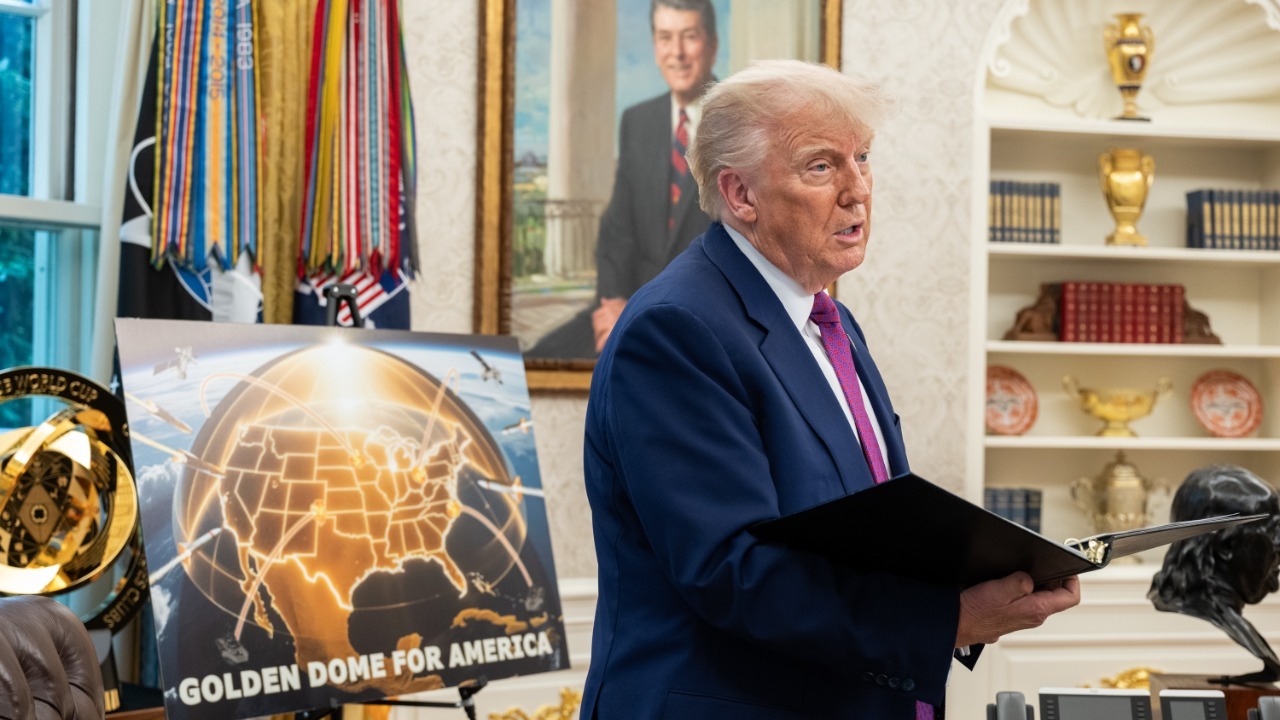
SpaceX and Blue Origin are redirecting attention and engineering capacity toward the Pentagon’s fast-growing missile defense program now branded as Golden Dome, as congressional funding, new contract solicitations, and a $175 billion price tag from the White House accelerate the initiative from policy paper to procurement reality. The shift signals that the largest commercial space companies see Golden Dome not as a distant concept but as a near-term revenue opportunity with a 2029 operational deadline. That timeline, combined with fresh appropriations and an expanding web of Space Development Agency solicitations, is reshaping competitive dynamics across the defense-industrial base.
From Executive Order to Golden Dome
The program traces back to a White House directive published in January 2025 that laid out a national missile shield over the continental United States, ordering the Department of Defense to produce a reference architecture and implementation plan for a layered defense against ballistic and hypersonic threats. That directive called for accelerating the Hypersonic and Ballistic Tracking Space Sensor, known as HBTSS, and for developing and deploying proliferated space-based interceptors capable of engaging missiles during their boost phase, the brief window after launch when they are slowest and most vulnerable. In policy terms, it moved space-based intercept from a long-debated concept into a formal presidential requirement.
The Congressional Research Service later identified this directive as Executive Order 14186 and documented its rebranding to Golden Dome, framing the initiative as a multi-decade commitment with significant technical and budgetary risk. CRS analysts highlighted likely oversight issues, including scope creep as new mission sets are added, cost growth beyond early topline estimates, feasibility questions surrounding space-based intercept, and the acquisition strategy the Pentagon ultimately adopts. Those concerns will influence how quickly contracts move from solicitation to award and whether commercial providers such as SpaceX and Blue Origin can compete on equal footing with traditional defense primes that have decades of missile defense experience but less practice with high-volume space production.
Congress Turns Concept Into Budget Lines
Golden Dome gained tangible financial backing when Congress passed the FY2026 defense appropriations, which converted the presidential directive into funded accounts across the Missile Defense Agency and Space Development Agency. Appropriators carved out money for space-based tracking, early architecture work, and initial interceptor studies, creating the budget lines that acquisition officials need to issue contracts and obligate funds. In Washington’s budgeting sequence, this step marks the transition from aspirational strategy documents to executable programs of record.
The appropriations bill matters for SpaceX and Blue Origin because funded programs attract contractor investment in ways that unfunded executive orders rarely do. Corporate boards and investors are far more willing to support hiring surges, factory retooling, and prototype builds when they can point to appropriated dollars rather than policy speeches. With FY2026 money now in place, commercial space companies have a clear financial signal that Golden Dome work will be paid for, not just debated in hearings, and that early movers can shape requirements in ways that favor their existing launch vehicles, satellite buses, and communications architectures.
SDA Solicitations Signal Urgent Demand
The Space Development Agency has already translated that funding into specific contract opportunities, posting multiple solicitations on SAM.gov that tie directly to the emerging Golden Dome architecture. One of the most consequential is the competition for the Tranche 3 tracking layer of the Proliferated Warfighter Space Architecture, which will expand a constellation of satellites designed to detect and track hypersonic glide vehicles and advanced ballistic missiles. A related notice seeks bids for additional tracking-layer payload work, signaling that SDA intends to iterate its sensor design rapidly as threat signatures and on-orbit performance data evolve.
Beyond tracking satellites, the agency issued a special architecture study notice that explicitly references the Iron Dome for America concept and invites industry to help define how the full system should function from space to ground. That call, coordinated with broader Pentagon planning, effectively opens the door for commercial space firms to compete for the intellectual blueprint of Golden Dome rather than simply bidding on hardware. For companies that already operate large satellite constellations or manufacture launch vehicles at scale, these solicitations represent a chance to align the architecture with their existing capabilities, potentially reducing schedule and cost risk for the government while giving the winning vendors long-term influence over design choices.
The $175 Billion Bet and Its Deadline
President Trump selected Golden Dome as a marquee defense initiative and endorsed a $175 billion cost envelope for the overall missile defense system, according to reporting that cited internal administration estimates and a Congressional Budget Office review of space-related components. The plan envisions multiple layers, from space-based sensors and interceptors to upgraded ground and naval systems, with the aim of protecting U.S. territory from both traditional ballistic missiles and emerging hypersonic weapons. Gen. Michael Guetlein, a senior space and acquisition officer, was tapped to oversee the effort, underscoring the central role of orbital infrastructure in the concept.
The administration has also set an ambitious target of achieving operational capability by 2029, effectively compressing what might otherwise be a decades-long acquisition timeline into a single presidential term. That schedule is aggressive by any historical standard: large missile defense and space programs routinely take ten to fifteen years from initial concept to initial operational capability. The compressed window is precisely why commercial launch and satellite manufacturers see an opening. Government-owned factories and legacy production lines are not configured to build and orbit hundreds or thousands of spacecraft on such short notice, whereas SpaceX’s Starlink assembly lines and Blue Origin’s investments in its New Glenn rocket and orbital infrastructure are designed for high cadence. If Golden Dome is to meet its 2029 goal, the Pentagon will likely need to lean heavily on this kind of commercial capacity.
Technical Hurdles That Shape the Competition
Speed of deployment is only one dimension of the challenge. The physics of boost-phase intercept from orbit remain extraordinarily difficult, because interceptors must detect, track, and maneuver against missiles that are accelerating rapidly and may deploy countermeasures. Patrick Binning, a Johns Hopkins expert who has discussed Golden Dome’s technical hurdles, emphasized that the system is intended to complement land- and sea-based defenses rather than replace them. That framing lowers the bar from providing a perfect, impermeable shield to contributing an additional layer that can thin out incoming salvos, but it still demands levels of on-orbit reliability and responsiveness that no country has yet demonstrated with operational space-based interceptors.
The sensor architecture presents its own steep problems. HBTSS and related tracking satellites must discriminate relatively dim, fast-moving targets against the thermal clutter of Earth’s surface and atmosphere, a task that differs markedly from traditional ground-based radar operations. Proliferating hundreds or thousands of nodes in low Earth orbit could improve coverage and resilience, but every satellite must share data with its neighbors and ground stations in near-real time to support intercept decisions. Companies that already operate mesh networks in space, such as SpaceX with its laser-linked broadband constellation, have a structural advantage in demonstrating that kind of connectivity at scale. At the same time, integrating commercial networking concepts into classified missile warning and defense missions raises cybersecurity, encryption, and command-and-control questions that policy makers and engineers will need to resolve early to avoid costly redesigns later.
Why the Pivot Matters for Oversight
Most public attention on Golden Dome has focused on technology and price, but the program’s real inflection point may be its acquisition model, particularly if commercial firms help define the architecture. The CRS brief on Executive Order 14186 flagged acquisition approach as a central oversight concern, warning that when the government buys satellites from a company that also shaped the system design, traditional checks on cost and performance can weaken. Congress will have to decide whether to rely on cost-plus contracts familiar to legacy defense primes, fixed-price arrangements more common in commercial space, or some hybrid that balances innovation incentives with taxpayer protections. Each choice will influence which firms are best positioned to win, and how much risk the government ultimately bears if technical problems emerge.
The risk of scope creep is equally significant. A program that begins as a space-based tracking layer can quickly expand into interceptor development, new ground stations, software-defined command networks, cyber hardening, and integration with allied systems, each adding cost and complexity. If SpaceX, Blue Origin, or another commercial player secures early architecture and demonstration awards, that vendor could gain substantial influence over the technical standards and interfaces that later shape production contracts. That influence is not inherently problematic, industry-led standards often accelerate deployment, but it does require vigilant oversight to ensure that no single company can lock competitors out of subsequent phases through proprietary protocols or bespoke hardware choices that are difficult to replicate.
What Comes Next for Commercial Space and Defense
The convergence of executive direction, congressional funding, active solicitations, and a hard 2029 deadline has created conditions that favor companies able to move fast and build at scale. SpaceX and Blue Origin are far from the only firms watching these developments; established defense contractors such as Lockheed Martin, Northrop Grumman, and L3Harris bring deep missile defense pedigrees, mature sensor technologies, and experience navigating Pentagon acquisition rules. Yet the emphasis on proliferated constellations and rapid deployment tilts the playing field toward organizations with high-rate spacecraft manufacturing, vertically integrated launch services, and software-centric operations that can iterate quickly in response to on-orbit data.
The coming years will determine whether SDA’s architecture studies yield a design that commercial providers can execute within the budget and schedule constraints now attached to Golden Dome. Early demonstration launches, prototype constellations, and integration exercises with existing ground-based systems will offer the first concrete evidence of whether space-based intercept can move from theory to practice on the timeline the White House has set. For SpaceX and Blue Origin, the stakes are considerable: success could cement their status as indispensable pillars of U.S. national defense, while failure or major delays could prompt Congress to rethink the entire approach. For lawmakers and the Pentagon, the challenge will be to harness commercial speed and innovation without sacrificing transparency, competition, or long-term sustainability in what is poised to become one of the most expensive and consequential defense programs of the coming decade.
More From The Daily Overview
*This article was researched with the help of AI, with human editors creating the final content.

Grant Mercer covers market dynamics, business trends, and the economic forces driving growth across industries. His analysis connects macro movements with real-world implications for investors, entrepreneurs, and professionals. Through his work at The Daily Overview, Grant helps readers understand how markets function and where opportunities may emerge.

