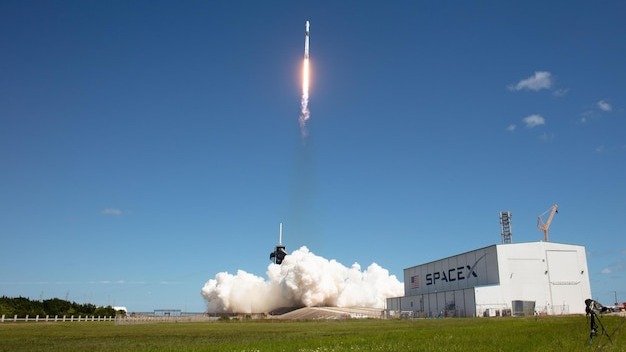
Elon Musk is moving SpaceX closer to the public markets, lining up four of Wall Street’s most powerful banks to steer what could be one of the largest stock offerings in history. The company is targeting a 2026 debut, setting the stage for a test of investor appetite for a space and satellite business that has grown from scrappy startup to critical infrastructure provider.
The mandate signals that SpaceX is preparing a “monster” initial public offering, with expectations shaped by rapid revenue growth, soaring private valuations, and intense demand from retail and institutional investors who have been locked out of the stock for two decades.
The four-bank syndicate behind a mega 2026 deal
SpaceX has selected a quartet of heavyweight underwriters, tapping Bank of America, Goldman Sachs, JPMorgan Chase and Morgan Stanley to lead the offering, according to reporting that describes the group as the core of a mega 2026 IPO. By concentrating the work with four of Wall Street’s most influential firms, the company is signaling that it expects a complex, globally marketed deal that will require deep distribution, sophisticated structuring and careful coordination across equity capital markets desks. One account notes that Wall Street banks have been working with SpaceX on early groundwork for potential offerings, underscoring how long this process has been in motion.
The choice of Morgan Stanley is particularly notable, since separate reporting indicated that Morgan Stanley had been emerging as a key adviser as SpaceX interviewed banks for roles in the IPO. A separate summary of IPO planning notes that Elon Musk’s company is lining up investors for what is expected to be a highly complex listing, reinforcing why such a concentrated syndicate makes strategic sense. Another report, by Thomas Barrabi, similarly describes Elon Musk turning to four major banks to lead the massive offering.
From private titan to public market test
For now, SpaceX remains firmly in private hands, with secondary markets and specialist platforms the only way for most investors to gain exposure. One marketplace that tracks pre-IPO activity stresses that SpaceX is a privately held company and is currently not publicly traded, noting that SpaceX is a, and that investors must rely on private transactions. Another overview aimed at retail traders makes the same point, explaining that SpaceX is not and does not yet list on exchanges like Nasdaq or the NYSE.
That scarcity has helped fuel a rich private valuation. A table of leading Private Companies highlights how investors track Symbol, Company, Price, 52 Wk Change and Estimated Valuation to benchmark giants like SpaceX against other unicorns. Analysts focused on the satellite sector have gone further, suggesting in an Analyst Roundtable that, after more than two decades of operations, potential valuations for a SpaceX IPO could reach as high as $1.5 trillion. That same discussion, framed under themes like The Arctic Space Race Heats Up and 10 Defining Moment, underscores how central the company has become to the broader space economy.
Revenue growth, Starlink scale and the valuation puzzle
Behind the IPO buzz is a business that has shifted from experimental rockets to recurring cash flow. Research firm Sacra, which invites readers to Unlock its SpaceX dataset, estimates that the company generated $14.2B in revenue in 2024, representing 63% growth year over year. Sacra’s note that readers can Click to access the dataset underlines how closely institutional investors are already dissecting the numbers behind Starlink and the launch business. A separate market intelligence snapshot similarly cites $14.2 in Annual Revenue and highlights the Year Over Year Growth Rate as a key driver of valuation models.
Elon Musk has been even more bullish about the trajectory. In comments reported by Reuters, he projected that SpaceX would record revenue of about $15.5 billion in 2025, describing the company as the most active launch operator globally. Another breakdown of Year Over Year notes that the company’s launch missions alone generated hundreds of millions of dollars, while Starlink’s subscriber base has become the main engine of top-line expansion. Together, these figures help explain why some analysts in The Key Questions for a Potential IPO discussion see room for valuations that rival or exceed the largest technology listings in history.
Investor frenzy, TSLA crosscurrents and retail expectations
As the IPO narrative has solidified, market chatter has accelerated. A detailed look at the market response notes that, after two decades of operating as a private company, expectations of a SpaceX IPO in 2026 are viewed as “accurate” by analysts who track the network infrastructure and satellite sectors. That same analysis points out that the IPO has quickly become a dominant topic in online investor communities, with traders debating everything from potential ticker symbols to how much of the business will be carved out for Starlink. A separate discussion of IPO dynamics emphasizes that going public could give SpaceX new capital to expand its constellation and deepen its role in global connectivity.
The excitement is not limited to would-be SpaceX shareholders. Tesla investors are already gaming out what a listing could mean for TSLA, particularly for those who have long seen their Tesla stake as a proxy for Musk’s broader empire. One shareholder question, highlighted in a report on TSLA, has received more than 600 votes, representing more than 1 million TSLA shares, pressing Musk on whether loyal Tesla holders will get preferential access to the SpaceX deal. That same piece notes that, In December, investors were already bidding up private-market prices for SpaceX shares, with some transactions implying valuations in the $22 billion to $24 billion range for earlier funding rounds. The intensity of that interest suggests that any allocation decisions in the IPO could have reputational consequences for Musk among his most committed retail base.
Strategic stakes: satellites, geopolitics and the path to listing
SpaceX’s move toward the public markets is not happening in a vacuum. The company sits at the center of a broader contest for orbital dominance, with Starlink playing a visible role in conflicts and in remote connectivity from Ukraine to the Arctic. Analysts in a feature that pairs The Arctic Space Race Heats Up with Key Questions for a Potential IPO argue that public investors will need to price not just launch revenue, but also regulatory risk, national security sensitivities and the capital intensity of maintaining a global constellation. That Analyst Roundtable frames the offering as a Defining Moment for how markets value space infrastructure, suggesting that the outcome could influence funding conditions for rivals and partners alike.
Those strategic stakes help explain why SpaceX has surrounded itself with a deep bench of advisers. A breakdown of Key Points in the banking lineup notes that Bank of America joins Goldman Sachs, Morgan Stanley and JPMorgan to assist with the initial public offering, reinforcing earlier reports that the company had been interviewing banks for months. Another summary of the Wall Street group underscores that the IPO could rank among the biggest public listings ever globally, while a separate note on Jan planning stresses that the IPO would be highly complex given SpaceX’s mix of launch, satellite and defense-related contracts.
For now, SpaceX and its bankers are still shaping the structure, including whether to separate Starlink or keep it inside a single listing. Backgrounders on Space Exploration Technologies remind readers that the company has resisted going public for years despite recurring speculation about a potential IPO, largely to avoid the short-term pressures of quarterly earnings. Another overview of Potential deal structures notes that SpaceX is not publicly traded and remains a private company, but that investors are already modeling scenarios in which Starlink is eventually spun off. However the final prospectus looks, the combination of rapid revenue growth, geopolitical relevance and a four-bank Wall Street syndicate ensures that the 2026 IPO will be one of the most closely watched market events of the decade.
More From TheDailyOverview
*This article was researched with the help of AI, with human editors creating the final content.

Grant Mercer covers market dynamics, business trends, and the economic forces driving growth across industries. His analysis connects macro movements with real-world implications for investors, entrepreneurs, and professionals. Through his work at The Daily Overview, Grant helps readers understand how markets function and where opportunities may emerge.

