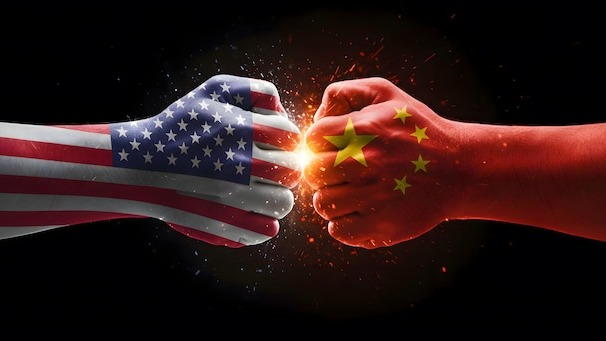
The world’s diplomatic map is being redrawn in the space between two superpowers. As the rivalry between the United States and China hardens into a long term feature of global politics, a cluster of “middle powers” is quietly building its own web of cooperation, from critical minerals to nuclear diplomacy. Rather than choosing sides, these states are experimenting with a third path that could loosen the grip of both giants on trade, technology and security.
The stakes are not abstract. Tariffs on some Chinese goods have surged to 145 percent, nuclear arms control frameworks such as New START have lapsed, and global supply chains have been repeatedly jolted by sanctions and export controls. In response, countries like Canada, Japan, South Korea, Australia, India, Brazil and Turkey are testing what amounts to a shock alliance of convenience, designed less to confront Washington or Beijing than to insure themselves against both.
The squeeze of great power rivalry
The starting point for this middle power turn is structural. Competition between the United States and China has shifted from episodic flare ups to what analysts describe as “structural competition” that will persist even when tensions are managed. Expert assessments of the relationship in 2026 point to a period of “controlled stability”, with rivalry normalized but not resolved, and with both powers focused on shaping rules for trade, technology and security rather than seeking outright confrontation. That kind of managed uncertainty is precisely what leaves mid sized economies exposed, since they depend on open markets and predictable rules more than either superpower does.
The trade war illustrates how volatile that environment has become. According to detailed analysis of the economic fallout, tariffs imposed by The China and the United States peaked with U.S. duties reaching 145 percent on some Chinese goods, and Chinese countermeasures helping drive bilateral trade down to 324.4 billion dollars in 2024. Even as high level meetings resumed to prevent escalation, the message to third countries was clear: their prosperity could be collateral damage in a fight they did not start. Surveys of specialists on the relationship show About one third expecting ties to become more antagonistic and another third seeing a chance of improvement, a split that underlines how little clarity governments have when they plan long term investments.
From hedging to quiet coordination
Middle powers have not stood still in the face of that uncertainty. Reporting on their diplomacy describes how governments from Canada to Turkey are “boosting cooperation” in areas ranging from supply chains to security dialogues, often outside the formal structures dominated by Washington or Beijing. The emerging pattern is less a single treaty than a lattice of overlapping initiatives, where countries that rarely appeared together in the same sentence, such as Brazil and South Korea, now find themselves comparing notes on how to keep trade flowing even when sanctions or export controls hit key sectors.
At Davos, the Canadian leader Mark Carney used his special address to argue that Allies will “buy insurance” and “increase options” in order to rebuild sovereignty, while also stressing that sovereignty can be shared when interests align. His language captured a broader mood among partners of the United States who no longer assume that a single alliance can cover all their risks. A detailed account of how the world’s middle powers are teaming up notes that this cooperation is being driven by the sense that both the U.S. and China have become less predictable, and that the safest course is to diversify relationships rather than double down on one patron.
Supply chains, minerals and the Forge dilemma
Nowhere is this diversification more concrete than in supply chains. Governments in Canada, Japan, South Korea, Australia, India, Brazil and Turkey are all seeking to reduce single point dependencies in critical minerals, semiconductors and clean energy components. Commentators who advocate a middle power alliance argue that its core mission should be “diversifying and strengthening supply chains”, not only to guard against shocks but also to give these states leverage when they negotiate with larger economies. The logic is straightforward: if cobalt, lithium or rare earths can be sourced from multiple friendly jurisdictions, no single exporter or importer can dictate terms.
Washington has tried to channel some of this energy into its own framework, unveiling a new minerals alliance known as Forge. Officials in Washington insist that the Forge initiative is about securing supply chains against disruptions or price coercion, and they explicitly reject claims that it is designed as an exclusive bloc targeting China. Yet the very need to stress that point shows how sensitive partners are to being pulled into a binary contest. For many of them, the more attractive option is to use U.S. backed schemes as one pillar of a broader strategy that also includes deeper trade with India, new processing capacity in Brazil, and technology partnerships with Japan and South Korea, rather than treating any one framework as the whole game.
Hedging on China while nudging on security
The other side of the equation is how these same countries engage with Beijing. Detailed reporting on diplomacy in Asia and Europe describes how traditional U.S. allies are hedging their bets, with a succession of leaders from key Western nations and American partners making their way to Beijing in what has been described as a pragmatic “pivot” to China. Analysts note that China and the US are locked in a tussle over global governance, with China quietly expanding its influence in trade and tech rule making even as it challenges U.S. dominance in multilateral forums. For middle powers, maintaining access to the Chinese market while avoiding entanglement in any potential anti China coalition has become a delicate balancing act.
Beijing has its own narrative about this moment. Chinese officials argue that China has “always maintained a very prudent and responsible” stance on security issues, including nuclear weapons, and they criticize what they see as an already advancing bloc based order led by others. At the same time, the expiry of New START has prompted experts to call on Asian middle power countries to cooperate in prodding the major nuclear powers toward renewed disarmament talks, precisely because great power leadership is seen as lacking. That combination, a China that presents itself as cautious yet assertive, and a United States that is building new coalitions like Forge, leaves mid sized states with both leverage and risk as they try to shape outcomes on issues from arms control to cyber norms.
A flexible club, not a new bloc
One of the most important insights from recent commentary is that a middle power alliance is unlikely to look like a classic bloc. Analysts writing on the promise of such an arrangement argue that, given its members’ diverse interests, it would seek to constrain the US and China rather than confront them directly, and that its flexibility would be its main strength. Instead of a treaty with mutual defense clauses, what is emerging resembles a “network of clubs”, where countries sign up to specific initiatives on supply chains, digital standards or climate finance without committing to a single overarching organization. That looser structure makes it easier for governments to join without provoking retaliation from either superpower.
Public opinion among experts also supports a cautious approach. Surveys of specialists on U.S. China relations highlight the uncertainty over whether the relationship will become more cooperative or much more antagonistic, which in turn encourages middle powers to keep their options open. Coverage of Davos underscores how the rivalry between China and the US now shapes debates on geopolitics, trade and tech, with some observers arguing that China is quietly winning ground in areas like infrastructure finance and digital payments. Against that backdrop, the emerging middle power coordination looks less like an ideological project and more like a risk management strategy, akin to households diversifying their retirement savings rather than betting everything on a single stock.
More From The Daily Overview
*This article was researched with the help of AI, with human editors creating the final content.

Grant Mercer covers market dynamics, business trends, and the economic forces driving growth across industries. His analysis connects macro movements with real-world implications for investors, entrepreneurs, and professionals. Through his work at The Daily Overview, Grant helps readers understand how markets function and where opportunities may emerge.

