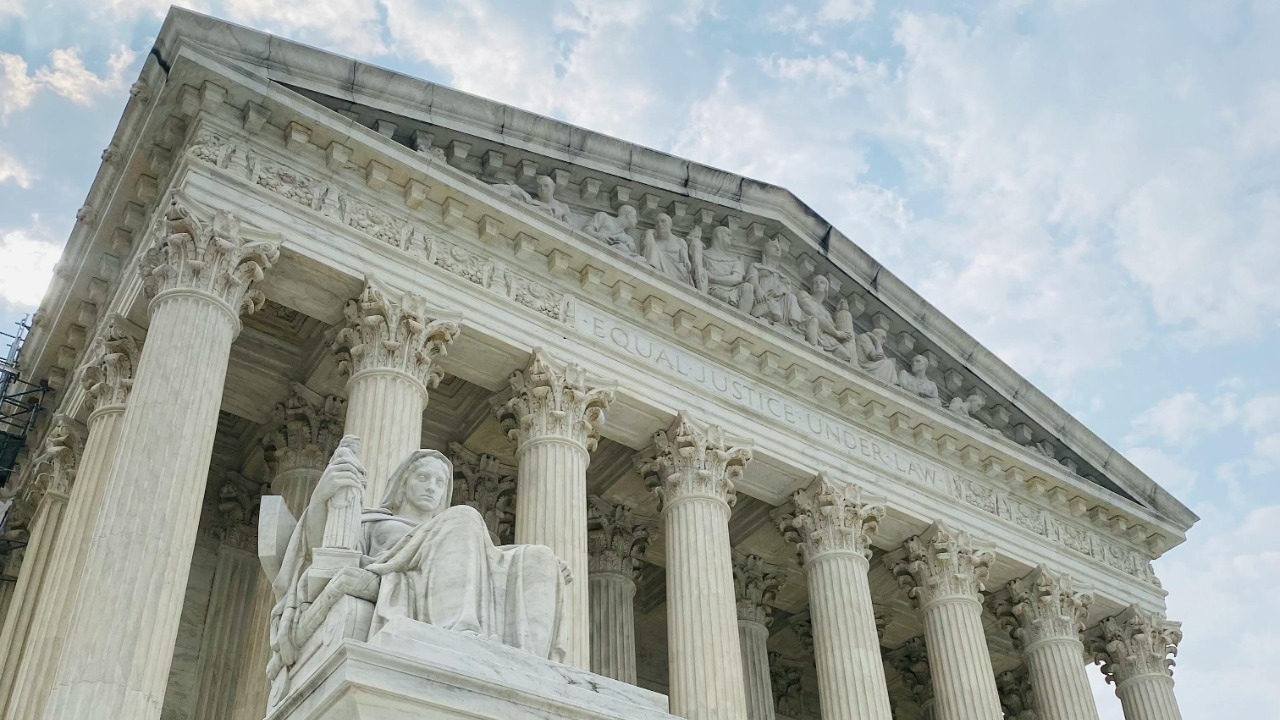
The Supreme Court is about to decide whether President Donald Trump can reach directly into the heart of U.S. monetary policy, testing how far a president’s power over the economy can extend. At stake in Trump v. Cook is not only one central banker’s job but the legal scaffolding that has long insulated interest rate decisions from day to day politics. The outcome will help determine whether future presidents treat the Federal Reserve as an independent referee or as another lever on the economic dashboard.
The Trump v. Cook showdown
At the center of the case is President Donald Trump’s attempt to remove Federal Reserve Governor Lisa Cook, a move that challenges the long standing assumption that central bank governors cannot be fired simply for policy disagreements. The dispute turns on whether the president can treat a Fed governor like a cabinet secretary, serving at his pleasure, or whether statutory protections limit his reach when it comes to the officials who help set interest rates and guide the dollar. The Supreme Court has agreed to hear Trump v. Cook as one of the marquee disputes of its current term, a signal that the justices see the case as a major test of presidential authority over the economy.
The legal question is intertwined with a broader fight over emergency economic powers. In a separate but related controversy, the justices are being asked to interpret a 1977 law that grants the president sweeping tools to address economic emergencies and to decide whether that statute gives him broad authority to reshape trade and financial flows. According to a detailed term preview, the Court is weighing whether that law can be read to bless aggressive interventions that could affect the “efficacy of U.S. monetary policy,” a phrase that captures how closely these disputes cut to the Federal Reserve’s core mission of stabilizing prices and employment through interest rate decisions and balance sheet moves, as outlined in Trump v. Cook.
Fed independence on the line
For more than a century, the Federal Reserve has operated on the premise that its leaders must be shielded from direct political retaliation so they can raise or cut rates based on economic data rather than electoral calendars. The Federal Reserve Act of 1913 codified that principle by allowing the president to remove governors only “for cause,” a phrase that has traditionally been read to mean serious misconduct or incapacity, not a disagreement over inflation strategy or bank regulation. In Trump v. Cook, the Court is being asked to decide whether that “for cause” language still has teeth or whether a determined president can redefine it to cover almost any conflict with a governor’s views, a question that goes to the heart of the Fed’s institutional design under Federal Reserve Act.
Harvard Law Professor Daniel Tarullo, a former central bank governor himself, has warned that the case could become a defining moment for the Roberts Court’s approach to economic governance. In his view, the justices are being asked whether the independence of the Federal Reserve will remain a meaningful constraint on presidential power or whether it will be recast as a norm that can be overridden whenever the White House invokes economic urgency. Tarullo has framed Trump v. Cook as a test of whether the Court will preserve a buffer between partisan politics and monetary policy or instead fold the central bank more tightly into the president’s chain of command, a concern he has laid out in detail while analyzing the independence of the.
Cook’s defense and the limits of “cause”
Lisa Cook’s legal team has responded by arguing that the accusations used to justify her removal do not come close to the kind of “cause” envisioned by the Federal Reserve Act of 1913. They describe the mortgage fraud allegations cited by the administration as “untested” and emphasize that the conduct at issue predates her appointment to the Fed, which in their view makes it an especially weak basis for firing a sitting governor. By that logic, allowing the president to oust Cook on such grounds would effectively erase the statutory protection and invite future presidents to comb through old disputes or unproven claims whenever they want to reshape the Board of Governors, a concern that has drawn support from state officials and legal scholars who see the case as a stress test of the Fed’s guardrails, as reflected in Cook’s filings with the Cook defense.
Cook’s allies also stress that the “for cause” standard has historically been tied to clear failures of “ability, fitness or competence,” not to disagreements over how quickly to raise interest rates or how strictly to police bank capital. They argue that if the Court blesses a broader reading, presidents will be tempted to threaten or remove governors who resist politically popular but economically risky moves, such as keeping rates artificially low ahead of an election or pressuring the Fed to finance large deficits. That prospect has alarmed a coalition of state attorneys general and former regulators who have filed briefs backing Cook, warning that once the “for cause” barrier is lowered in one high profile case, it will be difficult to prevent future administrations from using similar tactics to bend monetary policy to short term political goals at the Fed.
A Supreme Court already shifting the balance
The Trump v. Cook fight is landing before a Supreme Court that has already signaled a willingness to expand presidential control over independent agencies. In earlier disputes, the justices have chipped away at tenure protections for officials at bodies like the Consumer Financial Protection Bureau, reasoning that the Constitution gives the president broad authority to supervise the executive branch. That trajectory has encouraged the Trump administration to press its case aggressively, and it has also fueled concern among central bank defenders that the Court may be inclined to treat the Fed more like a conventional agency than a uniquely insulated institution, a fear sharpened by recent arguments in which the Supreme Court appeared open to expanding presidential control over independent federal agencies.
The Court’s current docket underscores how central these questions have become. The justices are set to begin a short argument week on a Tuesday in January, during which they will hear Trump v. Cook alongside other disputes that test the boundaries of executive power, including challenges to firearms regulations described as “gun vampire rules.” A detailed preview of that sitting notes that the Court will be working through a compressed schedule, with arguments stacked closely together and the justices probing how far they can go in reworking the structure of the administrative state. The same preview highlights that the Court’s breakdown of oral arguments was published at 5:57 p.m. EST, a small detail that nonetheless reflects how closely observers are tracking each step in a term that could reshape the balance between the presidency and independent regulators, as outlined in the 57 minute breakdown of the week’s arguments.
Tariffs, emergencies and the reach of economic power
Trump v. Cook is not the only front on which President Donald Trump is testing the outer limits of his economic authority. Earlier this year, Trump announced 25 percent tariffs on countries that continue to trade with Iran, a move that rippled through global markets and raised urgent questions for allies such as India that rely on Middle Eastern energy supplies. That policy, framed as a response to deadly protests and rising tensions in the region, has been challenged in court by importers and trade groups who argue that the president has stretched emergency powers beyond what Congress intended, and those challenges are now converging with the Supreme Court’s broader review of how far the White House can go in unilaterally reshaping trade flows and financial conditions, a clash captured in litigation over Trump tariffs.
More From The Daily Overview

Julian Harrow specializes in taxation, IRS rules, and compliance strategy. His work helps readers navigate complex tax codes, deadlines, and reporting requirements while identifying opportunities for efficiency and risk reduction. At The Daily Overview, Julian breaks down tax-related topics with precision and clarity, making a traditionally dense subject easier to understand.

