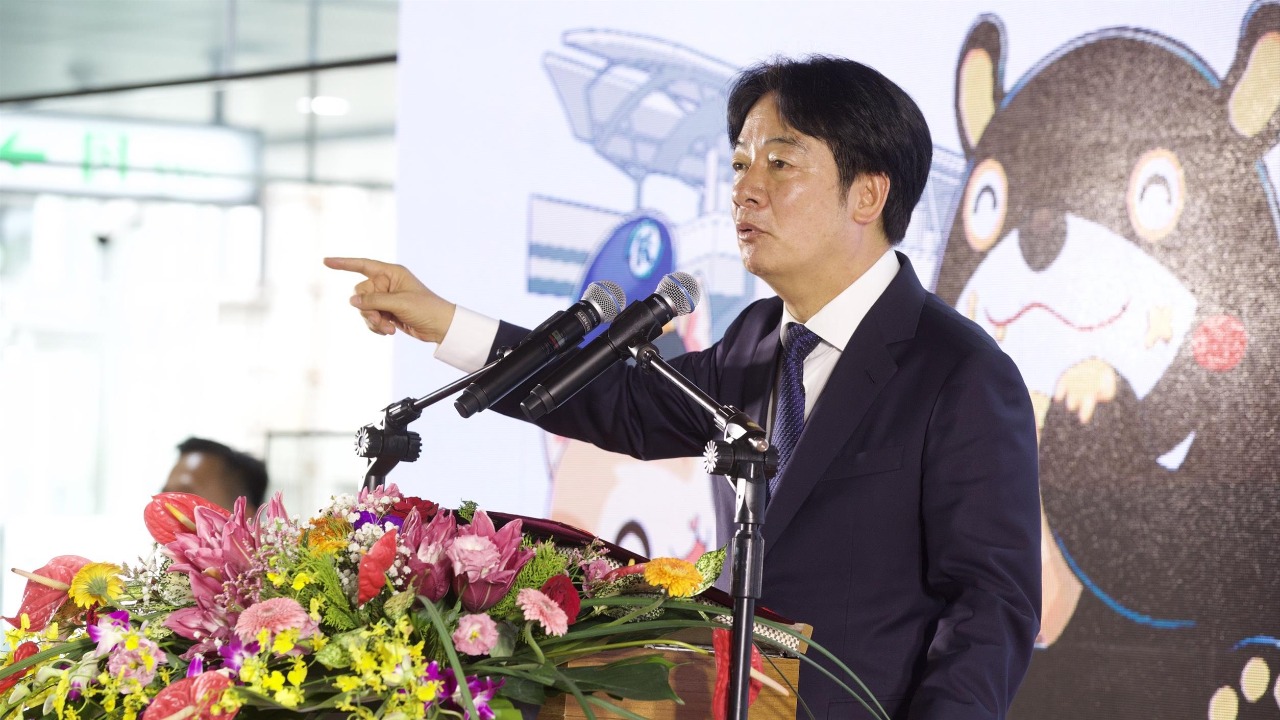
Taiwan’s new president, Lai Ching-te, is sharpening the island’s message to Beijing by pairing blunt political warnings with a fresh pledge to pour an additional 40 billion US dollars into defense. His approach signals that Taipei intends to answer mounting military pressure not with concessions, but with a long-term plan to harden its defenses and deepen ties with partners who want to keep the Taiwan Strait stable.
By casting the buildup as both a deterrent and a democratic necessity, Lai is trying to reassure Taiwanese voters while putting the onus on China for any future escalation. The scale and timing of the new spending promise, layered on top of existing budgets and special funds, show that he is betting on sustained investment rather than short bursts of emergency procurement.
Lai’s sharper tone and Beijing’s immediate backlash
Lai has moved quickly to define his presidency as one that will not soften Taiwan’s political stance in the face of Chinese pressure, even as he insists he wants to keep the peace. In his early public remarks, he has framed Taiwan as a “sovereign, independent country” and argued that only its people can decide their future, a formulation that tracks closely with his long-standing position inside the Democratic Progressive Party. That language has drawn a swift and predictable response from Beijing, which continues to label Lai a “separatist” and to insist that Taiwan is part of the People’s Republic of China, a claim Taiwan’s government rejects as incompatible with its own constitution and democratic system, as reflected in official cross-strait statements and recent coverage of his inauguration and policy speeches in early reporting.
Beijing’s reaction has not been limited to rhetoric. Chinese authorities have paired their criticism of Lai with stepped-up military and political pressure, including large-scale People’s Liberation Army air and naval activities around the island and new efforts to squeeze Taiwan’s international space. Chinese warplanes and vessels have repeatedly crossed the median line of the Taiwan Strait and entered Taiwan’s air defense identification zone, moves that Taipei’s defense ministry has catalogued in daily updates and that outside observers have tracked in detail through recent dispatches. I read Lai’s latest comments blasting Beijing’s intimidation as a deliberate attempt to frame these maneuvers as the core problem in cross-strait ties, while positioning his own defense push as a necessary response rather than a provocation.
The 40 billion dollar pledge and what it buys
The centerpiece of Lai’s security agenda is his promise to add roughly 40 billion US dollars in defense spending over the coming years, on top of Taiwan’s already rising military budget. He has presented this figure as part of a multi-year plan to modernize the armed forces, accelerate procurement, and close gaps that have worried both Taiwanese strategists and foreign partners. The pledge builds on earlier special budgets for items such as coastal defense cruise missiles and new naval platforms, and it comes as Taiwan’s regular defense allocation has already climbed to around 2.5 percent of gross domestic product, according to budget-focused reporting that tracks the island’s recent spending trajectory.
Where that extra money goes will matter as much as the headline number. Lai and his security team have signaled that they want to prioritize so-called “asymmetric” capabilities that can make any invasion or blockade attempt far more costly for China, rather than trying to match the People’s Liberation Army ship for ship or plane for plane. That means more mobile anti-ship and air defense missiles, smart naval mines, fast attack craft, and survivable command-and-control systems, along with investments in cyber defense and resilience of critical infrastructure. The outlines of this approach are visible in Taiwan’s recent purchases of systems such as Harpoon coastal defense missiles and HIMARS rocket artillery, which have been detailed in arms sale notices and Taiwanese budget documents, and Lai’s new 40 billion dollar commitment is designed to lock in that shift at scale.
China’s drills, gray-zone pressure, and the risk calculus
Lai’s tougher language and spending plans are unfolding against a backdrop of sustained Chinese military activity that has already pushed the Taiwan Strait into a more volatile phase. Chinese forces have staged multi-day exercises encircling the island, flown large formations of J-16 and Su-30 fighters near Taiwan’s airspace, and sent PLA Navy vessels through waters east of the island that were once rarely patrolled. Taiwan’s defense ministry has reported instances where more than 60 Chinese aircraft and over a dozen warships operated around the island in a single day, figures that have been corroborated in independent tallies and that underscore how routine these high-tempo drills have become.
Alongside the overt shows of force, Beijing has leaned on “gray-zone” tactics that fall short of open conflict but steadily wear down Taiwan’s defenses and morale. Chinese coast guard and maritime militia vessels have increased their presence near Taiwan-controlled islands, while cyberattacks and disinformation campaigns target government agencies and media outlets. Taiwanese officials have described these operations as part of a broader strategy to normalize Chinese pressure and test Taiwan’s responses, a view echoed in recent analyses of new Chinese maritime rules and law enforcement moves in nearby waters. When Lai blasts Beijing for “political and military intimidation,” he is speaking to this layered campaign, and his 40 billion dollar defense push is meant to convince both domestic and foreign audiences that Taiwan will not be coerced into concessions.
Domestic politics, public opinion, and the draft debate
At home, Lai must sell his defense buildup to a public that is wary of war but increasingly skeptical that China’s pressure will ease on its own. Polling over the past few years has shown strong support for maintaining Taiwan’s de facto independence and for closer security ties with the United States and other partners, even as many Taiwanese remain cautious about any move that could be seen as a formal declaration of independence. Surveys cited in recent election coverage suggest that a clear majority favors the current “status quo” while backing higher defense spending, a combination that gives Lai political space to argue that his 40 billion dollar plan is about preserving peace rather than changing Taiwan’s legal status.
The more sensitive issue is manpower. Taiwan has already extended compulsory military service for young men from four months to one year, a reform that took effect after Russia’s invasion of Ukraine jolted public debate about readiness. Lai has endorsed that shift and hinted that further changes to training and reserve mobilization are needed, but he must balance those demands against concerns about fairness and the impact on careers and education. Reporting on the conscription reform, including detailed breakdowns of training plans and public reaction in policy-focused pieces, shows that while many Taiwanese accept the need for stronger defenses, they expect the government to prove that the extra time and money will translate into real capability rather than bureaucracy.
US support, regional partners, and what comes next
Lai’s defense pledge is also calibrated for an international audience, especially in Washington and key Asian capitals that see Taiwan’s security as central to regional stability. The United States, under President Donald Trump, has continued to approve arms sales and deepen unofficial ties with Taipei, while urging Taiwan to invest more in its own defense and to focus on cost-effective systems that fit an asymmetric strategy. Recent US decisions to move forward with packages that include F-16V fighters, MQ-9B SeaGuardian drones, and additional coastal defense missiles, documented in official notifications, align closely with the priorities Lai has highlighted. By committing an extra 40 billion dollars, he is signaling that Taiwan intends to be a serious security partner rather than a passive recipient of foreign support.
Beyond the United States, Lai is looking to deepen practical cooperation with Japan, Australia, and European democracies that have grown more vocal about the risks of a Taiwan crisis. Japanese officials have repeatedly warned that “peace and stability across the Taiwan Strait” are vital to Japan’s own security, a phrase that has appeared in joint statements and in recent commentary on Tokyo’s defense white papers. European governments, while more cautious, have sent parliamentary delegations and expanded economic engagement, signaling that they see Taiwan as part of a broader contest over rules and norms in the Indo-Pacific. I see Lai’s strategy as an attempt to lock these partners into a shared expectation: that Taiwan will invest heavily in its own defense, and in return, others will treat its security as a core interest rather than a distant concern.
More From TheDailyOverview
- Dave Ramsey warns to stop 401(k) contributions
- 11 night jobs you can do from home (not exciting but steady)
- Small U.S. cities ready to boom next
- 19 things boomers should never sell no matter what

Grant Mercer covers market dynamics, business trends, and the economic forces driving growth across industries. His analysis connects macro movements with real-world implications for investors, entrepreneurs, and professionals. Through his work at The Daily Overview, Grant helps readers understand how markets function and where opportunities may emerge.

