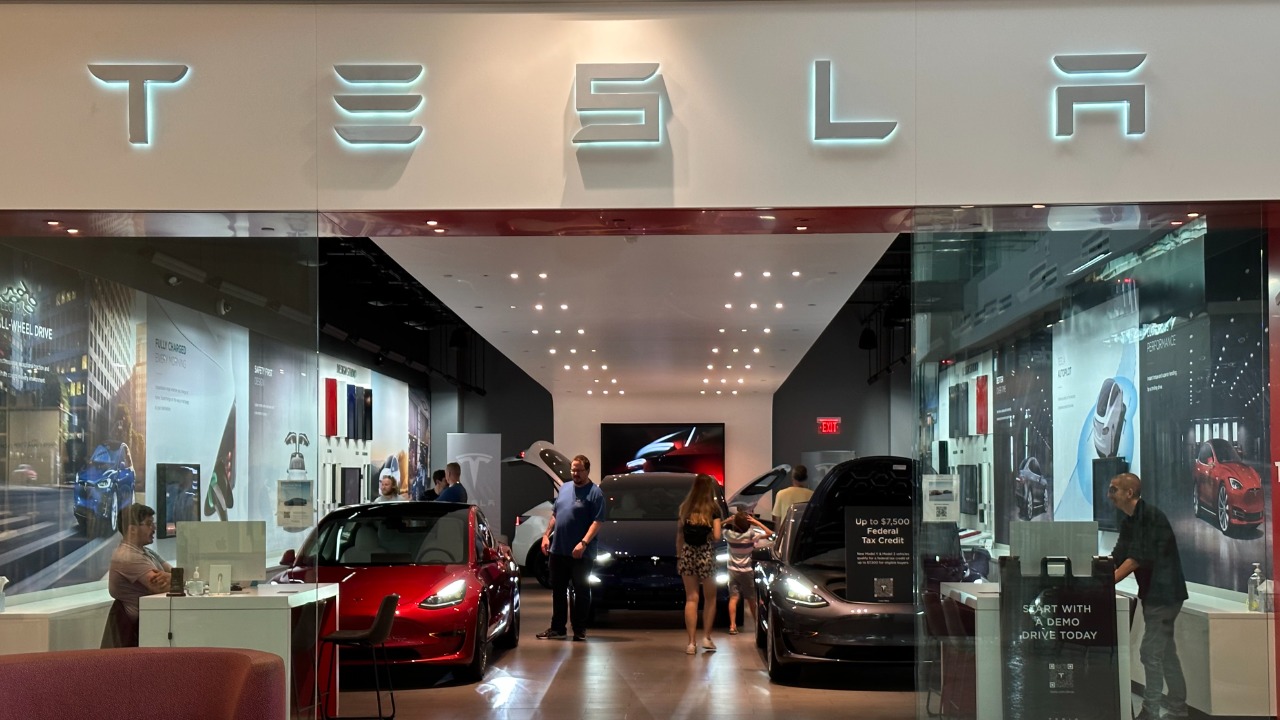
Tesla’s latest earnings have turned a long‑running success story into a warning sign for the electric vehicle boom. Profit has fallen sharply at the same time the company has ceded its long‑held lead in global EV sales, a symbolic shift that underscores how quickly the competitive landscape is changing.
Instead of debating whether Tesla can dominate the next decade of clean transport, investors and policymakers now have to ask a more basic question: can the company adapt as rivals undercut its prices, incentives shift and growth in key markets slows.
Profits plunge as growth engine stalls
Tesla’s headline number is stark: annual profit dropped 46% in the most recent year, a collapse that would be notable for any automaker and is especially jarring for a company that built its brand on hypergrowth. One detailed breakdown put total profit for 2025 at $3.8 billion, roughly half the level reported in 2024, as the company leaned on price cuts to keep factories busy while demand cooled. Another summary of the same results framed it bluntly, saying Tesla profits slumped as the company’s once‑unassailable margins eroded.
The pain was even more acute in the final quarter of the year, when the company’s net profit fell 61 percent to $840 million, dragging full‑year earnings down from $7.1 billion in 2024 to that same $3.8 billion figure. Separate tallies of the quarter’s performance describe how the electric vehicle maker earned $1.5 billion in profit on $25.5 billion in revenue, down from $2.7 billion in profit a year earlier, and another account of the same call notes that Tesla told investors its quarterly profit had fallen 55 percent.
BYD’s rise and the end of Tesla’s volume crown
At the same time its earnings engine is sputtering, Tesla has quietly lost the status that once defined it: the world’s biggest seller of electric cars. Multiple sales tallies show that China based BYD has overtaken Tesla as the top EV seller worldwide for the first time, a milestone that would have seemed unlikely when Elon Musk once laughed off the Chinese company’s prospects. A separate analysis of global deliveries describes how China based BYD now Surpasses Tesla as World Leader in Electric Car Sales, underscoring how quickly the center of gravity in the EV market has shifted toward Chinese manufacturers.
For Tesla, the loss of that volume title is more than a matter of bragging rights. One concise earnings summary framed the situation as a Topline story in which Tesla profits dropped 46 percent year over year just as it lost its crown as the top EV seller, a shift that may not immediately change the company’s day‑to‑day operations but carries clear symbolic value in the eyes of investors. Another brief, labeled as The Brief and tagged as News, stressed that the loss of leadership came out of an earnings update delivered on a Wednesday evening, reinforcing the sense that this was a turning point rather than a blip.
From premium EVs to robots and software
As its core car business comes under pressure, Tesla is leaning harder on a familiar narrative: that its future lies in software and automation rather than simply selling more vehicles. On the latest earnings call, Tesla highlighted how FSD (its supervised driver‑assistance package) is becoming a more meaningful revenue stream, with one report noting that Subscriptions Jump as the company disclosed, for the first time, how many customers are paying monthly for the service. Another detailed account of the same call describes how Tesla is trying to offset falling automotive gross margins, which slid into the mid‑teens, by pitching a future of robotaxis and humanoid robots that could, in theory, generate higher‑margin recurring revenue.
That pivot is not just rhetorical. One detailed summary of the company’s latest update notes that Tesla is ending production of some existing models and shifting more resources toward building humanoid robots, a move that signals how seriously it takes the idea of becoming an AI and robotics company. A separate recap of the same strategy shift explains that Tesla profits slumped in the same period that the company talked up its plans to hand more factory capacity over to these new products, underscoring the risk of betting on unproven lines of business while the core franchise is under strain.
Policy headwinds and the China factor
Tesla’s troubles are not unfolding in a vacuum. In the United States, President Donald Trump and Republicans in Congress have reshaped the policy environment in ways that particularly benefit Chinese competitors. One detailed account of the global EV shake‑up notes that last year Mr. Trump and his allies eliminated tax credits for many electric vehicles, a move that raised effective prices for U.S. buyers and made it harder for companies like Tesla to sustain growth without aggressive discounting. At the same time, Chinese industrial policy has continued to support domestic champions such as BYD, helping them scale production and cut costs to levels that Western rivals struggle to match.
Those dynamics are visible in Tesla’s own sales trajectory. One analysis of its latest results notes that Sales Fall Second in a row, even as revenue from services such as Supercharging fees jumped 18 percent, a sign that the company is extracting more value from its installed base while struggling to add new customers at the same pace. Another concise summary, framed as Topline news, stresses that Tesla is now navigating a world in which its profit engine is weaker, its policy tailwinds are diminished and its most aggressive competitors are headquartered in China.
What the reset means for investors and the EV transition
For investors, the numbers add up to a fundamental reset of expectations. One detailed breakdown of the year’s results, headlined around how Tesla Profit Crashes, emphasizes that the company’s earnings are now more volatile and more dependent on price cuts and incentives than in the past. Another concise summary, presented as The Brief, underscores that the 46 percent drop in profit and the loss of the top‑seller crown arrived together, a pairing that helps explain why the stock has been so sensitive to each new data point about deliveries and margins.
For the broader EV transition, Tesla’s stumble is a reminder that even market‑making companies are not guaranteed smooth sailing. One account of the latest earnings call notes that FSD subscriptions and other software‑driven revenue lines are growing, but another detailed summary of the quarter’s results, which describes how Tesl reported a 55 percent drop in quarterly profit, shows how far those new businesses still have to go before they can fully offset the pressures on the core automotive line. Another recap of the same quarter, which notes that the electric vehicle maker earned $1.5 billion on $25.5 billion in revenue, underlines the same point: this is still, overwhelmingly, a car company, and its ability to fund ambitious bets on robots and autonomy will depend on how quickly it can stabilize that core business.
More From TheDailyOverview
*This article was researched with the help of AI, with human editors creating the final content.

Grant Mercer covers market dynamics, business trends, and the economic forces driving growth across industries. His analysis connects macro movements with real-world implications for investors, entrepreneurs, and professionals. Through his work at The Daily Overview, Grant helps readers understand how markets function and where opportunities may emerge.