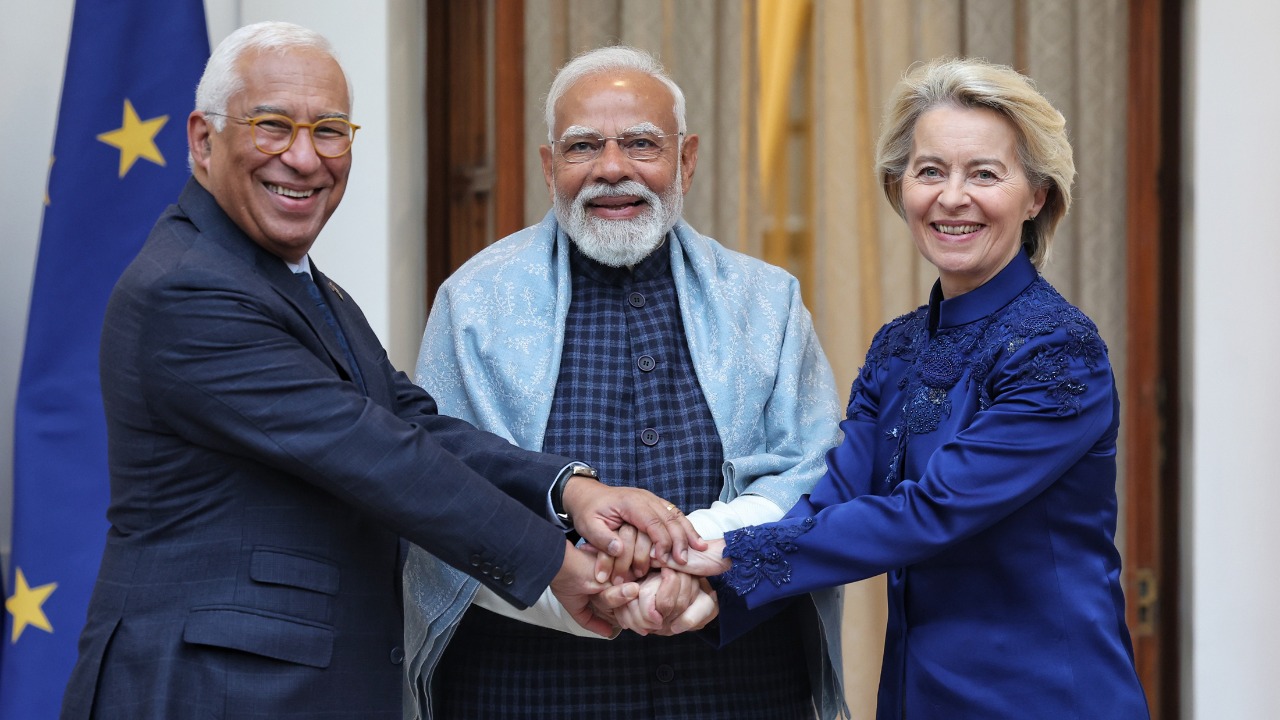
The world’s biggest trade deals of 2026 are being signed without Washington at the table, and that is not a coincidence. From a vast India–EU pact to new agreements linking Canada and China, major economies are wiring together alternative trade routes while the United States leans on tariffs and one-off bargains.
What is taking shape is not just a flurry of contracts but a structural shift in how power is exercised in the global economy. I see a pattern in which allies and “middle powers” hedge against U.S. unpredictability, build their own networks, and quietly test what a trading system looks like when the United States is no longer the central architect.
India and Europe’s ‘mother of all deals’ rewrites the map
The clearest symbol of this shift is the new free trade agreement between India and Europe, described by leaders on both sides as a once in a generation breakthrough. The pact creates a market worth roughly 27 trillion dollars in combined gross domestic product and covers a free trade area of about two billion people, a scale that would normally feature the United States at its core but now does not. European Commission officials, including President of the European Commission Ursula von der Leyen, have embraced the deal as a strategic anchor for supply chains and energy security, while Indian leaders frame it as proof that New Delhi can secure top tier access to Western markets on its own terms, without waiting for Washington to move first, as detailed in reporting on the Tuesday.
European leaders have leaned into the drama, with President of the European Commission Ursula von der Leyen publicly hailing a “mother of all deals” and analysts at one Atlantic think tank noting that the superlative is “Trumpian” in style even though the agreement does not involve the United States at all. Coverage of the accord from Brussels, including dispatches that begin with a stark “BRUSSELS, In the latest display of major economies pursuing blockbuster free trade deals against the backdrop of President Donald Trump,” underscores that this was negotiated in explicit contrast to Washington’s tariff heavy posture, as seen in accounts of how India and Europe, both stung by Trump’s earlier trade moves, turned to each other in a landmark pact described as the What comes next for a two billion person market.
Canada, China and the rise of U.S.-free trade corridors
The India–EU deal is not an isolated case, it is part of a cluster of large agreements that have all taken shape without U.S. participation. Earlier this year, Canada concluded a new trade deal with China, a striking choice for a close U.S. ally that is also a core partner in the United States–Mexico–Canada Agreement, and one that signals Ottawa’s determination to diversify away from a single dominant market. Reporting on how Canada recently cut a new deal with China, alongside a separate pact between the EU and South American partners, has been cited as evidence that “new trade deals show the global economy is realigning without the U.S.,” a phrase that captures how these corridors are being built around Washington rather than through it, as described in analysis of New alignments.
Those choices are not cost free for Washington. When India and Europe sealed their agreement, it was described in multiple accounts as just the latest in a string of major 2026 trade announcements that did not involve the U.S., a list that also includes Canada’s outreach to China and other regional compacts. One widely cited summary put it bluntly, noting that “All the biggest trade deals so far in 2026 don’t involve the US” and highlighting how a European deal with India was being billed as “the most historic free trade agreement” while Washington focused on tariffs and threats, a framing echoed in coverage that emphasized how India and Europe had moved ahead even as U.S. talks on a separate deal stalled, as reflected in the description of All the major pacts.
Tariffs, mini deals and a U.S. strategy that looks small
While others sign sweeping free trade agreements, the United States has doubled down on tariffs and narrow bargains, a strategy that may deliver short term leverage but leaves it outside the new architecture. Official guidance on international trade notes that in section 1.2, “Free Trade Agreements,” The United States maintains FTAs with 20 countries, including Australia, Bahrain, and Canada and Mexico through the USMCA, but it also stresses that after proclaiming various tariff actions referenced in section 2.3 of the same framework, Washington has shifted toward using duties as a primary tool rather than negotiating new comprehensive pacts, a pattern laid out in the Free Trade Agreements section.
President Donald Trump has leaned into that approach with a series of targeted tariff arrangements that are far smaller than the India–EU deal or Canada’s agreement with China. A real time tracker of Trump’s trade actions notes in its Latest blog updates that The United States announced a new tariff deal with Chinese Taipei on 15 January 2026, alongside other moves involving partners such as the Philippines and Pakistan, illustrating a preference for narrow, transactional accords over broad liberalization, as catalogued in the Latest updates.
Trade specialists argue that this leaves Washington playing a different game from its partners. Edward Alden, a senior fellow at CFR who focuses on U.S. competitiveness, has pointed out that Here the rule of thumb is that countries are increasingly writing the rules without waiting for the United States, and that the Trump actions to date have encouraged others to hedge by deepening ties among themselves rather than relying on U.S. market access, a judgment captured in his overview of Here are the trade trends to watch.
Middle powers test a ‘GLOBAL TRADE ORGANIZATION’ without Washington
Behind these deals is a deeper political recalibration by so called middle powers that are wary of overdependence on any single giant, including the U.S. and China. From Davos, one influential observer described how governments are effectively sketching out a “GLOBAL TRADE ORGANIZATION” of their own, with new agreement and dispute settlement systems that sit alongside, and sometimes outside, the World Trade Organization, a trend that reflects both frustration with U.S. tariff coercion and concern about China’s export dominance, as reported in analysis of how countries are GLOBAL trade rules.
The India–EU accord is a case study in that hedging logic. Detailed accounts describe how American tariff coercion and China’s export dominance pushed Brussels and New Delhi to wrap up the elusive accord, with negotiators in Brussels and New Delhi explicitly seeking to “close ranks” against both Trump and Xi. One live blog on Trump tariffs framed the India–EU agreement as a rebuff to Trump that followed Canada’s trade deal with China, while another summary of all the biggest trade deals so far in 2026 stressed that a new trade deal between India and Europe was just the latest pact announced in less than a month that did not involve the U.S., a pattern that has drawn a furious response from President Trump, as captured in coverage of how India and Europe have India and Europe are repositioning.
North America’s USMCA review shows the limits of going it alone
Even in North America, where the United States remains deeply integrated with its neighbors, the big structural process of 2026 is not a new U.S. led trade initiative but a mandatory health check on an existing pact. The Issue, as one policy analysis puts it, is that The United States–Mexico–Canada Agreement, or USMCA, the backbone of North America’s competitiveness, will undergo a formal review in July 2026 that could lead to its extension, modification of arrangements, or expiration in 2036, a reminder that Washington’s most important trade framework this year is defensive rather than expansionary, as outlined in the USMCA review.
More From TheDailyOverview
*This article was researched with the help of AI, with human editors creating the final content.

Grant Mercer covers market dynamics, business trends, and the economic forces driving growth across industries. His analysis connects macro movements with real-world implications for investors, entrepreneurs, and professionals. Through his work at The Daily Overview, Grant helps readers understand how markets function and where opportunities may emerge.

