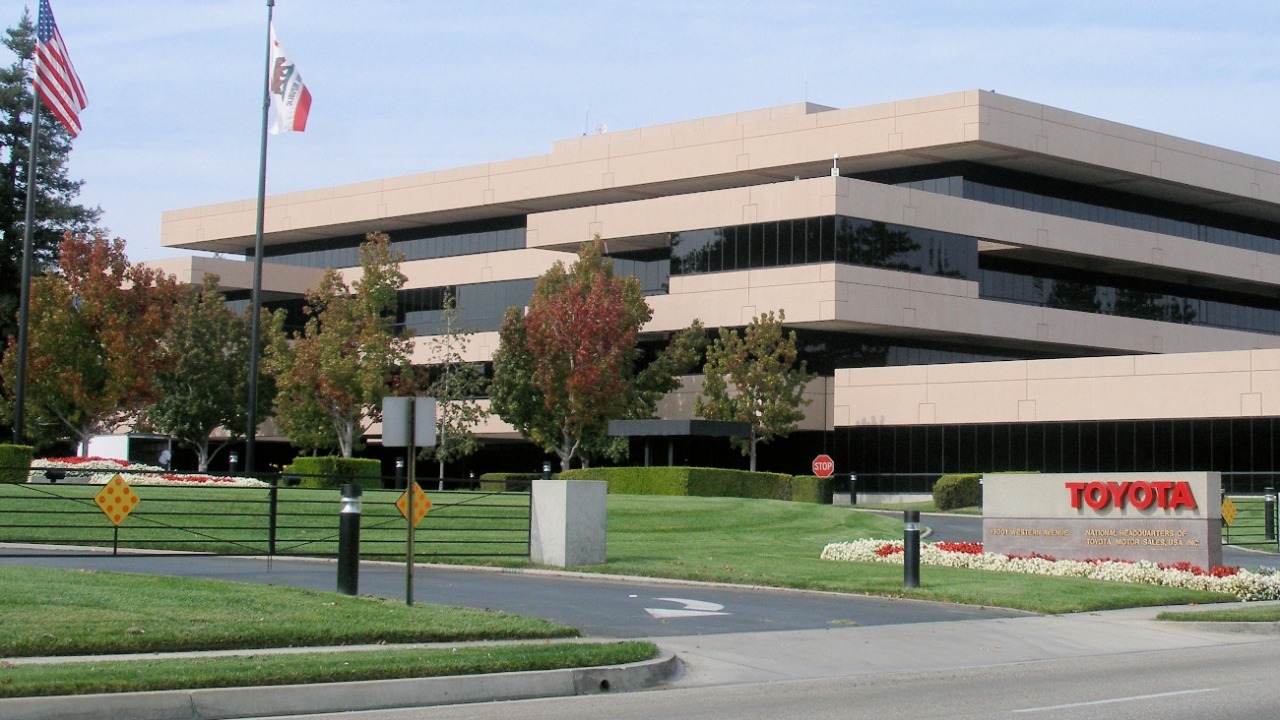
Toyota, the world’s largest automaker by volume, sold only a sliver of battery-electric vehicles relative to its massive global output in 2024, even as competitors raced to scale EV production. The gap is not accidental. It reflects a deliberate corporate strategy that prizes hybrids and a spread of powertrain technologies over a singular bet on battery EVs, a choice now colliding with tightening emissions rules and aggressive Chinese competition.
A Fraction of Sales Are Pure Electric
Toyota’s own production and sales data tells the story bluntly. The company’s BEV volumes remain small relative to its total sales and to peers, according to its 2024 global figures. In the United States, the picture is similar: Toyota’s electrified sales growth has been driven largely by hybrids and plug-in hybrids, with only limited BEV contribution, including modest performance from the bZ4X, according to Toyota Motor North America’s 2024 results. The company can accurately claim “electrified” leadership in total volume, but that label masks how little of its mix is fully electric.
That distinction matters because the global EV race is increasingly defined by pure battery-electric output. China dominates global EV manufacturing, sales, and trade dynamics, according to the International Energy Agency. Toyota’s product mix and Japan’s broader market split differ sharply from the BEV-heavy strategies pursued in China and parts of Europe, a structural gap the IEA’s analysis of regional electric car trends makes clear. While BYD and Tesla expanded BEV deliveries at scale, Toyota remained anchored in a transitional powertrain portfolio.
The Multi-Pathway Bet and Its Payoff
Toyota’s position is not born of neglect or confusion. The company’s detailed strategy in its fiscal 2024 SEC filing shows it intentionally prioritized hybrids, plug-in hybrids, fuel-cell vehicles, and what it calls a “multi-pathway” approach over rapid BEV adoption. The rationale, spelled out on Toyota’s own sustainability page, frames hybrids and PHEVs as necessary during the transition period. Toyota argues it is smarter to build multiple hybrids, each cutting emissions relative to conventional gasoline models, rather than concentrating limited battery supplies into fewer fully electric cars, as CleanTechnica has described in its coverage of the company’s strategy debate. With battery supplies still constrained globally, the company treats this as pragmatic resource allocation rather than technological foot-dragging.
That math has been financially rewarding. Toyota’s April-through-December 2024 financial results showed strong operating income, buoyed by hybrid demand across multiple regions and by the ability to sell those vehicles at prices that preserve margins. Hybrid production requires less retooling and capital per unit than a full BEV platform shift, and it avoids the pricing and margin compression that has squeezed EV-focused competitors facing discount wars. But this financial comfort creates its own risk: the longer Toyota profits from hybrids, the less urgency it faces to build out BEV manufacturing at the speed regulators and competitors now demand. The U.S. Environmental Protection Agency’s transportation emissions data underscore that road vehicles remain a leading source of greenhouse gases, and the Biden administration’s nationwide charger buildout signals a policy environment that will increasingly reward zero-emission vehicles over partial solutions.
Delays in U.S. EV Production
The clearest sign of Toyota’s slower BEV timeline came in October 2024, when the company told suppliers it would push back the start of its first U.S.-built battery EV to 2026, according to Reuters reporting on Nikkei’s initial account. The delayed production was attributed to slowing EV sales growth in the U.S. and concerns about near-term demand. Toyota had previously announced a $1.3 billion investment at its Georgetown, Kentucky, factory to build battery packs and a new electric SUV, and it is ramping up lithium-ion battery production at a separate facility in North Carolina. But the Kentucky plant’s production start slipped, leaving Toyota without a domestically assembled BEV in the U.S. market while rivals expand their lineups and position themselves for federal incentives tied to local manufacturing.
For consumers and dealers, the delay means Toyota’s American BEV offerings remain limited to imports like the bZ4X for the near term, at a moment when competitors are filling more showroom segments with electric pickups, crossovers, and entry-level models. The company has stated BEV rollout targets including multiple dedicated platforms, around 10 models, and ambitions of roughly 1.5 million BEV sales globally by the middle of the decade, but the U.S. delay raises questions about how much of that volume will be sourced from North American plants versus factories in Japan or other regions. It also complicates dealer planning: retailers that have invested in chargers and training to prepare for a broader BEV lineup must continue relying on hybrids to meet customer demand for lower-emission vehicles, reinforcing Toyota’s existing sales mix rather than accelerating its transition.
Regulatory Pressure and Carbon Timelines
The tension between Toyota’s hybrid-heavy strategy and long-term climate goals becomes sharper when viewed against decarbonization roadmaps. The International Energy Agency’s work on transport systems emphasizes that meeting global climate targets requires a rapid shift away from internal combustion engines, even when they are paired with hybridization. In its sustainable development scenario, the IEA’s projections of CO₂ reductions show steep declines in emissions from road vehicles over the coming decades, driven largely by direct electrification and cleaner electricity generation. Hybrids can play a bridging role, but the pathway ultimately points toward a fleet dominated by zero-emission vehicles rather than incremental efficiency gains.
U.S. policy is moving in the same direction, even if implementation is uneven. The EPA’s transportation data illustrates how much of the country’s climate challenge is wrapped up in cars, SUVs, and trucks, and federal support for charging infrastructure is designed to remove one of the main barriers to BEV adoption. As the national fast-charging network expands and state-level mandates for zero-emission vehicle sales tighten, automakers that lag in BEV offerings risk facing compliance costs, lost market share, or both. For Toyota, this means its multi-pathway narrative must eventually converge with a regulatory reality that treats hybrids as a useful but insufficient step on the road to full electrification.
Strategic Risks and Possible Pivots
Toyota’s leadership argues that its diversified approach reduces risk by avoiding a single-technology bet, and there is some evidence to support that view. In markets where charging infrastructure is sparse or grid reliability is weak, hybrids can deliver meaningful fuel savings and emissions cuts without demanding major lifestyle changes from drivers. The company’s scale in hybrid components also gives it cost advantages that competitors struggle to match. Yet the same diversification can dilute focus. While BEV specialists refine software, batteries, and manufacturing at high volumes, Toyota must spread engineering resources across combustion engines, hybrid systems, hydrogen fuel cells, and emerging solid-state batteries, potentially slowing its learning curve in any one area.
The company does have room to pivot more aggressively if conditions change. Its global footprint, supplier relationships, and financial strength could support a faster BEV ramp once management is convinced that demand, regulation, and infrastructure are aligned. A more decisive shift would likely involve reallocating capital expenditure from legacy engine programs into dedicated EV platforms, accelerating battery capacity build-out, and using its popular hybrid nameplates as stepping stones to all-electric successors. Whether Toyota chooses that path soon will determine if its current strategy looks, in hindsight, like prudent caution during a turbulent transition, or a costly delay that left it scrambling to catch up in a market that moved faster than its models did.
More From The Daily Overview
*This article was researched with the help of AI, with human editors creating the final content.

Grant Mercer covers market dynamics, business trends, and the economic forces driving growth across industries. His analysis connects macro movements with real-world implications for investors, entrepreneurs, and professionals. Through his work at The Daily Overview, Grant helps readers understand how markets function and where opportunities may emerge.