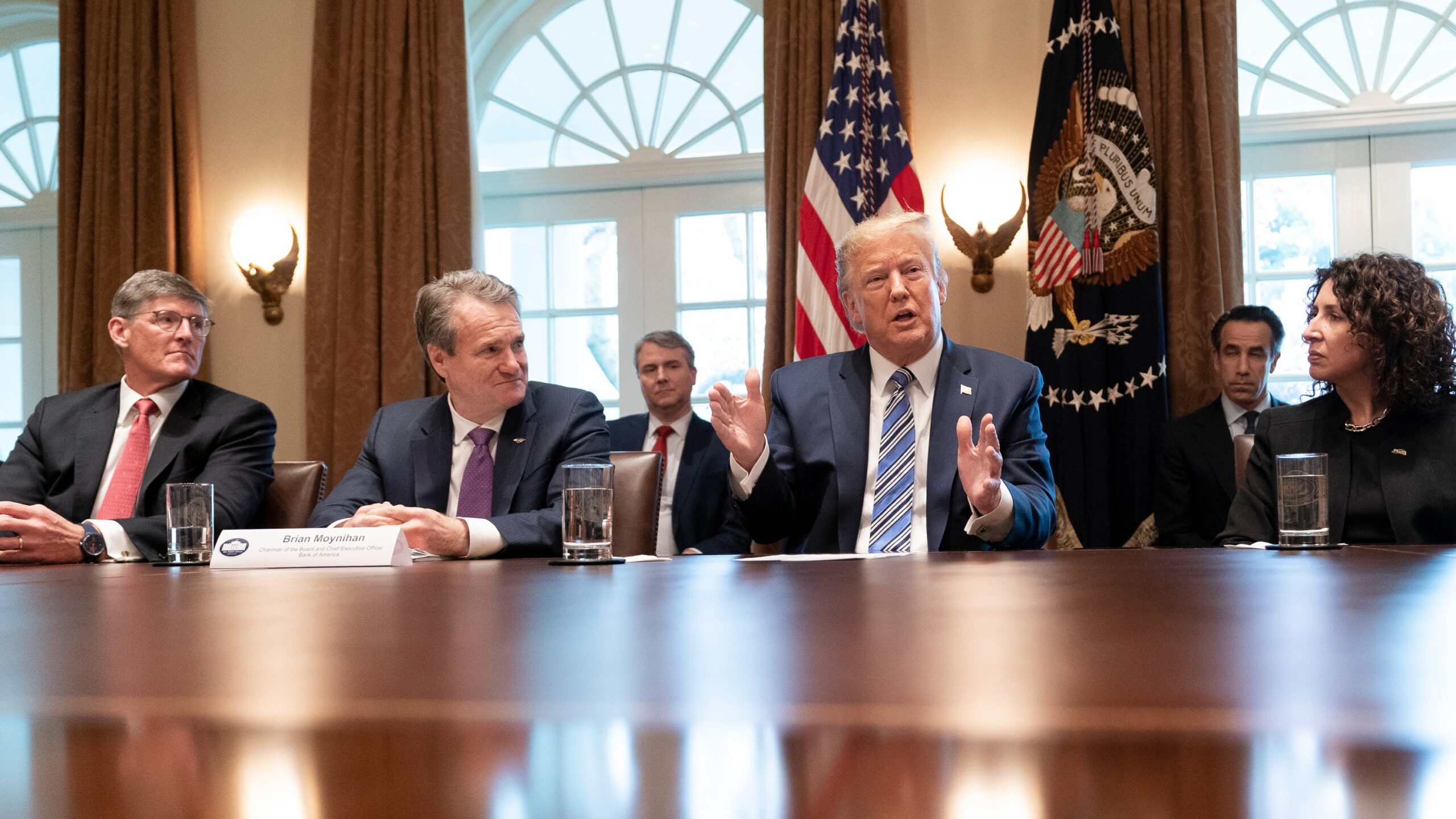
The decision to leave Bank of America chief executive Brian Moynihan off the guest list for a Trump reception in Davos turned a private slight into a very public signal. What might once have been dismissed as a scheduling quirk now looks like a deliberate escalation in a long running clash between the White House and some of the country’s most powerful financiers. The fallout is rippling across Wall Street, where executives are recalibrating how close they want to stand to a president who is increasingly willing to single out individual bankers by name.
At stake is more than one CEO’s pride. The Moynihan episode crystallizes a broader struggle over political loyalty tests, “debanking” accusations and regulatory threats that is reshaping how big banks navigate Washington. It is also exposing a split inside the financial industry itself, between those who lean into the Trump era and those who are trying to keep a lower profile.
The Davos snub that set off alarms
The immediate flashpoint was a reception hosted by President Trump on the sidelines of the World Economic Forum in Davos, where the absence of Brian Moynihan, the boss of the nation’s second largest bank, was impossible to miss. According to detailed accounts of the event, the presidential gathering brought together a select group of global executives, yet Moynihan, who runs Bank of America, was not invited, even as other Wall Street leaders circulated in the room. The episode, described as a widening rift in coverage that listed it among the day’s Top Stories, underscored how personal the relationship between the president and individual bankers has become.
The snub did not occur in a vacuum. Reports from Davos described how the exclusion unfolded on a Wednesday evening, with other American finance chiefs in attendance while Moynihan was left out of the room. His omission, highlighted in one account as part of a broader Davos scramble among corporate leaders to manage their exposure to Trump, was portrayed as a pointed message rather than an oversight. The same reporting that detailed the Wednesday reception also framed the incident as part of a “widening rift,” a phrase that has quickly become shorthand for the deteriorating ties between the president and one of the country’s most important bankers, and it emphasized how Moynihan’s omission became a talking point among attendees.
A second slight and a deepening personal rift
What makes the Davos episode more consequential is that it was not the first time Brian Moynihan found himself on the outside looking in. Earlier, the Bank of America CEO had already been left off the guest list for a high profile White House dinner with Wall Street executives, a gathering that brought together leading financiers for an evening with Trump. That earlier decision to exclude the CEO of the United States’ second largest lender was widely read as a warning shot, and later coverage of the Davos reception explicitly noted that the Swiss snub was the second time Moynihan had been frozen out of a marquee event with the president, a pattern that, as one analysis put it, “hints at a deeper rift” between the two men and the institution he leads, a point underscored in reporting that quoted Akila Quinio.
The earlier White House episode was itself rooted in controversy. Trump had already publicly clashed with Bank of America over allegations that conservative customers were being “debanked,” and sources described how the president pointedly left out CEO Brian Moynihan from a dinner for Wall Street leaders at the White House. That event, which brought together a who’s who of finance, was framed as a reward for executives seen as aligned with the administration, and the absence of the Bank of America chief stood out. Accounts of the dinner stressed that Trump’s decision to snub the CEO followed the uproar over alleged account closures and that the White House guest list was used to send a message to Wall Street about the political costs of crossing the president.
From “debanking” fights to legal warfare
The Moynihan feud is part of a broader campaign by Trump to pressure large financial institutions over what he and his allies describe as ideological discrimination. Bank of America and JPMorgan Chase have both been accused by conservative activists of refusing to do business with some right leaning clients, allegations the banks have rejected. In response to those claims, Bank of America and Chase have insisted that political affiliation has no bearing on which customers they serve, but the president has continued to spotlight the issue.
Trump’s willingness to escalate these disputes has gone beyond rhetoric. In Miami-Dade court he has launched a $5 billion lawsuit against JPMorgan and its longtime chief Jamie Dimon, a move he first previewed in a post on his social media platform, where he wrote on Truth Social Saturday that he would be suing JPMorgan Chase over what he described as unfair treatment. The suit, which JPMorgan has said has no merit, marks a rare instance of a sitting president directly suing a major bank and its CEO, and it has further chilled relations between the administration and parts of the financial sector. Coverage of the case has emphasized how Trump used Truth Social Saturday to preview the legal action before it was filed.
Jamie Dimon walks a tightrope in Davos
Jamie Dimon has taken a different tack from Brian Moynihan, opting to engage directly with Trump even as tensions rise. In Davos, Dimon publicly described himself as a “globalist,” a label that has often been used as a political insult in nationalist circles, while also acknowledging that he had met with Trump twice over a short period to discuss policy. Those meetings came as the administration floated a cap on credit card interest rates as part of a broader push on affordability, a proposal that would directly affect JPMorgan’s massive card business. Accounts of the Davos conversations noted that Dimon used the opportunity to warn about unintended consequences of aggressive caps, even as he tried to keep lines of communication with Trump open.
Dimon’s balancing act has not insulated him from the broader storm. The same president who has met him privately and whose officials are weighing his input on credit card rules is also suing his bank for billions of dollars, a contradiction that underscores how volatile the relationship between the White House and Wall Street has become. For other executives watching from the sidelines, the spectacle of a CEO being courted for policy advice in Davos while simultaneously fighting a massive lawsuit in Miami-Dade court is a reminder that proximity to power in this environment carries real legal and reputational risks. It also highlights how figures like Dimon are being forced to navigate a political landscape where yesterday’s ally can quickly become today’s adversary.
Wall Street’s era of self-censorship
The Moynihan and Dimon sagas are feeding into a broader mood of caution across the financial industry. At Davos, one senior analyst at a United States investment bank, who was not authorized to speak publicly, described how the possibility of a presidential broadside now hangs over every public comment. That person said Trump’s potential criticism is at the back of their mind whenever they speak about markets or policy, a sentiment that reflects a wider pattern of self censorship on Wall Street. The same reporting noted that this analyst was careful to keep both their firm and colleagues in mind when weighing how to talk about Trump in public forums.
More From TheDailyOverview
*This article was researched with the help of AI, with human editors creating the final content.

Grant Mercer covers market dynamics, business trends, and the economic forces driving growth across industries. His analysis connects macro movements with real-world implications for investors, entrepreneurs, and professionals. Through his work at The Daily Overview, Grant helps readers understand how markets function and where opportunities may emerge.