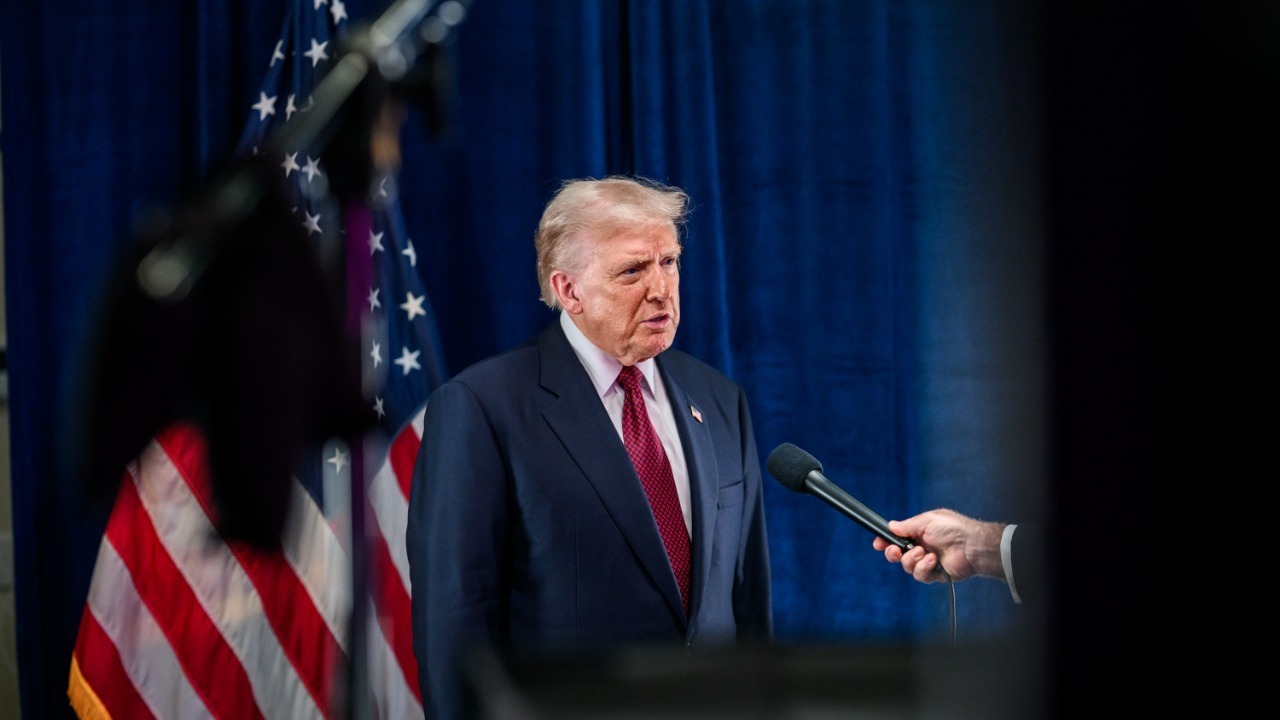
Political risk is no longer a background worry for global markets, it is the story. As President Donald Trump settles into his second term, the swirl of tariffs, personnel shocks and foreign policy gambits is already eroding the sense that U.S. assets are the world’s safest default. The result is not a sudden stampede out of America, but a steady, unnerving shift in how capital is priced, hedged and deployed.
Faith in the United States as a predictable anchor for global portfolios is being tested in real time. From the dollar’s slide to the rise of “Sell America” trades, investors are treating Washington as a source of volatility rather than a stabilizer, and Trump 2.0 is at the center of that reassessment.
From “risk-free” to “political risk premium”
For decades, investors treated U.S. Treasurys and blue chip stocks as the closest thing to a risk-free asset, but the Trump 2.0 era is forcing a repricing. Analysts now talk explicitly about a political risk premium on U.S. assets, a shift captured in detailed work on Political dynamics and capital flows. In that analysis, the figure 47 is used to illustrate how quickly sentiment can swing when policy surprises hit. I see that as emblematic of a broader pattern, where each new headline from Washington is treated less as noise and more as a tradable shock.
The shift is visible in benchmark indices as well as in currency markets. One influential review of global positioning notes that the S&P 500 has risen by about 15 percent over the past year and even touched record highs, yet the same work stresses that allies and asset managers are not “selling” America so much as hedging it. That distinction matters. It means investors are still participating in U.S. growth, but they are pairing those bets with insurance against policy shocks that originate in the Oval Office.
The “Sell America” trade and a sliding dollar
Nowhere is the erosion of confidence clearer than in the currency market, where “Sell America” has become a shorthand for a cluster of trades. Detailed reporting on this trend shows that Investors are increasingly souring on the United States, pointing to a weakening dollar, a stalled stock market in some sectors and rising Treasury yields as signs that political turbulence is feeding into asset prices. I read that as a warning that the traditional “safe haven” status of U.S. paper is no longer automatic.
Other data points reinforce the story. One widely cited analysis notes that Since its peak in mid January the dollar has fallen by more than 9 percent against a basket of major currencies, and And the yield on ten year Treasurys has climbed in tandem. That combination, a weaker currency and higher borrowing costs, is exactly what you would expect if global buyers are demanding compensation for political uncertainty.
Tariffs, Greenland and the third wave out of the dollar
Trump’s trade policy is the most visible channel through which politics is shaking market confidence. Analysts tracking the second term describe how Trump’s tariff threats, including a Trump move tied to Greenland, have helped trigger what one account calls a “third wave” out of the dollar after Western governments froze Russian assets in 2022. When a single presidential comment about a territory like Greenland can move currency markets, it underlines how tightly political theater and portfolio decisions are now intertwined.
Professional investors are trying to map these shocks into strategy. A detailed set of Key takeaways on Trump in 2026 argues that Trump trade policies dominated headlines and roiled markets in 2025, and that in 2026 his proposals targeting affordability and foreign policy are again central to asset allocation. A companion analysis framed as Key guidance for European advisers makes the same point: tariffs and executive use of tools like the International Emergency Economic Powers Act are now core inputs in cross border risk models, not footnotes.
Markets are up, but nerves are frayed
One of the paradoxes of Trump 2.0 is that headline economic data still look solid even as political anxiety rises. An interactive tracker of the U.S. economy under Donald Trump notes that 378 days into his term the unemployment rate stands at 4.4%, Bitcoin is down 26.8% since he took office and the S&P 500 is up 14 percent. Those are not the numbers of an economy in crisis, yet they coexist with a pervasive sense that politics could knock the expansion off course at any moment.
Sector level analysis points to similar cross currents. A review of the stock market under Trump highlights how Tax policy has been a Tailwind even as deficits widen, and that Rising tariff revenues may partially offset those gaps. At the same time, strategists warn that the second year of a presidency often brings more volatility, a point echoed in a separate assessment of how history in President Trump’s second year might worry some investors even if markets ultimately defy the pattern.
Dollar “yo-yo,” Fed drama and the search for havens
Currency volatility is another channel through which Trump 2.0 is unsettling global portfolios. One detailed account describes how Trump’s rhetoric and policy shifts have turned the dollar into a “yo yo,” with one strategist expecting clients to reorient their portfolios to overweight export oriented U.S. stocks as a hedge against swings in the greenback. That same analysis notes that Since the market bottomed, investors have been forced to think harder about currency risk when buying American equities.
Monetary policy is amplifying those concerns. A recent breakdown of the Major Takeaways from Trump’s latest central bank move notes that Donald Trump has selected a new chairman of the Federal Reserve, and that Kevin Warsh plans to lower interest rates and support a weaker dollar. That follows years in which markets had to digest Trump’s public pressure on Federal Reserve Chair, and even military moves in Venezuela, with one video analysis arguing that markets have sometimes shrugged off those actions but cannot ignore them indefinitely.
More From TheDailyOverview
*This article was researched with the help of AI, with human editors creating the final content.

Grant Mercer covers market dynamics, business trends, and the economic forces driving growth across industries. His analysis connects macro movements with real-world implications for investors, entrepreneurs, and professionals. Through his work at The Daily Overview, Grant helps readers understand how markets function and where opportunities may emerge.

