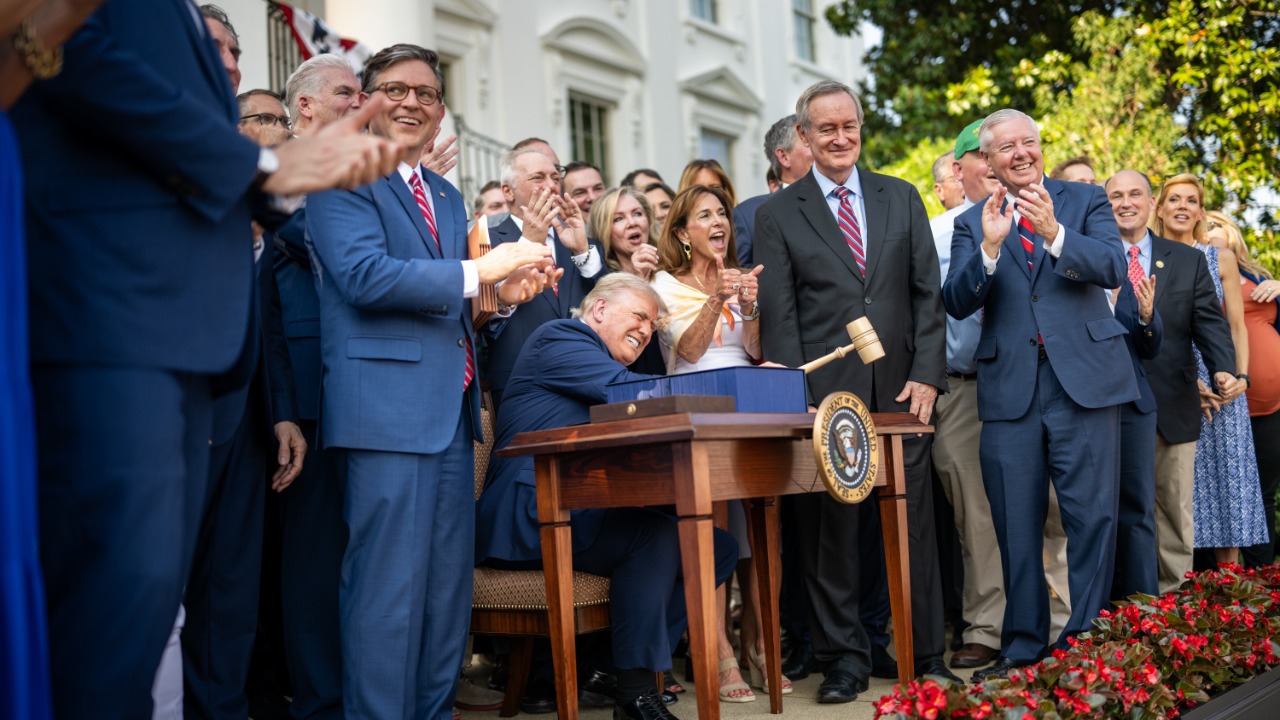
President Donald Trump is wagering that the most generous tax refund season in U.S. history will double as a campaign message, turning the One Big Beautiful Bill into a tangible payoff for voters. The administration is touting projections that refunds could reach between $1,000 and $2,000 per household and pump roughly $65 billion into the economy, a scale that would rival past stimulus efforts while leaning heavily on the tax code rather than direct checks. The political bet is that a spring windfall will soften economic anxiety ahead of the next election, even as some of Trump’s own allies warn the effect could fade long before voters reach the ballot box.
The strategy hinges on timing and perception as much as on raw dollars. Bigger refunds can feel like a raise, especially for households that have been squeezed by higher prices and uneven wage gains, but they are also a backward-looking measure of what taxpayers already earned and paid. If the money lands in bank accounts just as families are catching up on rent, medical bills, or credit card balances, the short-term relief may be real while the political gratitude is fleeting.
How Trump’s “One Big Beautiful Bill” rewired the 2026 tax season
The One Big Beautiful Bill reshaped the 2026 filing landscape by combining rate cuts, new deductions, and inflation adjustments into a single package that the White House now brands as proof of Trump’s economic stewardship. Administration materials highlight that total taxpayer savings could amount to tens of billions of dollars, with officials framing the law as a way for Jan workers and retirees to keep more of what they earn and to see that benefit show up in their refunds rather than only in each paycheck. That framing is central to the political pitch: the refund becomes a once-a-year reminder of presidential action, not a diffuse trickle that is easy to overlook.
Republican tax writers have echoed that message, describing the 2026 filing year as a Big moment when the doubled standard deduction and lower tax rates fully filter through withholding tables. The Internal Revenue Service has reinforced the structural shift, noting that for tax year 2026 the standard deduction will be $24,150 for many filers under the One, Big, Beautiful Bill. That higher threshold means millions of households will no longer itemize, simplifying returns while also changing who benefits most from the law’s more targeted breaks.
The mechanics behind “largest refund season in history”
Behind the political slogans sits a fairly technical story about withholding, brackets, and inflation. After the law passed, the Treasury Department adjusted how much tax employers take out of paychecks, deliberately erring on the side of slightly higher withholding so that many workers would be more likely to receive a refund rather than owe money in April. Economists and financial analysts now expect 2026 to mark an unprecedented year for refunds, with Jan projections from administration officials suggesting total taxpayer savings could reach record levels once all returns are processed.
Independent estimates point in the same direction, though with more nuance. One analyst, Besse, has said, “I think we’re going to see $100 [billion]-$150 billion of refunds, which could be between $1,000 and $2,000 per household,” arguing that such a surge could give families breathing room and help them have a more secure future, according to Dec reporting. The White House has amplified similar figures, with Jan materials asserting that total taxpayer savings could amount to historic levels of relief in 2026, a claim that underpins the president’s frequent references to delivering the largest refund season in U.S. history in USA, TODAY communications.
Who actually gets the money?
For all the talk of averages, the distribution of refund gains is anything but even. Bank of America Global Research has estimated that Trump is giving the U.S. economy a $65 billion tax refund shot in the arm, mostly for higher-income people, suggesting that the largest checks will flow to households that already have more financial cushion. According to that analysis, the U.S. economy is bracing for a “K-shaped” pattern in which wealthier taxpayers reap most of the benefits while lower earners see more modest changes, a dynamic highlighted in Feb research. That tilt reflects both the structure of the bill and the reality that higher earners pay more in federal income tax to begin with.
Middle-income households still stand to benefit, particularly from the higher standard deduction and expanded state and local tax relief. For 2025, the standard deduction increased to $15,750 for single filers and $31,500 for married couples filing jointly, a change that set the stage for the even larger 2026 thresholds described by the IRS and detailed in Jan coverage of who could see a bigger tax refund in 2026. At the same time, the cap on deducting state and local income or general sales taxes jumps to $40,000 for some filers, a change that particularly helps upper-middle-class homeowners in high-tax states, as outlined in Feb reporting. That mix of broad and targeted benefits is likely to shape how different income groups perceive the law’s fairness.
Refunds, tariff checks, and the risk of mixed messages
The refund strategy does not exist in a vacuum. It is unfolding alongside a separate, more controversial idea: a proposed $2,000 tariff dividend check that Trump has floated as a way to return revenue from his trade policies directly to households. The concept has generated confusion among taxpayers who are already trying to track their refunds and now wonder whether a second payment might arrive, a tension captured in coverage that asks whether a $2,000 tariff dividend check is coming and explains how to monitor IRS payments, as reported by Maria Francis of the USA TODAY NETWORK in With the latest tax season updates. The overlap between refunds and potential tariff dividends risks blurring the line between structural tax policy and one-off stimulus.
Within Trump’s own party, the tariff check idea has been divisive. A Jan broadcast segment described how President Donald Trump has promoted the $2,000 checks as a way to share the gains of his trade agenda, even as some Republicans worry about the precedent of using tariff revenue for direct payments, a debate captured in Jan coverage of the proposal. That internal split matters because it shapes how unified the GOP will appear when selling the broader economic package. If voters hear one message about permanent tax relief and another about ad hoc checks, they may struggle to understand which benefits are durable and which are campaign-season extras.
Short-term “sugar high” or durable economic boost?
Economists who have looked closely at the 2026 refund surge tend to agree on one point: the money will lift spending in the short run. Bigger refunds could be coming in 2026 due to changes in withholding and bracket adjustments, which means many households will suddenly find themselves with more cash than they expected, according to Jan analysis of Bigger refund dynamics. That influx is likely to show up in retail sales, travel bookings, and debt repayment, giving the broader economy a measurable bump as the year unfolds.
The open question is how long that bump will last and whether it will translate into sustained confidence. One analyst quoted in Feb coverage warned that “the sugar high will be short-lived if [the refunds], in fact, go toward paying and supporting prices of things like additional health care, additional rent, additional food,” arguing that the benefit may be temporary if inflation and cost pressures catch up, a concern detailed in Feb reporting. Even some GOP allies think the administration may be overestimating how much political goodwill can be purchased with $100 to $150 billion in refunds if everyday costs continue to climb.
Voter sentiment: refunds versus economic anxiety
Trump’s advisers are betting that when Americans see larger deposits hit their bank accounts, they will connect that experience directly to the president’s policies. Trump himself has promised bigger tax refunds and described the upcoming filing period as the largest refund season of all time, telling supporters what they can expect from the One Big Beautiful Bill in Dec remarks. A separate Dec video message framed the 2026 season as a New Year reset on personal finance, with President Trump portrayed as helping Americans achieve their money goals by delivering the largest refunds ever, a theme amplified in Dec commentary that linked the policy to common resolutions.
Yet public mood is shaped by more than a single line item on a tax return. During the recent government shutdown, economic anxiety grew even as the administration remained optimistic, with one White House official saying, “Still, the administration remains optimistic: ‘Looking at the data, we feel good about the trajectory here,’” according to Still reporting on the final push to Election Day. That disconnect between official optimism and household stress suggests that even a record refund season may not fully offset worries about job security, housing costs, and health care, especially in swing states where margins are thin and memories of disruption are fresh.
Long-term costs and the safety-net tradeoff
Beyond the immediate political calculus lies a more sobering fiscal picture. Six Nobel laureate economists have warned that a massive budget bill passed by House lawmakers and backed by President Trump would weaken key safety-net programs while greatly lifting the federal debt, urging that Policymakers should consider the long-term impacts of their decisions on both the economy and the population, as detailed in a Policymakers statement. Their critique goes beyond partisan lines, arguing that front-loading benefits through refunds while back-loading costs through higher debt and potential cuts to essential social programs is a risky trade.
Other analysts have raised similar alarms about the One Big Beautiful Bill. While proponents highlight economic stimulation and tax certainty, critics raise concerns over regressive impacts, environmental side effects, and broader Trump administration economic and social consequences, according to a comprehensive overview that notes how the law could reshape incentives for years to come in While analysis. If future Congresses respond to rising deficits with spending cuts rather than tax increases, the very voters now celebrating larger refunds could face reduced support in areas like health care, housing assistance, or education funding.
More From The Daily Overview
*This article was researched with the help of AI, with human editors creating the final content.

Julian Harrow specializes in taxation, IRS rules, and compliance strategy. His work helps readers navigate complex tax codes, deadlines, and reporting requirements while identifying opportunities for efficiency and risk reduction. At The Daily Overview, Julian breaks down tax-related topics with precision and clarity, making a traditionally dense subject easier to understand.

