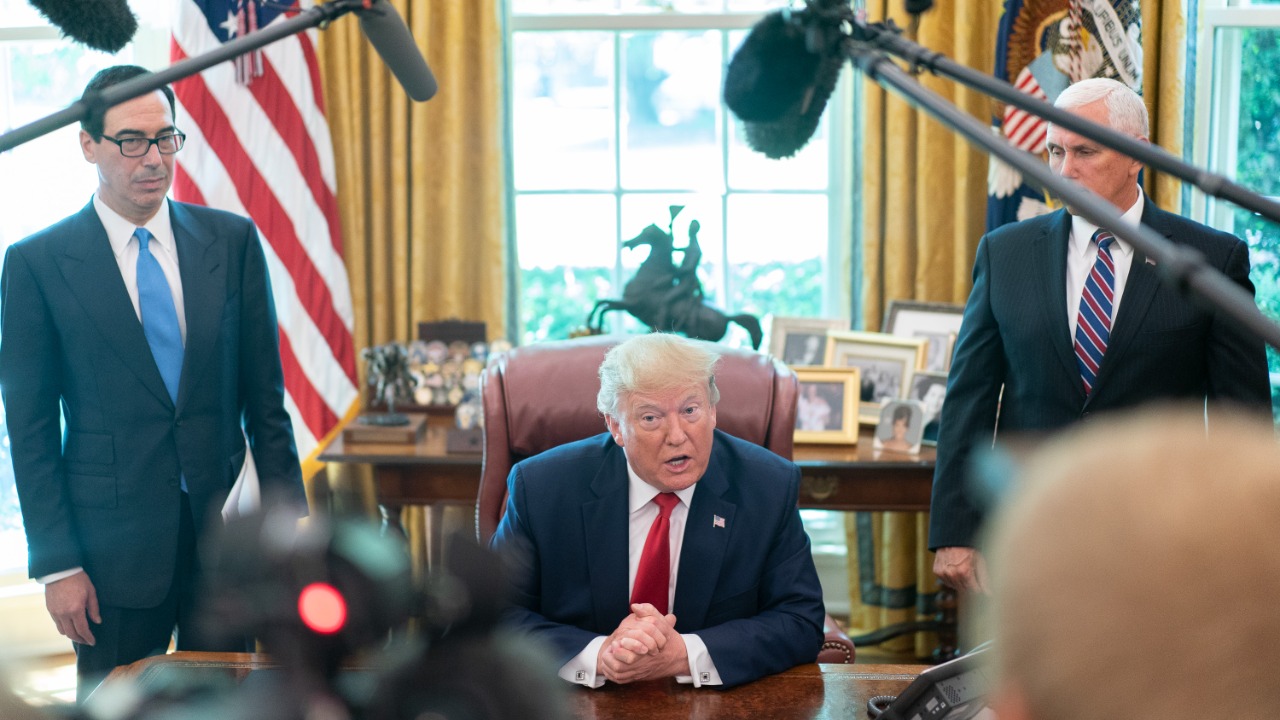
President Donald Trump is presenting Iran’s protest crackdown as a crisis that has suddenly eased, claiming Tehran has halted executions and stopped killing demonstrators just as Washington steps back from immediate military action. His assurances arrive while activists describe a death toll in the thousands and Iran remains largely cut off from the outside world, leaving a wide gap between presidential rhetoric and verifiable facts on the ground.
The result is a volatile mix: a US president signaling restraint after days of threats, an Iranian leadership accused of mass repression, and protesters whose fate is obscured by an internet blackout and contested casualty figures. How Trump frames Iran’s behavior now will shape not only potential military moves but also the leverage Washington has over a regime facing its most serious domestic unrest in years.
Trump’s claim that “the killing has stopped”
Trump has seized on what he describes as new assurances from Tehran, telling reporters that he has been informed “the killing has stopped” in Iran and that the regime has “no plan for executions” of detained protesters. He has presented this as a direct response to his own warnings, suggesting that his pressure forced Iranian leaders to pull back from mass punishment of those who filled the streets in recent days. In his account, the shift is dramatic: a government that had been shooting demonstrators and preparing executions is now, he says, standing down.
Those statements came as he spoke about the unrest that has gripped Iran since security forces moved to crush protests that have lasted nearly a week, a crackdown that rights groups and activists say left at least 2,500 people dead and more than 1,000 detained. Trump’s insistence that “the killing has stopped” and that Iran has “no plan for executions” has been relayed in live briefings that track the protests and his comments in real time, including his reference to being told that executions were off the table and his hope that “it’s true,” even as he acknowledged that independent confirmation is lacking. His remarks have been highlighted in rolling coverage of the Iran protests and in updates noting that he believes Iran has “no plan for executions” of protesters after his public threats.
A protest movement under blackout
While Trump speaks of halted killings, Iran is entering its seventh day with almost no internet, a blackout that makes it nearly impossible to verify what is happening in cities where security forces previously opened fire. Network data shows connectivity has dropped to about 1 percent of normal traffic, effectively sealing off the country from outside scrutiny as protests spread across the country. That information vacuum means that claims from both the White House and Tehran are difficult to test, and it leaves families of detainees and the dead reliant on smuggled videos, word of mouth and the accounts of activists who have managed to stay online.
Reports from inside Iran describe a grim picture that contrasts sharply with any suggestion of a clean halt to violence. Iranian authorities are accused of charging relatives to retrieve bodies from morgues, including in Kahrizak in Tehran Province, and of holding hundreds of people in overcrowded detention centers after mass arrests. One frame grab from video shows rows of corpses in a morgue, with activists alleging that the number of protesters killed is far higher than officials admit and that the cost to reclaim a body can be crippling for families. These accounts, including allegations that Iranian authorities are monetizing grief, sit uneasily beside Trump’s assertion that the worst of the crackdown is over, and they underscore how the internet shutdown shields the regime from accountability as the protests continue.
From “locked and loaded” to a pause on strikes
Trump’s new tone on Iranian executions marks a sharp pivot from his earlier language, when he repeatedly talked about coming to “rescue” the Iranian people and said the United States was “locked and loaded” if Iran carried out mass killings. His administration signaled that military options were on the table, including potential strikes on Iranian security forces or facilities implicated in the crackdown, and officials openly discussed ways to deter Tehran from executing protesters. That posture raised fears of a rapid escalation between two long-time adversaries at a moment when domestic unrest in Iran was already destabilizing the region.
In recent hours, however, Trump has pointed to the supposed halt in killings as a reason to step back from immediate military action, even as he keeps the threat in reserve. A congressional research analysis of possible US responses notes that President Trump’s stated intention to “rescue” protesters, combined with talk of being “loaded and ready to go,” has created expectations among some Iranians that Washington might intervene directly if the bloodshed continues. At the same time, live coverage of the standoff has emphasized that tension still lingers between Iran and the United States, with Tehran reopening its airspace while remaining on high alert and regional militaries watching for any sign that Trump might reverse course and order strikes after all.
Conflicting narratives on executions and the death toll
The core of Trump’s argument is that Iran has backed away from executing protesters, a claim he says is based on direct messages from Tehran. He has told reporters that he was informed there is “no plan for executions” and that “the killing has stopped,” crediting his own public warnings for the shift. In one briefing, he said that he had been assured that Iran would not execute any protesters and that he hoped that information was accurate, even as he conceded that the United States had not yet verified it independently.
That narrative clashes with what activists and independent monitors are reporting. Human rights groups say the death toll from the crackdown has jumped past 2,500, and they warn that hundreds of detainees face the risk of harsh sentences, including capital punishment, in Iran’s courts. One detailed account describes how the number of dead has surged as security forces fired on crowds and raided neighborhoods, while more than 1,000 protesters remain in custody, including some held near the British Embassy in Tehran. Another report notes that Trump had previously warned Iran against protest executions as the death toll climbed, underscoring the gap between his earlier alarm and his current, more optimistic tone. The contrast is stark between Trump’s claim that Iran has “no plan” to execute protesters and the accounts of death toll past and detainees who still face possible death sentences.
Strategic stakes for Washington and Tehran
Behind the immediate drama of Trump’s statements lies a broader strategic contest between Washington and Tehran that stretches from the streets of Iranian cities to the Persian Gulf and the nuclear file. Regional security assessments warn that, as the clock ticks on diplomacy over Iran’s nuclear program, tensions remain high after a series of geopolitical incidents in April and beyond, including attacks on shipping and military facilities. The United States has repositioned forces and adjusted deployments around key facilities in the region, even as it weighs how far to go in backing protesters without triggering a wider war. For Iran’s leaders, the protests and the threat of foreign intervention intersect with long-standing fears about regime survival and external pressure over their nuclear activities.
More From The Daily Overview

Silas Redman writes about the structure of modern banking, financial regulations, and the rules that govern money movement. His work examines how institutions, policies, and compliance frameworks affect individuals and businesses alike. At The Daily Overview, Silas aims to help readers better understand the systems operating behind everyday financial decisions.

