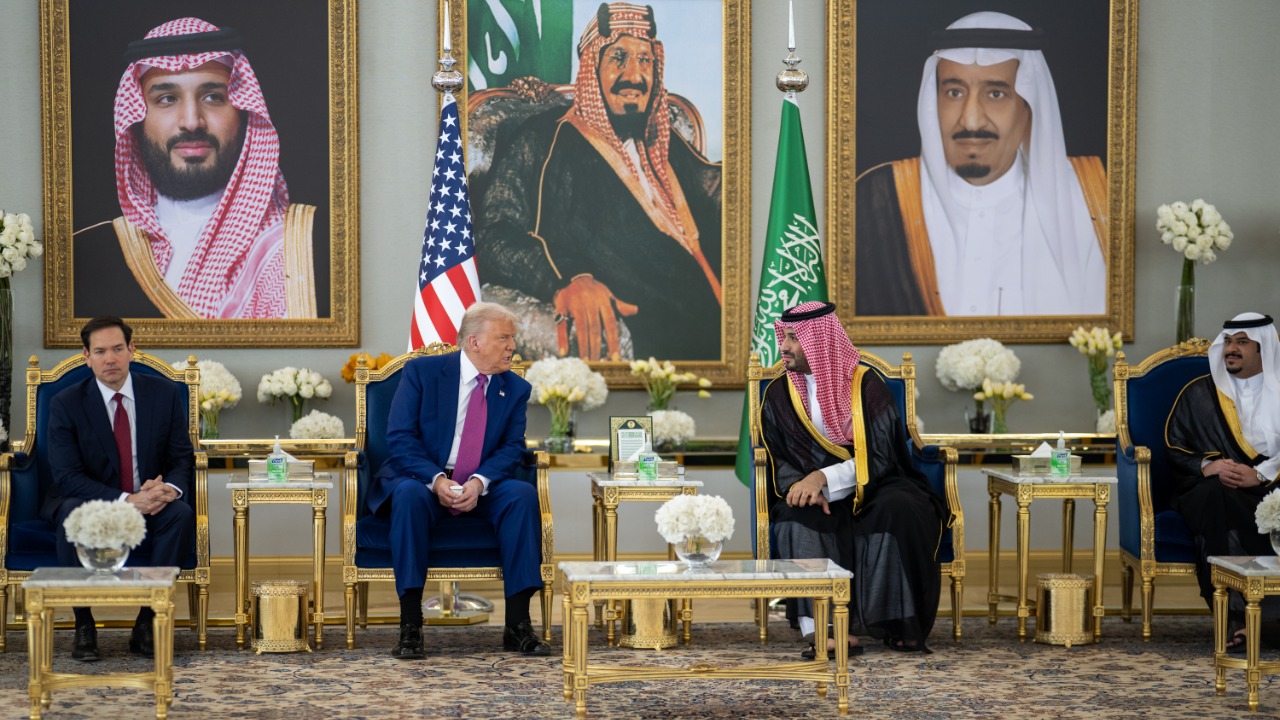
President Donald Trump is touting a sweeping pledge from Saudi Arabia to pour hundreds of billions of dollars into the United States, casting it as proof that his personal diplomacy is reshaping global capital flows. He has repeatedly highlighted a headline figure of $600 billion in promised investment, framing it as a turning point for American workers, manufacturers, and technology firms. The scale of the number is eye catching, but understanding what it really means requires looking closely at what has been signed, what has been promised, and how it fits into the long, complicated economic relationship between Washington and Riyadh.
The origin of Trump’s $600 billion claim
Trump’s assertion that Saudi Arabia will invest $600 billion in the United States traces back to his high-profile swing through the Middle East earlier this year, when he announced a package of commercial and strategic agreements with the kingdom. During that trip, the White House released a $600 Billion figure in a Fact Sheet titled “Fact Sheet, President Donald, Trump Secures Historic, Billion Investment Commitment, Saudi Arabia, STRENGTHEN,” dated May 12, 2025, presenting it as a historic commitment to channel Saudi capital into American infrastructure, health, energy, and science. That document framed Saudi Arabia as one of Washington’s most important economic partners and positioned the pledge as a centerpiece of Trump’s argument that his foreign trips translate directly into domestic jobs.
Independent coverage of the same trip underscored that the $600 billion number was not conjured out of thin air, but instead bundled together a mix of defense purchases, technology partnerships, and industrial projects. Reporting on the visit noted that the deals built on earlier business relationships between the United States and Saudi Arabia, with the White House emphasizing that the agreements were part of a broader push to deepen ties across the Middle East and Europe. In other words, Trump’s $600 billion claim rests on a combination of new commitments and extensions of existing arrangements, all packaged into a single headline number that serves both diplomatic and political purposes.
From $600 billion to nearly $1 trillion
The story did not stop at $600 billion. As the relationship between Trump and Saudi Crown Prince Mohammed bin Salman evolved, the Saudi side moved to expand the scale of its promised investments. Saudi Crown Prince Mohammed bin Salman told President Trump Tuesday that the Kingdom of Saudi Arabia would increase its investments in the United States to near $1 trillion, a pledge that was reported on Nov 17, 2025 and that dramatically raised expectations about the long term scale of Saudi capital in American markets. That conversation, described as taking place on President Trump Tuesday, effectively recast the original $600 billion as a floor rather than a ceiling.
Coverage of the same development from another outlet noted that Trump initially stated that the investment would amount to “at least” $600 billion, but that the Saudi leader confirmed the commitment would rise to nearly $1 trillion, with the report also pegged to Nov 17, 2025 and identifying the key players simply as Trump and Saudi. A separate set of Key Points later explained that Saudi Crown Prince Mohammed bin Salman raised Saudi Arabia’s US investment pledge from $600 billion to $1 trillion, with that summary, dated Nov 18, 2025, explicitly tying the increase to targeted sectors and agreements and naming Saudi Crown Prince Mohammed, Salman, and Saudi Arabia as central actors. Together, these accounts show how Trump’s original claim has been overtaken by even larger Saudi promises, while still using the $600 billion benchmark as the starting point.
What the money is supposed to fund
Trump has presented the Saudi commitments as a direct boon to American workers, pointing to specific sectors that stand to benefit if the pledges materialize. During his trip to the Middle East, President Donald Trump secured a $600 billion commitment from Saudi Arab partners that was described as flowing into companies such as Boeing, Google, DataVolt, AMD, and GE Vernova, with the report dated May 14, 2025 and explicitly noting that it came During his trip to the Middle East. That breakdown suggests a focus on aerospace, cloud computing, data centers, semiconductors, and energy technology, all areas that align with both US industrial priorities and Saudi Arabia’s own push to diversify its economy away from oil.
Later in the year, the White House framed the expanded Saudi pledge in similarly concrete terms, describing Saudi Arabia’s nearly $1 trillion investment commitment into US infrastructure, technology, and industry as rising from the earlier $600 billion baseline and stressing that the funds would flow directly into American communities. That Nov 17, 2025 Fact Sheet, which highlighted the role of Saudi Arabia in the economic and defense partnership, reinforced the idea that the money is meant to support tangible projects such as roads, factories, and research hubs rather than remaining abstract financial commitments. Taken together, the sector specific reporting and the official framing show how Trump’s $600 billion talking point is embedded in a broader narrative about rebuilding domestic capacity through foreign capital.
Myth, reality, and the scale of Saudi capital
Even with detailed sector lists and official Fact Sheets, the sheer size of the numbers Trump cites invites skepticism, especially given his history of using eye popping figures in political messaging. Analysts who specialize in Gulf economies have tried to separate hype from reality by looking at the long term trajectory of Saudi trade and investment with the United States. One such analysis, titled “Distinguishing Myth From Reality, Saudi Arabia, Trade and Investment With the United States, Purchases of,” examined whether claims like “Can $600 Billion in Trade” are plausible when compared with existing flows and noted that US exports to the kingdom still lag behind those from other major partners such as China, with the study hosted by a policy institute at Saudi Arabia’s Trade and Investment With the United States. That context suggests that while $600 billion in deals over many years is not impossible, it would represent a significant step up from historical patterns and would depend heavily on follow through.
Trump’s broader record on investment figures also colors how experts interpret the Saudi pledges. When he later claimed that foreign partners were lining up a $17 trillion investment in the United States, fact checkers pointed out that the number was not grounded in any verifiable commitments and that the European side, in particular, had not endorsed anything close to that scale. One review, dated Oct 10, 2025, quoted The European Commission and trade official Cecilia Malmstr, affiliated with the Peterson institute, stressing that “The European Commission cannot order or decide how private companies invest in the US” and concluding that a $17 trillion inflow over four years appeared unlikely, as detailed in a fact check. That pattern of inflated rhetoric does not automatically invalidate the Saudi numbers, but it does encourage a more cautious reading of Trump’s $600 billion claim, treating it as an aspirational ceiling rather than a guaranteed outcome.
Geopolitics, symbolism, and what comes next
Beyond the spreadsheets, Trump’s emphasis on Saudi investment is also about geopolitics and symbolism. By spotlighting a headline figure of $600 billion and then celebrating the move toward nearly $1 trillion, he is signaling that the United States remains the preferred destination for Gulf capital at a time when China and Europe are competing aggressively for the same funds. The White House has repeatedly portrayed Saudi Arabia as a cornerstone partner in both security and economic terms, and the May 12, 2025 Fact Sheet that introduced the historic commitment did so against the backdrop of Trump’s broader efforts to reshape alliances in the Middle East. For Riyadh, the pledges serve as a way to lock in political goodwill in Washington while advancing its own Vision 2030 agenda through partnerships with American firms.
Whether the full $600 billion, let alone the near $1 trillion, ultimately arrives will depend on years of project level decisions, regulatory approvals, and market conditions that no single leader can fully control. Some of the announced deals are already moving forward in sectors like aviation and cloud computing, while others remain memorandums of understanding that could be scaled back or reconfigured. As I weigh the available evidence, I see Trump’s claim that Saudi Arabia will invest $600 billion in the United States as rooted in real, documented commitments but stretched to their most optimistic interpretation, a pattern consistent with his broader approach to economic messaging. The stakes are high for American workers and companies that have been promised a wave of Saudi funded projects, and the real test of this diplomacy will be measured not in press releases but in factories built, data centers opened, and long term jobs created on the ground.
More From TheDailyOverview
- Dave Ramsey says these two simple questions show whether you’re rich or poor
- Retired But Want To Work? Try These 18 Jobs for Seniors That Pay Weekly
- IRS raises capital gains thresholds for 2026 and what’s new
- 12 ways to make $5,000 fast that actually work

Grant Mercer covers market dynamics, business trends, and the economic forces driving growth across industries. His analysis connects macro movements with real-world implications for investors, entrepreneurs, and professionals. Through his work at The Daily Overview, Grant helps readers understand how markets function and where opportunities may emerge.

