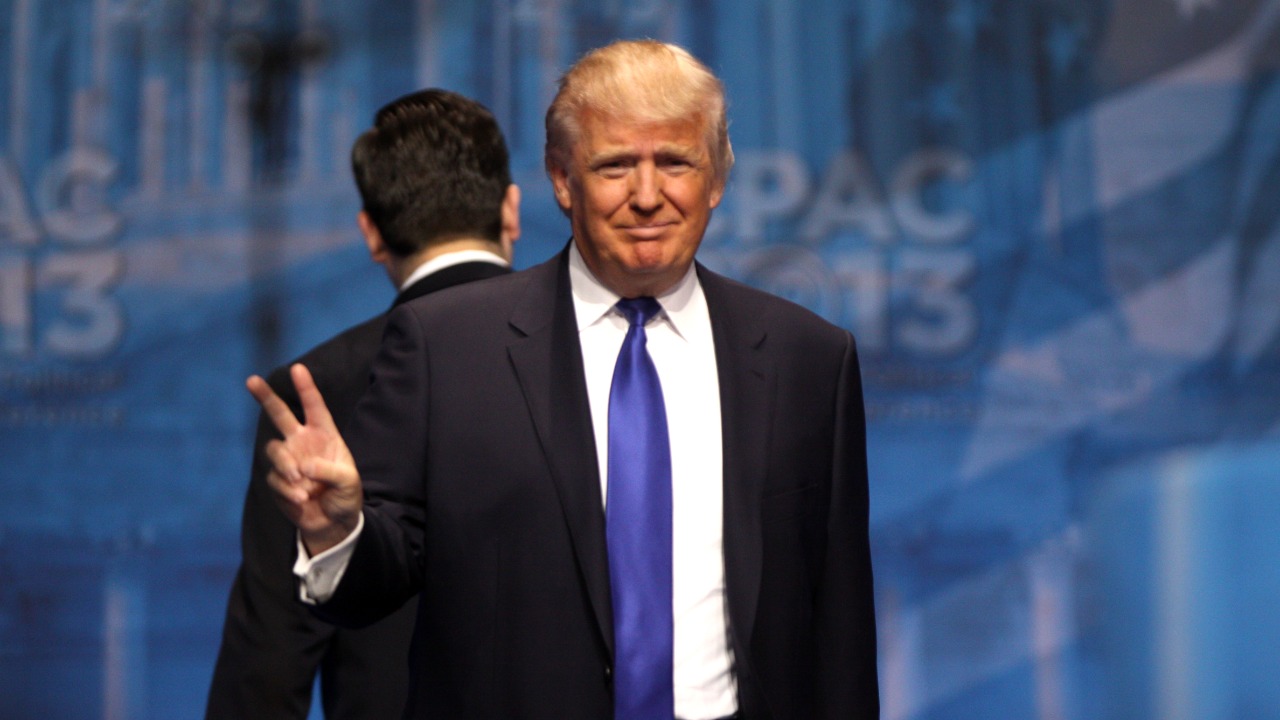
Financial markets have grown used to reacting to presidential posts in real time, but the latest flare-up over cooking oil showed just how quickly a single threat can vaporize hundreds of billions of dollars in paper wealth. Within minutes of President Donald Trump warning that he could choke off Chinese cooking oil flows, roughly $450B in value was knocked off the S&P 500, turning an obscure corner of the trade war into a front-page risk for every retirement account tied to the index. I see that move as a stark reminder that political brinkmanship is now a core market driver, not background noise.
The episode did not come out of nowhere. It capped days of escalating rhetoric over used cooking oil and soybeans, and it landed in a market already primed to sell first and ask questions later. For investors, the message was blunt: when the commander in chief targets a niche commodity, the shock can still slam the broad 500 and erase $450 in value per share across portfolios before most people have time to refresh their brokerage apps.
The post that turned cooking oil into a market shock
The selloff that wiped out roughly $450B in minutes was triggered when President Donald Trump used social media to threaten a hard stop to Chinese cooking oil imports, effectively dangling an embargo over a trade that had barely registered with most investors before. Market watchers described how the S&P 500, a benchmark built on 500 of the largest U.S. companies, lurched lower almost immediately as algorithms and human traders alike tried to price in the risk that a new front in the trade fight with Chinese suppliers could spill into everything from consumer staples to industrials. Reporting on Nov 11, 2025, detailed how that single threat to Chinese cooking oil flows erased $450B from the S&P 500 in a matter of minutes, underscoring how tightly politics and portfolio values are now intertwined, and I see that as the core lesson from the move linked to Trump’s Chinese cooking oil threat.
Later coverage on Nov 29, 2025, reinforced that narrative, describing how markets took a late-day hit after President Donald Trump again raised the prospect of terminating Chinese cooking oil imports in a post on Truth Social and how that message rippled through the S&P 500 in minutes. In that account, Markets were portrayed as reacting less to the commodity itself and more to the signal that the White House was willing to weaponize yet another trade channel with Chinese partners, a dynamic that helps explain why the broad 500 index could shed $450B so quickly once the threat appeared on Truth Social and became the latest flashpoint in the standoff between Nov traders and Oct policy risks, as captured in the analysis of Trump’s Chinese cooking oil threat erased $450B.
How a niche commodity became leverage in the China Trade War
The cooking oil shock only makes sense when you see it as part of a broader strategy to use every available lever in the China Trade War, including flows that once seemed too small or technical to matter. Earlier in the saga, President Donald Trump said his administration was considering a cooking oil embargo over a perceived soybean snub from China, tying the threat directly to agricultural grievances and signaling that food-related commodities were now fair game in the trade confrontation. That warning, delivered amid an ongoing trade war with China, framed cooking oil as a bargaining chip rather than a mundane input, a shift that was laid out in detail when President Donald Trump floated a cooking oil embargo over soybean purchases in remarks about soybean snubs.
At the same time, analysts were already warning that Markets were underestimating how a move against Chinese cooking oil could reverberate through supply chains and energy markets. A separate account on Nov 29, 2025, described how Markets took a late-day gut punch in Oct after President Donald Trump went on Truth Social and threatened to terminate Chinese cooking oil imports, turning what had been a niche commodity story into a broad risk-off moment. In that telling, the combination of Oct trade war escalation and a direct presidential post on Truth Social and other platforms was enough to convince traders that cooking oil had become a new front in the conflict, a point underscored in the coverage of how Markets reacted when Markets took a late-day gut punch.
The $450 Billion Erased In Minutes
What made this episode stand out even in a volatile year was the sheer speed and scale of the market reaction, with $450 Billion Erased In a span measured in Minutes rather than hours or days. On Tuesday, a post on X from The Kobeissi Letter highlighted how roughly $450 Billion in market value vanished in just seven Minutes after the cooking oil comments hit, turning a policy trial balloon into a real-time stress test for risk models that had not fully priced in commodity-specific sanctions. I see that as a vivid example of how social media posts and rapid-fire commentary can now move entire asset classes, a dynamic captured in the account of how $450 Billion Erased In 7 Minutes after the remarks flagged by The Kobeissi Letter.
That same analysis also relayed concerns from China experts that Beijing will see this as weakness, arguing that a move to threaten cooking oil imports without a clear follow-through plan could embolden Chinese negotiators rather than intimidate them. From a market perspective, that critique matters because it suggests the $450 Billion Erased In Minutes may have been the result of traders pricing in not just the immediate trade risk but also the possibility of a more entrenched and unpredictable standoff. When I look at that reaction, I see investors trying to front-run a scenario in which Beijing tests the limits of U.S. resolve on commodities, a scenario that helps explain why the S&P 500 could shed so much value so quickly once The Kobeissi Letter amplified the scale of the pullback.
Why used cooking oil suddenly matters
Behind the headlines about cooking oil embargoes is a surprisingly large and intricate trade in used cooking oil, or UCO, that links Chinese exporters to U.S. refiners and biofuel producers. Earlier in Oct, Reuters reporters Kanishka Singh, Ella Cao and Joe Cash detailed how the U.S. was China’s top market for used cooking oil, noting that China shipped hundreds of thousands of tons of UCO worth $286.7 million into that channel and that any disruption would hit both sides of the Pacific. That context, laid out in coverage of how Reuters, Kanishka Singh, Ella Cao and Joe Cash described China as heavily exposed to U.S. demand for UCO, shows why a threat to end the used cooking oil trade with China was never just symbolic, as explained in the report on how the U.S. was China’s top market for used cooking oil in Trump’s threat to end UCO trade.
Analysts also pointed out that cooking oil is not just a kitchen staple but a feedstock for renewable diesel and other fuels, which means any disruption can ripple into energy prices and climate policy debates. A detailed explainer on Oct 14, 2025, under the banner Why Trump Is Eying Cooking Oil as Leverage in the China Trade War, described how Cooking oil could become a new front in the US-China Trade War and how U.S. refiners might struggle to source UCO from abroad if Chinese supplies were cut off. That piece argued that Why Trump Is Eying Cooking Oil as Leverage reflects a broader strategy to use Cooking flows with Chin suppliers as a bargaining chip, a framing that helps explain why markets reacted so sharply once investors realized that cooking oil had become a formal lever in the China Trade War, as outlined in the analysis of Why Trump Is Eying Cooking Oil.
From headline risk to portfolio strategy
For traders on the day of the selloff, the cooking oil threat was just the latest headline risk in a series of shocks that had already pushed the S&P 500 lower as the trade war escalated. Earlier in Oct, the S&P 500 dropped after Trump warned China of a cooking oil import ban, with one account noting how the Stock market today saw the 500 index fall alongside the Dow Jones Industrial Average as investors digested the possibility of a new barrier to Chinese imports. That move, chronicled by Investing, showed that the market was already sensitive to any sign that Trump was prepared to escalate against China of cooking oil imports, a sensitivity that set the stage for the much larger $450B wipeout when the threat was repeated more forcefully, as described in the coverage of how the Stock market today saw the S&P 500 drop.
Strategists have since argued that investors need to treat these kinds of policy jolts as recurring features of the landscape rather than one-off surprises. When Trump Opens New Front in the China Trade War with Cooking Oil, as one account of Oct 13, 2025, put it, the implication is that any sector tied to cross-border flows can suddenly become a bargaining chip, and portfolios concentrated in trade-sensitive names are especially exposed. In that context, I see diversification across sectors and geographies, along with a clear plan for how to respond when President Trump signals a new front in the China Trade War, as essential tools for navigating a world where a single post about Cooking Oil can knock hundreds of billions off the S&P 500, a reality underscored when Trump Opens New Front in the China Trade War: Cooking Oil was detailed in analysis of Trump Opens New Front in China Trade War: Cooking Oil.
More From TheDailyOverview
- Tennessee loses $2.6B megafactory and faces major layoffs
- Retired But Want To Work? Try These 18 Jobs for Seniors That Pay Weekly
- What to do with your pennies after the U.S. stops minting them
- Home Depot CEO warns of a troubling customer trend in stores

Grant Mercer covers market dynamics, business trends, and the economic forces driving growth across industries. His analysis connects macro movements with real-world implications for investors, entrepreneurs, and professionals. Through his work at The Daily Overview, Grant helps readers understand how markets function and where opportunities may emerge.

