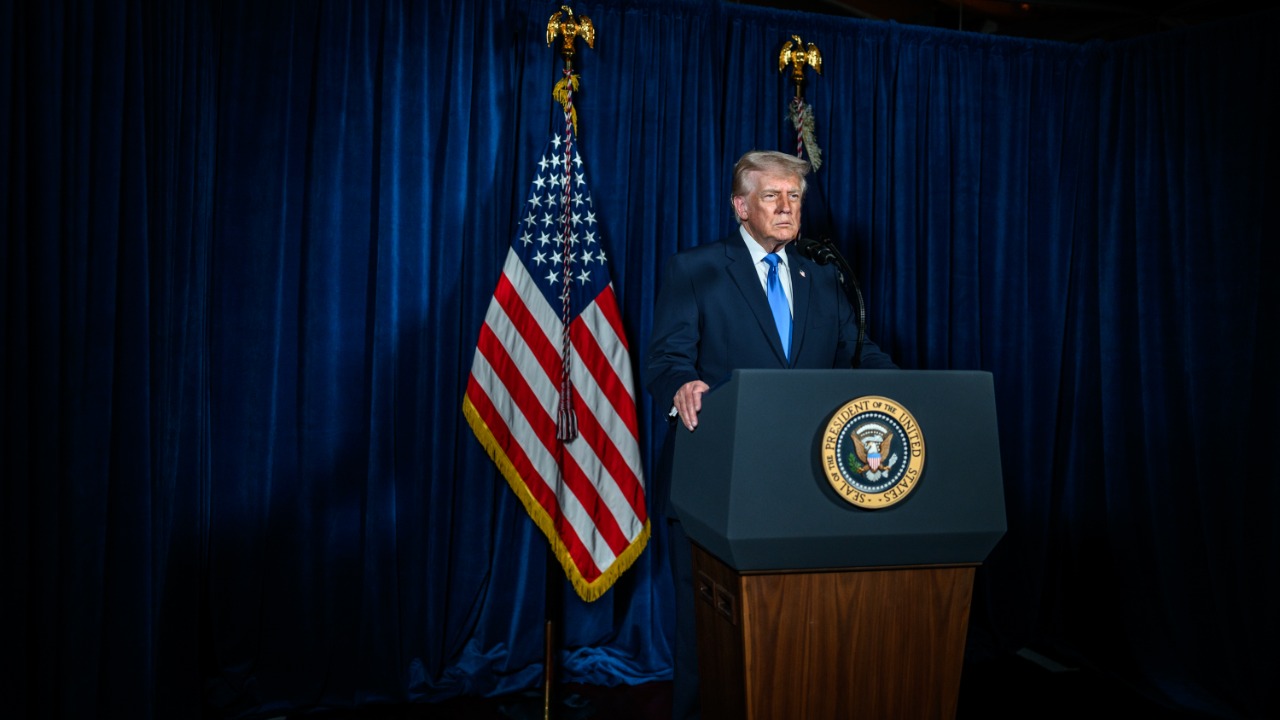
President Trump used a rare prime-time address from the White House to unveil a new cash bonus for service members, casting the payout as both a patriotic gesture and proof that his economic strategy is working. The so-called “warrior dividend,” set at $1,776 per eligible recipient, instantly became the headline-grabbing centerpiece of a speech that also tried to reassure Americans about inflation and wages. The announcement landed at the intersection of economic policy, culture-war symbolism, and military politics, raising questions about who benefits, who pays, and how much of the story matches the facts.
In the address, the president framed the one-time payment as a reward for sacrifice and a dividend from his trade agenda, even as independent analysts quickly began parsing his claims about prices, paychecks, and the source of the money. I see the move as both a tangible boost for troops and a calculated political bet that a four-figure check, wrapped in Revolutionary War numerology, can reset the conversation about his handling of the economy.
The symbolism and scope of the $1,776 payout
The choice to peg the bonus at $1,776 was not subtle. By tying the amount to the year of American independence, Trump signaled that he wants the payment to read as a patriotic thank-you, not just another line item in the defense budget. In his remarks, he emphasized that “Nobody deserves it more than our military,” presenting the checks as a moral obligation as much as a fiscal decision, and congratulated troops on what he cast as a long-overdue recognition of their service.
According to reporting on the announcement, Trump described the initiative as a series of $1,776 “warrior dividend” payments for U.S. troops, with the branding and the exact figure repeated throughout his prepared text. Coverage of the rollout notes that the plan is structured as a one-time bonus rather than a permanent raise, and that the administration has linked it to legislation Trump signed into law on 4 July, underscoring the deliberate Revolutionary-era symbolism behind the $1,776 figure.
How Trump says the “warrior dividend” will be funded
From the start, Trump has insisted that taxpayers are not directly footing the bill for the new checks. In the speech, he argued that the money would come from tariff revenues, presenting the bonus as a way of making foreign exporters “pay” U.S. troops. That framing fits with his broader narrative that tariffs are a tool to shift economic burdens abroad, even as economists have long pointed out that higher import taxes typically filter down to American consumers and businesses through higher prices.
In a follow-up explanation of the program, Trump’s team said the “warrior dividend” would be funded from tariff revenues that have flowed into federal coffers since he returned to office in January, reinforcing his claim that the payments are a direct dividend from his trade policy. One detailed account of the rollout notes that President Donald Trump, speaking at the White House on a Wednesday, described the checks as a special bonus for U.S. troops and explicitly tied the funding stream to tariffs, with the administration portraying the initiative as a way to share that revenue with the military through warrior dividend checks.
A prime-time defense of Trump’s economic record
The bonus announcement did not come in isolation. Trump used the national address to mount a broader defense of his economic stewardship, arguing that he had tamed inflation and lifted wages after what he described as mismanagement under Biden. He portrayed the current economy as a turnaround story, claiming that prices that had been “soaring” when he took office are now under control and that workers’ pay is finally outpacing the cost of living.
In the televised remarks, President Trump, speaking on a Wednesday night, walked viewers through a series of talking points about inflation, wages, and consumer costs, highlighting items like egg prices as examples of what he said were meaningful declines. He asserted that his policies had brought down “soaring prices” and that household budgets were in better shape than when he took over, weaving those claims into the same speech where he unveiled the military bonus and described it as being funded in part with revenue from tariffs, according to a detailed account of what to know about President Trump’s prime-time address.
Fact-checks and the gap between rhetoric and reality
Independent fact-checkers moved quickly to test Trump’s claims against available data, particularly his assertions about inflation, wage growth, and the novelty of the “warrior dividend.” While the president framed the checks as a surprise windfall that had been in the works for only a short time, analysts noted that the idea had been circulating inside his administration for longer than he suggested and that some of his economic boasts glossed over more mixed indicators.
One comprehensive review of the speech highlighted how Trump, speaking from the White House, blended accurate statistics with exaggerations and selective framing. It noted that President Trump’s comments about the timing of the bonus program, including his suggestion that the plan had barely existed “until about 30 minutes ago,” did not match the longer internal discussions that preceded the announcement, and it scrutinized his portrayal of inflation and wage trends, offering a more nuanced picture than the one in his remarks in a detailed fact-check of President Trump’s speech.
Political stakes: rewarding troops while blaming Biden
Politically, the “warrior dividend” functions as both policy and message. By putting cash directly into the hands of service members, Trump is courting a constituency that already leans Republican, while also trying to showcase a concrete benefit from his trade and budget decisions. At the same time, he used the address to draw a sharp contrast with Biden, arguing that the economic problems he confronted were inherited and that his predecessor had failed both workers and the military.
Reporting on the speech underscores how Trump sought to defend “his economy” in prime time, explicitly blaming Biden for earlier inflation and slower wage growth while crediting his own return to office in January with stabilizing conditions. In that narrative, the military bonus becomes proof that his approach is generating enough fiscal room to reward troops, even as critics question whether tariffs are truly a free source of money and whether the one-time payout compensates for broader cost-of-living pressures, according to a detailed account of how Trump sought to defend his economy and contrast it with Biden.
What the “warrior dividend” means for troops and the broader debate
For individual service members, a $1,776 check is not abstract politics, it is rent, car payments, or a chance to pay down credit card debt. Junior enlisted troops in particular, who often juggle modest base pay with rising housing and childcare costs, are likely to welcome any extra cash, regardless of how it is framed from the podium. In that sense, the program’s immediate impact is straightforward: it puts real money into military households that have been squeezed by the same inflation Trump spent much of his speech describing.
Yet the broader debate the “warrior dividend” opens up is less about whether troops deserve a bonus and more about how presidents use the military to tell economic stories. By branding the checks with Revolutionary symbolism, tying them to tariffs, and unveiling them in a high-profile White House address, Trump has turned a one-time payment into a test of his larger argument that his economic strategy is both patriotic and effective. As fact-checkers and economists continue to dissect his claims, the checks themselves will arrive in mailboxes and bank accounts, leaving service members to decide whether the dividend feels like a meaningful reward or a politically timed gesture layered on top of a still-uneven economy.
More From TheDailyOverview

Julian Harrow specializes in taxation, IRS rules, and compliance strategy. His work helps readers navigate complex tax codes, deadlines, and reporting requirements while identifying opportunities for efficiency and risk reduction. At The Daily Overview, Julian breaks down tax-related topics with precision and clarity, making a traditionally dense subject easier to understand.