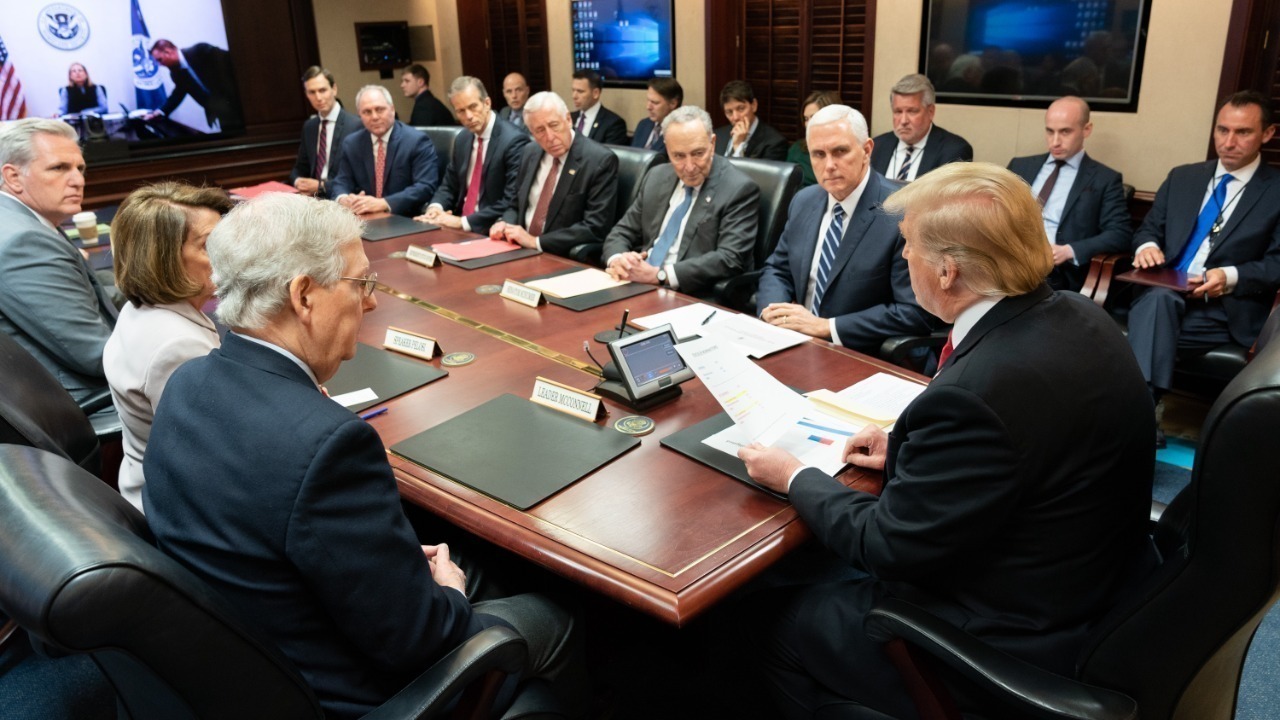
President Donald Trump is testing the outer limits of presidential power, turning procedural corners and legal gray zones into tools for advancing his priorities when Congress resists. From foreign policy to domestic spending and elections, he is increasingly relying on unilateral moves that treat statutes and norms as obstacles to be worked around rather than rules to be followed.
What is emerging is not a single dramatic showdown but a pattern: Trump identifies a pressure point, pushes past traditional checks, then dares a divided Congress and slow-moving courts to stop him. I see that pattern most clearly in his use of executive orders, spending maneuvers, personnel tactics and election-related interventions that collectively sideline the 119th Congress.
Executive orders as a substitute for legislation
Trump has turned the Term Executive Orders into a kind of parallel lawmaking track, using Executive Order directives to implement policies that would struggle to survive the normal legislative process. A detailed chart of Trump’s 2025 and 2026 directives shows how frequently he has reached for this tool, with each Executive Order listed by Date Issued and Short description in a way that underscores the breadth of his agenda across immigration, regulation and national security Term Executive Orders. The volume and scope of these directives, compared with earlier administrations, reflect a strategic choice to govern by decree rather than negotiation.
Critics argue that Trump is not just using Executive Order authority aggressively but redefining it, treating many orders as if they were new statutes. One analysis notes that Trump is doing this at unprecedented levels, with the White House issuing so many directives that they function as a substitute for legislation, and portraying resistance from Congress as proof that only presidential action can get things done Trump. In my view, that framing is central to his political strategy: by casting Congress as feckless and himself as decisive, he normalizes the idea that major policy shifts can and should come from the Oval Office alone.
Rewriting foreign policy without the Senate
Nowhere is Trump’s go-it-alone approach clearer than in foreign policy, where he has moved to pull the United States out of a wide array of international bodies and commitments without seeking new authorization from Congress. In a memorandum titled “Withdrawing the United States from and Ending Funding for International Organizations, Conventions, and Treaties that are Contrary to the Interests of the United States,” he sets out a Section labeled Purpose that cites his earlier Executive Order 14199 and directs agencies to identify and exit arrangements he deems misaligned with national interests Withdrawing the United. The document’s language makes clear that Trump sees withdrawal decisions as a core presidential prerogative, even when those commitments were originally approved with Senate advice and consent.
Legal scholars have flagged how sweeping this move is, describing The Announced U.S. Withdrawal from Many International Entities On January as a break with the traditional understanding that Congress shares responsibility for binding and unbinding the country from major international obligations. In that analysis, President Trump is portrayed as using the memorandum “Withdrawing the United States from and Ending Funding for International Organizations, Conventions, and Treaties that are Contrary to the Interests of the United States” to centralize decisions that once required broader political consensus The Announced. I see this as part of a larger pattern: by treating international commitments as revocable at will, Trump not only sidelines the Senate but also signals to allies and adversaries that U.S. policy can swing sharply with each presidential decision.
War powers and Venezuela as a constitutional stress test
Trump’s handling of Venezuela has become a live test of how far a President can go in using force without Congress. Legal experts argue that his unprovoked use of military force in that country violates the Constitution, which reserves the power to declare war to Congress, and also runs afoul of international law standards that bar attacks not grounded in self-defense or clear authorization Constitution. The argument is not simply that Trump acted without a vote, but that he has treated existing authorizations as blank checks for new conflicts that Congress never contemplated.
Commentary on the Venezuela strikes goes further, warning that The Trump administration’s actions and justifications have effectively dissolved the boundary that was supposed to restrain presidential power in matters of war. By retrofitting legal rationales after the fact and insisting that prior authorizations cover new operations, The Trump team has turned what was meant to be a meaningful check into little more than a speed bump The Trump. From my perspective, this is one of the clearest examples of Trump using ambiguity in existing law to bypass Congress, effectively daring lawmakers to claw back powers they have allowed presidents to accumulate over decades.
Spending fights and the “ask forgiveness, not permission” strategy
On domestic policy, Trump has zeroed in on the power of the purse, trying to take control of spending decisions that the Constitution assigns to Congress. A full-year continuing resolution that locked prior year funding levels in place through September 30 included $3 billion in emergency funds that the administration then sought to reshape through targeted rescissions and delays, effectively deciding which programs would live or die without new legislation continuing resolution. Democrats argued that using rescission threats to sit on money Congress had already appropriated was illegal, but the administration pressed ahead, betting that political gridlock would prevent a swift response.
Trump’s approach fits a broader pattern described by budget law specialists as “Ask for Forgiveness, Not Permission.” Under the Impoundment Control Act, If Congress fails to act within 45 days to affirm a rescission request, the President must spend the funds originally proposed for cancellation, yet the law also creates opportunities for delay and partial withholding that can have real-world impact even if Congress ultimately says no If Congress. I read Trump’s maneuvers as an attempt to stretch those gray areas to the breaking point, using the complexity of budget rules to shift practical control of spending from Capitol Hill to the Oval Office.
Personnel power plays and recess appointment threats
Personnel has always been policy, but Trump has treated staffing fights as another arena where he can sidestep the Senate. Even before his second term, President-elect Donald Trump signaled that he wanted to use recess appointments to fill his Cabinet, a move that would bypass the Senate and install key officials without traditional confirmation hearings President. That early threat set the tone for a presidency that has repeatedly floated recess appointments as leverage whenever nominations stall, effectively pressuring senators to choose between confirming his picks or watching him install them temporarily on his own terms.
Legal commentary on the recess power notes that, as President Trump prepared for his second term, he voiced frustration with the Senate confirmation process and called on Republic allies to consider more aggressive use of that authority if the regular method proved “inadequate” As President Trump. I see this as part of a broader effort to redefine checks and balances as mere procedural hurdles, with Trump framing any Senate resistance as obstruction that justifies more unilateral action.
Agenda 47 and governing around a “fraying” coalition
Trump’s policy blueprint, branded as Agenda 47, was built on the promise of working with Congress to enact sweeping changes, from a digital bill of rights to overhauls of federal agencies. Reporting on that plan notes that a number of the president’s Agenda 47 pledges explicitly envisioned collaboration with lawmakers, even as Trump also signaled that he would use executive power to move ahead where possible if Congress balked Agenda. In practice, I see him treating legislative wins as optional and unilateral moves as the default path to “delivering” on those campaign promises.
That posture has strained his relationship with lawmakers in his own party. Republicans Say Trump’s Coalition in Congress Is “Fraying but Not Broken,” with some members openly rebuking his use of veto threats and unilateral war powers even as they continue to back much of his domestic agenda Republicans Say Trump. From my vantage point, that “fraying but not broken” coalition is precisely what enables Trump’s workarounds: there is enough discontent to generate headlines, but not enough to produce veto overrides or serious statutory pushback.
Congress as “sidekick” to an imperial presidency
Trump’s accumulation of power has reshaped the daily reality on Capitol Hill. The 119th Congress has mostly been relegated to a sidekick role, deferring to Trump’s muscular executive branch as it moves at a brisk pace on regulations, foreign policy and tax enforcement while lawmakers struggle to keep up Congress. That dynamic is not entirely new, but Trump has leaned into it more aggressively than his predecessors, treating congressional inaction as a green light rather than a constraint.
Commentators have described how Earlier presidents tried to use executive orders to sidestep Congress, but Trump’s actions over a short span have gone further, using old statutes and emergency powers in novel ways and then daring opponents to challenge him in court Earlier. I see this as the practical definition of an imperial presidency: not just a strong executive, but one that treats Congress as an afterthought, useful when it cooperates and irrelevant when it does not.
Oil, courts and the Venezuela revenue shield
Trump’s recent move to shield Venezuelan oil revenue in the United States from creditors and court orders shows how he blends foreign policy, economic leverage and executive authority. Trump on Friday signed an executive order aimed at blocking courts or creditors from impounding revenue tied to the sale of Venezu oil, effectively placing those funds under special protection while his administration pursues its broader strategy toward Caracas Trump. The order not only affects bondholders and companies with claims against Venezuela, it also signals that Trump is willing to rewrite the rules of sovereign debt enforcement by decree.
Further reporting notes that Trump, identified as U.S. President Donald Trump, seeks to stop courts and creditors from seizing Venezuelan oil revenue in the U.S., using his authority as President Donald Trump to prioritize geopolitical objectives over private claims Venezuelan. In my assessment, this is another example of Trump using executive tools to preempt judicial and legislative input, effectively deciding on his own how far U.S. law should bend to accommodate his foreign policy goals.
Election rules and Project 2026
Trump’s willingness to bypass Congress is perhaps most alarming when it touches the rules of democracy itself. Attempts to interfere with voting and elections have included his threat to end mail voting and do away with voting machines, along with pressure on state officials such as the Wisconsin Elections Commission, moves that critics see as aimed at shaping the 2026 midterms in his favor Attempts. These are not acts of Congress, but presidential statements and pressures that can nonetheless influence how states administer elections.
At the same time, Project 2026 has seen The White House aggressively lobbying other Republican-controlled states to change their election laws, with On Trump’s orders Missouri Republ lawmakers pushing measures that would tighten voting rules and create fewer constraints on partisan gerrymandering The White House. I see this as a two-level strategy: Trump uses the bully pulpit and executive influence to reshape state election systems while avoiding the messy, uncertain path of federal legislation.
Street politics, media pressure and the broader power grab
Trump’s institutional maneuvers are reinforced by a constant drumbeat of political theater that keeps pressure on opponents. Coverage of protests in Aug described how people showed up in big numbers in Austin Texas, cheering Texas Democrats as they returned to the state amid a huge Texas fight over voting rules, even as national figures like Trump used the moment to frame the battle over election law as a test of partisan loyalty Austin Texas. Those scenes illustrate how street-level mobilization and presidential rhetoric can interact, with Trump leveraging public anger to justify further unilateral steps.
All of this unfolds against a backdrop in which Trump is carrying out a power grab that observers say the United States has not seen in modern times, using White House orders far more often than former presidents and treating many of those directives as if they were new laws rather than administrative guidance White House. Taken together, the executive orders, spending maneuvers, war powers claims and election interventions form a coherent project: a presidency that treats Congress not as a coequal branch, but as an optional partner that can be bypassed whenever it gets in the way.
More From The Daily Overview

Grant Mercer covers market dynamics, business trends, and the economic forces driving growth across industries. His analysis connects macro movements with real-world implications for investors, entrepreneurs, and professionals. Through his work at The Daily Overview, Grant helps readers understand how markets function and where opportunities may emerge.

