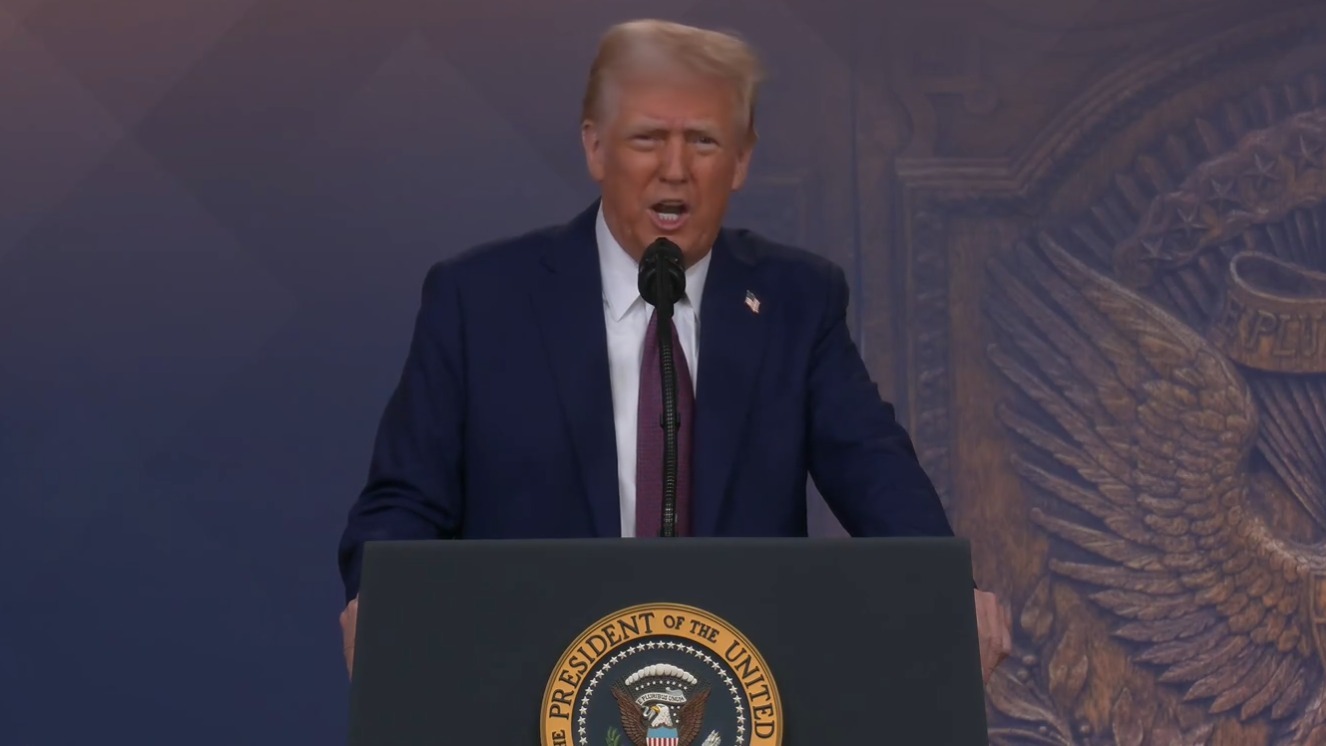
Donald Trump has sold his tariff blitz as a patriotic move that punishes foreign rivals and protects American workers. In practice, the policy is acting more like an own goal, pushing up prices at home even as the White House points to headline deficit gains. New numbers on family budgets, factory costs, and projected growth show a strategy that may look strong on paper while quietly draining household wallets.
The core conflict is simple. Trump talks about an “American economic miracle,” yet independent analysts see weaker growth and higher living costs built into his tariff plan. As the administration leans harder on tariffs as a cure-all, it becomes clearer that the real bill shows up in supermarket aisles, on car lots, and in monthly household budgets. The policy may feel tough on foreign exporters, but the pain is landing close to home.
Deficit bragging rights, weaker growth
The main talking point for Trump’s team is that tariffs bring in money and shrink the federal deficit. The Congressional Budget Office, as described in an Associated Press summary, estimates that his current and proposed duties would reduce U.S. deficits by about $2.8 trillion over the next decade. That is a big number and an easy sound bite about making foreign exporters “pay” for American fiscal health. Yet the same CBO work also finds that these tariffs would cut overall economic output, turning the supposed win into a tradeoff that looks far less flattering once you look past the headline.
When growth slows, wages, hiring, and business investment usually slow too. The deficit gain, in other words, comes with a hidden price tag for workers and consumers. In soccer terms, a government can cheer a lower deficit, but if the path there drags down output and living standards, the policy starts to look self-defeating. The CBO is not a partisan player; its role is to model how policies affect the budget and the economy. Its finding that Trump’s tariffs both cut deficits and reduce growth suggests the president is trading long-run prosperity for a short, sharp talking point.
Family budgets take the direct hit
The clearest sign that this is an own goal rather than a clean win comes from what households are already paying. One recent estimate, reported by financial analysts, found that Trump’s tariffs cost American households about $1,000 last year. That figure reflects higher import costs feeding straight into consumer prices. Tariffs are collected at the border, but importers usually pass those costs along through higher prices on electronics, clothing, tools, and other goods. When a policy adds $1,000 to the yearly bill for a typical household, it acts less like a patriotic fee and more like a tax hike by another name.
The squeeze is likely to tighten. Modeling cited in a Newsweek breakdown estimates that American families will face about $1,300 in extra costs from Trump’s tariffs in 2026 alone, not counting duties imposed through emergency powers. Combined with the earlier $1,000 hit “last year,” the direction is clear: the burden is rising, not fading. This pattern also undercuts the common claim that tariffs mainly hurt foreign producers. The evidence shows that American consumers are absorbing much of the blow, with higher bills for everyday items and big-ticket purchases alike.
Factories squeezed by record-high duties
Manufacturers, often held up by Trump as the main winners from his trade agenda, are facing their own strain. Analyst Laura Zindel calculates that effective tariff rates reached 10.1 percent in 2026, the highest level since 1946. In her review of manufacturer, she notes that this jump hits firms that rely on imported components for steel, electronics, chemicals, and other inputs. When the tariff burden climbs to a postwar record, companies must either absorb the hit through lower profits, cut back on investment and hiring, or pass the extra cost on to customers.
The strain shows up across supply chains. A car plant that pays more for imported parts may need to raise sticker prices on new models, making vehicles like a 2026 pickup or compact SUV harder to afford. A small appliance maker that imports motors or circuit boards will see unit costs rise in line with that 10.1 percent effective rate. Zindel argues that this level of protection pushes the economy toward a more closed and less competitive era. The common claim that tariffs will revive domestic industry looks weaker when factories are forced to pay record duties on the very materials they need to operate and grow.
Household pain by the numbers
Behind the averages sit specific figures that show how deep the tariff costs can run. Analysts working with the same models that produced the $1,300 estimate for 2026 have also highlighted how many families are pulled into the line of fire. One scenario suggests that about 7,223 households in a typical mid-sized county could see their annual tariff-related costs jump by at least $698 if current policies stay in place. For many of those families, $698 is close to a month of groceries or several utility bills, not a minor rounding error.
Another way to see the scale is to look at the spread across income levels. In one breakdown, the bottom 20 percent of households saw tariff costs equal to about 0.87 percent of their after-tax income, while the top group faced a much smaller share. That may sound like a small number, but for families living paycheck to paycheck, losing 0.87 percent of take-home pay to higher prices can be the difference between building a small savings cushion and running up credit card debt. These kinds of figures help explain why the headline $1,000 and $1,300 averages feel much heavier in lower- and middle-income neighborhoods than in wealthier ZIP codes.
Political cracks in Trump’s tariff story
Trump has tried to frame all of this as a triumph. In a Wall Street Journal opinion piece, described in a New York Post, he boasted that his tariff blitz has “created an American economic miracle” and prevented an “economic meltdown.” That message is meant to project strength and certainty: tariffs as the engine of growth rather than a drag. Yet the CBO’s warning about slower growth, combined with the household and manufacturing data, points in a different direction. When a president claims a miracle while independent analysts tally higher costs and weaker output, the gap between message and reality becomes a political weak spot.
Some of that tension is already visible inside Trump’s own party. In the House of Representatives, six Republicans broke with him on a key vote involving tariffs on Canada, which is led by Prime Minister Mark Carney. Their defiance came in a Democrat-backed effort and was framed around fears that the tariffs would raise prices and make life less affordable. Reporting on the Republican revolt shows that even some conservatives now see tariffs as a liability with voters angry about inflation. When members of Trump’s own party are willing to oppose him on a signature economic tool, it signals that the political cost of higher prices may be starting to outweigh the appeal of tough-on-trade rhetoric.
More From The Daily Overview
*This article was researched with the help of AI, with human editors creating the final content.

Grant Mercer covers market dynamics, business trends, and the economic forces driving growth across industries. His analysis connects macro movements with real-world implications for investors, entrepreneurs, and professionals. Through his work at The Daily Overview, Grant helps readers understand how markets function and where opportunities may emerge.

