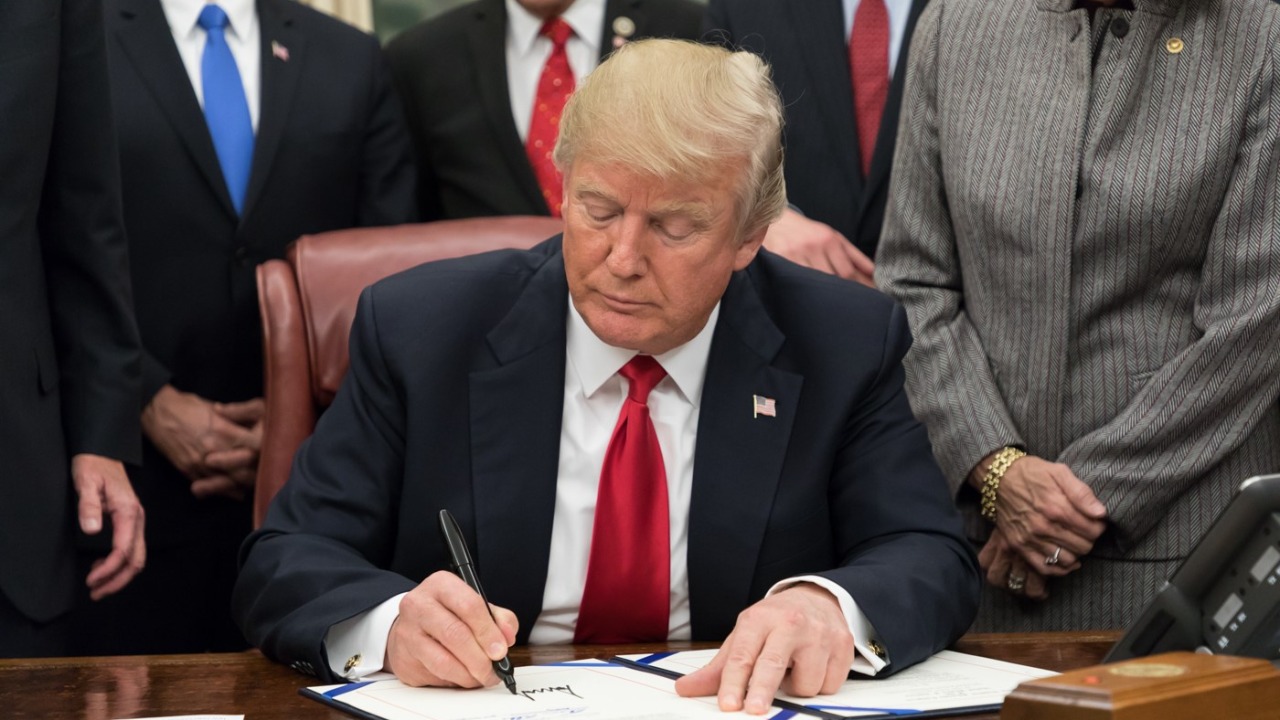
President Donald Trump is testing the limits of presidential power in a way that hits his own wallet first. He has repeatedly suggested that money flowing from lawsuits tied to his time in office should be treated almost like personal winnings, even when the funds would originate with taxpayers. At the same time, he is promoting the idea of generous government checks for voters, creating a striking contrast between his claims on public money for himself and his promises of cash for everyone else.
Those twin narratives, of a president as both victim owed vast compensation and benefactor handing out payments, now frame a broader fight over who controls the proceeds of legal battles involving the federal government. Trump’s insistence that he can effectively write himself blank checks from lawsuit cash is not just a rhetorical flourish, it is colliding with long standing rules on appropriations, ethics, and separation of powers.
Trump’s $10 billion IRS lawsuit and the “blank check” theory
The clearest expression of Trump’s new posture is his sprawling tax records case against the Internal Revenue Service and the Treasury Department. In that suit, he and his sons are demanding a $10 billion payout over the handling and disclosure of his tax information, an extraordinary sum for a sitting president to seek from agencies that report to him. The complaint casts Trump as the target of hostile bureaucrats and contractors, and it treats the alleged harm to his privacy and business as a debt the federal government must repay directly to him and his family.
Legal analysts have noted that this tax case is unlike Trump’s earlier litigation, which tended to focus on blocking investigations or limiting oversight rather than extracting a massive personal award. One detailed assessment of Trump’s $10 billion describes it as a sharp escalation, rooted in grievances dating back to when an Internal Revenue Service contractor first accessed and leaked his tax returns. By framing that episode as grounds for an 11 figure claim, Trump is effectively arguing that the government’s misconduct in his first term entitles him to a personal windfall now that he is back in power.
From “a lot of money” owed to personal control over payouts
Trump’s rhetoric around these cases has grown more explicit about who he believes should control any eventual payouts. In a televised interview from WASHINGTON, he said that the federal government owes him “a lot of money” for prior Justice Department investigations into his conduct, and he stressed that any settlement or payment “will” go across my. In that same exchange, President Donald Trump framed the issue as one of personal vindication, suggesting that he, not career officials or Congress, should have the final say over how any money tied to those investigations is handled.
He has gone even further in more informal settings, telling supporters that he “could be” seeking $230 million from his own Department of Justice as compensation for the probes that dogged his earlier term. In that clip, Trump describes the DOJ as both an adversary and a potential source of cash, reinforcing the idea that he can turn past scrutiny into a revenue stream. The figure of $230 m, repeated alongside the larger $230 million estimate, underscores how he is now talking about federal investigations not just as political witch hunts but as billable offenses that the government must pay him for.
Legal guardrails: settlements, fraud findings, and a tossed $500 million penalty
Trump’s claim that he can personally direct lawsuit proceeds runs into a dense thicket of federal law. Experts on appropriations and ethics have warned that settlements negotiated by government lawyers are not private side deals, and that Federal officials who structure payouts to benefit the president personally could violate the Miscellaneous Receipts Act, often shortened to the MRA. A detailed legal analysis argues that a Government Accountability Office finding, or GAO review, would likely conclude that routing settlement money around Congress and into accounts effectively controlled by Trump is incompatible with the Constitution’s power of the purse.
Trump’s broader financial and legal record also complicates his narrative that he is simply collecting what he is owed. In New York, state courts have FOUND him and his companies LIABLE FOR FRAUD, with one summary noting that New York judges concluded that Trump Organization entities inflated asset values to secure favorable loans and insurance terms. Although a New York appeals court later dismissed a $500 million civil fraud penalty against President Trump and his companies, wiping out the $500 m judgment, the underlying liability findings remain a political and legal backdrop to his current push for government funded compensation.
The Daily Beast “blank checks” framing and Trump’s own spin
Trump’s evolving theory of presidential entitlement has been captured in reporting that describes him as asserting the right to cut himself effectively unlimited checks from lawsuit proceeds. One account notes that President Donald Trump has claimed he can funnel as much taxpayer money as he wants into his own accounts if it is labeled as damages from legal settlements. In that telling, the president is not just a litigant but the ultimate arbiter of how public funds are transformed into private compensation, blurring the line between the Treasury and his personal balance sheet.
Another segment of the same reporting describes how Trump has boasted of having “won” what he calls the “Mar a Lago br” dispute and then pivoted to a jaw dropping 11 figure sum he says taxpayers effectively owe him, a narrative summarized under the phrase Trump Shakes Down Dropping Figure THE BILL. In that framing, the president is portrayed as treating the federal government like a deep pocketed adversary he can strong arm, with taxpayers left to split the bill for his grievances over leaks and investigations tied to his tax returns.
The contrast with $2,000 checks for voters and other legal defeats
Trump’s personal claims on public money are unfolding alongside his high profile promises to send ordinary Americans their own payments. He has repeatedly promoted the idea of tariff funded “dividend” checks, telling supporters that $2,000 payments are on the way and prompting viral questions about whether $2,000 checks are really coming to their homes. In a separate policy pitch, he has said that these tariff dividend checks would arrive by mid 2026, with one analysis noting that Checks Really Coming has become a central question as President Trump ties the payments to resolving a $2 trillion deficit.
The gap between rhetoric and reality has already produced confusion and scams. A detailed explainer by reporter Bonnie Bolden in the Mississippi Clarion Ledger walks through what Americans can actually expect from the proposed $2,000 tariff dividend checks and warns readers to avoid schemes that exploit the uncertainty. That piece, framed around the question “When could Americans get a $2,000 tariff dividend check,” underscores how Trump’s promises of future largesse coexist with unresolved legal and fiscal questions about how such a program would be funded and administered.
More From TheDailyOverview
*This article was researched with the help of AI, with human editors creating the final content.

Grant Mercer covers market dynamics, business trends, and the economic forces driving growth across industries. His analysis connects macro movements with real-world implications for investors, entrepreneurs, and professionals. Through his work at The Daily Overview, Grant helps readers understand how markets function and where opportunities may emerge.

