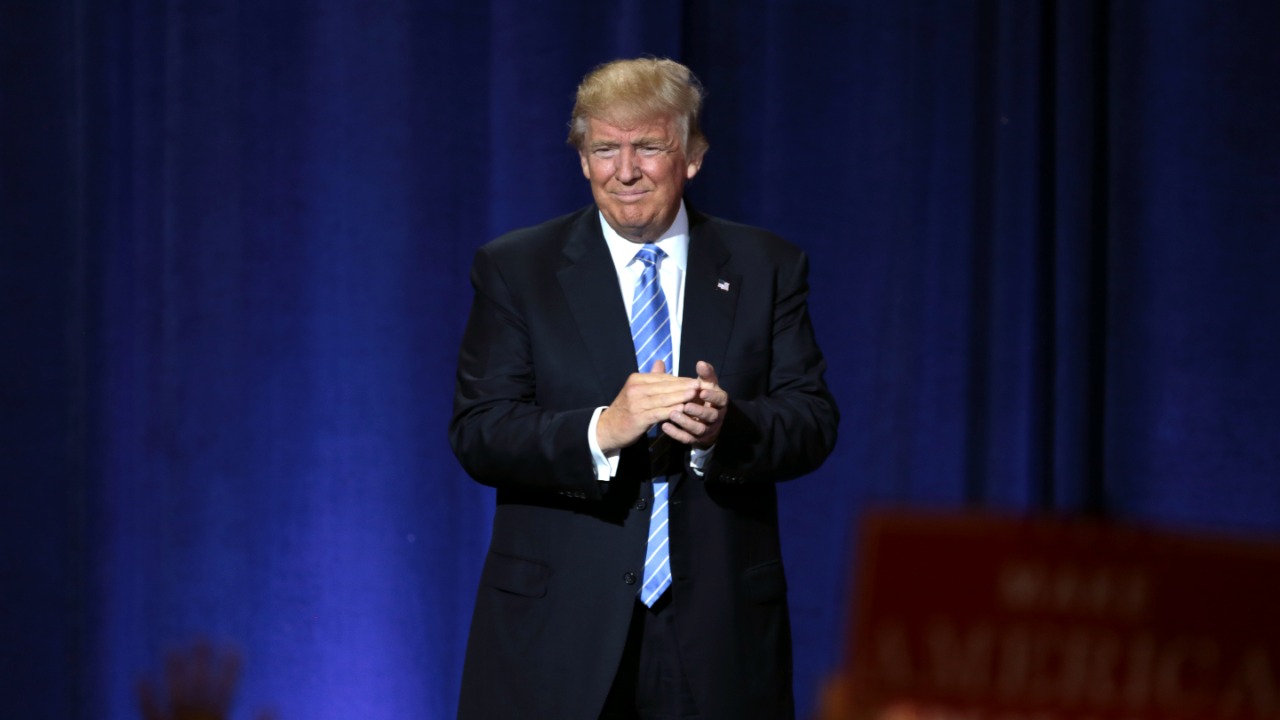
President Donald Trump is openly entertaining the idea that Americans could one day face a federal income tax bill of zero, framing it as the logical next step after a series of cuts that have already reshaped the tax code. The White House is now signaling that staff are actively studying alternatives, turning what once sounded like a campaign applause line into a live policy question with enormous stakes for workers, investors and the federal budget.
As the administration tests how far it can push the promise of “no income tax,” the emerging picture is a mix of sweeping rhetoric and incremental moves, from targeted breaks on overtime and tips to broader proposals that would exempt large swaths of earners altogether. I see a pattern taking shape: a political bet that voters will embrace the dream of $0 income tax even as experts warn that the tradeoffs could be profound.
Trump’s $0 income tax tease moves from slogan to live option
Trump has started talking about the end of the federal income tax not as a distant fantasy but as something that “may soon” arrive, telling supporters that Americans could stop paying income tax if the government can replace that revenue with other streams. In recent remarks, he has floated the idea that tariffs on imports could shoulder far more of the load, hinting that wage taxes might be swapped out for levies collected at the border instead. That shift in tone, from a campaign-style wish to an option under active review, is what now has budget analysts and business leaders treating the prospect as a serious policy path rather than a throwaway line.
Inside the administration, officials are describing a process in which staff are exploring “alternative revenue streams” that could allow the federal government to function without the current personal income tax structure. Trump has already framed this as part of a broader effort to overhaul how Washington raises money, telling audiences that the United States could rely more heavily on taxes that fall on consumption and trade instead of paychecks. According to one account of his recent comments, he has suggested that Americans might “pay no income tax” if the government leans harder on other sources of funding, a vision that would represent the most sweeping change to the tax system in more than a century and that is now being examined inside the White House as a real, if highly disruptive, option for the American government.
From megabill cuts to targeted breaks: the road to “no tax”
The $0 income tax talk does not arrive in a vacuum. Trump has already signed a sweeping tax “megabill” that locked in lower rates and expanded breaks in ways that heavily favored upper-income households. Nonpartisan analysts estimate that More than 70 percent of the net tax cuts in that law flow to the richest slice of taxpayers, reinforcing a pattern in which the biggest dollar benefits accrue at the top even as the White House sells the package as middle class relief. That earlier legislation also made the lower brackets from the Tax Cuts and Jobs Act permanent, cementing the structure of the 2017 law and setting the stage for more aggressive promises about what might come next.
Alongside those broad changes, Trump has pushed a series of targeted breaks that preview how a “no income tax” agenda might be built piece by piece. The White House’s “One Big Beautiful Bill” pitch highlighted the idea of exempting overtime pay from federal withholding, with officials touting that, on average, Americans could receive up to $1,400 more per year from no tax on overtime, and even citing a figure of $1,400 m in promotional material. The Internal Revenue Service has since issued guidance on related deductions, including a new break for service workers’ tips and extra hours, capping the maximum annual deduction at $12,500 for single filers and $25,000 for joint filers while phasing it out for higher earners, a structure detailed in the latest Nov guidance.
Who wins from Trump’s evolving tax blueprint
When I look at the distributional tables for Trump’s tax agenda so far, the pattern is stark. One detailed analysis of his 2024 plan found that if the proposals were fully in effect in 2026, the richest 1 percent of households would receive an average tax cut of about $36,300, while the bottom 20 percent of Americans would see an average benefit of about $800. Those figures underscore how the largest gains cluster at the top, even as the administration frames the package as a broad-based tax cut that helps workers and families across the income scale.
The same analysis shows that the structure of the cuts, from rate reductions to expanded business preferences, amplifies existing inequality rather than narrowing it. By locking in lower brackets from the Tax Cuts and Jobs Act and layering new breaks on top, the plan channels a disproportionate share of the benefits to high earners and investors. That tilt is central to the critique from budget watchdogs, who argue that Trump’s evolving blueprint, including his talk of eliminating the income tax entirely, would deepen the advantages of those already at the top of the income ladder, a conclusion reflected in the $36,300 estimate for the top 1 percent.
How experts say a world without income tax would work
Economists who have examined Trump’s rhetoric about abolishing the income tax tend to agree on one point: the money has to come from somewhere. In recent campaign-style speeches, he has talked about wiping out personal income taxes and replacing them with tariffs, suggesting that higher levies on imported goods could fund the federal government in place of wage-based taxes. Experts quoted in those assessments warn that such a shift would likely raise consumer prices, hit lower and middle income households through higher costs at the checkout line, and still fall short of fully replacing the revenue that the income tax currently generates.
Some analysts have tried to sketch what the United States would look like under Trump’s preferred scenario, in which the federal income tax is abolished and replaced entirely with other sources. One recent examination of his comments notes that President Donald Trump believes the income tax will be scrapped in the near future and swapped out for alternative levies that together equal roughly 13 percent of GDP, a scale that would require either very high tariffs, a broad national consumption tax, or deep cuts in federal spending. That same analysis of what a post income tax America might entail underscores the tradeoffs for Social Security, Medicare and defense if lawmakers try to maintain current services without the revenue that now comes from personal income taxes, a concern that runs through the President Donald Trump scenario modeling.
Middle class promises, bracket politics and the $150k line
Even as Trump talks about a future with no income tax at all, he is also advancing more immediate ideas that would carve large groups of earners out of the system. Earlier this year, reports surfaced that President Donald Trump is seeking to eliminate federal income taxes for Americans earning less than $150,000, effectively drawing a bright line between those he casts as “working Americans” and higher earners who would continue to pay. Under that concept, a household making under the $150 threshold could see its federal income tax liability drop to zero, while those above it would still owe, a structure that would dramatically shrink the tax base and concentrate collections on upper income brackets.
At the same time, the administration has moved to cement the current rate structure for everyone else. New guidance on Trump’s tax brackets confirms that his plan would make the Tax Cuts and Jobs Act, often shortened to TCJA, brackets permanent, locking in the lower marginal rates first enacted in 2017. Analysts note that this permanence, combined with the megabill’s additional cuts, amplifies the tilt toward higher earners identified by the Institute on Taxation and Economic Policy, a dynamic highlighted in the Key Takeaways on how the brackets interact with Trump’s broader agenda. For a typical dual earner couple in a place like Phoenix or Charlotte, that means a mix of modest rate relief, potential new deductions on overtime or tips, and the possibility, if the $150,000 idea advances, of falling entirely outside the federal income tax net.
The political gamble behind $0 income tax talk
Trump’s suggestion that Americans might soon pay no income tax is as much a political signal as a policy blueprint. By dangling the prospect of a $0 bill from the IRS, he is inviting voters to imagine a world in which their paychecks arrive untouched by Washington, even if the fine print would likely involve higher tariffs, new consumption taxes, or spending cuts that show up elsewhere in their lives. In that sense, the promise functions as a powerful campaign message, one that taps into long standing resentment of the tax code and the annual ritual of filing returns.
Yet the details emerging from expert analyses and official documents point to a more complicated reality. The megabill’s structure, which sends more than 70 percent of its net cuts to the rich, the distributional estimates that give the top 1 percent an average benefit of $36,300, and the reliance on permanent Tax Cuts and Jobs Act brackets all suggest that the biggest winners from Trump’s tax revolution are those already doing well. When I weigh those numbers against the rhetoric of relief for ordinary workers, the gap is hard to ignore. The White House may indeed be studying how to move toward a world with no income tax, but the path it has taken so far shows that who benefits, and who pays in other ways, will matter just as much as the headline promise of a $0 line on the 1040.
More From TheDailyOverview
- Tennessee loses $2.6B megafactory and faces major layoffs
- Retired But Want To Work? Try These 18 Jobs for Seniors That Pay Weekly
- What to do with your pennies after the U.S. stops minting them
- Home Depot CEO warns of a troubling customer trend in stores

Julian Harrow specializes in taxation, IRS rules, and compliance strategy. His work helps readers navigate complex tax codes, deadlines, and reporting requirements while identifying opportunities for efficiency and risk reduction. At The Daily Overview, Julian breaks down tax-related topics with precision and clarity, making a traditionally dense subject easier to understand.

