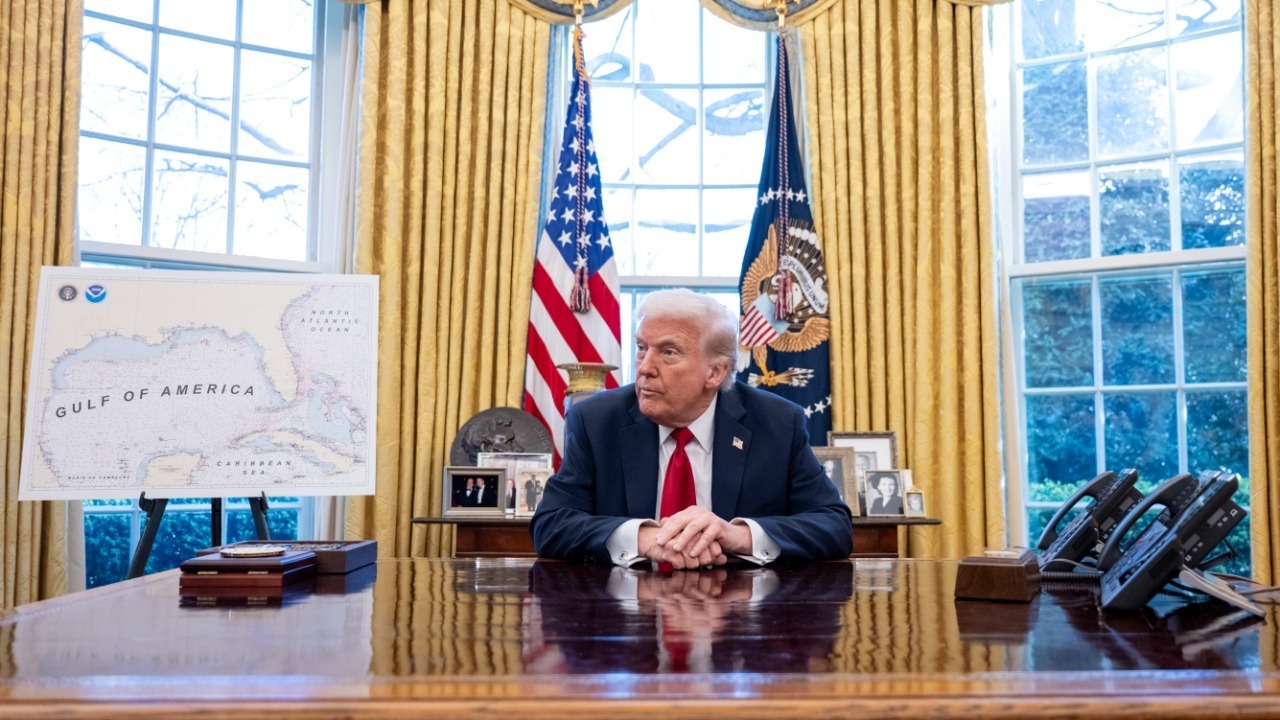
President Donald Trump is arguing that the real payoff from his tariff strategy has yet to show up in the data, even as critics point to higher prices and political backlash at home. He is casting the policy as a long game, insisting that the headline numbers understate what he calls a coming windfall for the United States and for households.
In recent days he has sharpened that message, telling supporters that tariff revenue will surge, that the “full benefit” of his duties has not been felt, and that new payments to Americans could eventually turn trade penalties into something closer to a dividend check. The gap between those promises and current public opinion is now one of the central economic arguments of his presidency.
Trump’s promise of untapped tariff gains
Trump has been working to reframe tariffs from a defensive tool into a growth engine, describing them as the foundation of a future boom that current statistics do not yet capture. In a video posted in Nov, he delivered what was billed as a Big Statement Over Tariff Plan, declaring that the outcome of his approach will “make US One Of The Richest” and arguing that foreign producers, not American taxpayers, will shoulder the cost. That framing is designed to turn a complex trade regime into a simple story of other countries paying the bill for U.S. prosperity.
He has paired that rhetoric with a specific claim that the gains from his duties are still in the pipeline rather than fully reflected in current growth or wage figures. In coverage dated Nov 23, 2025, he is quoted saying the Full Benefit Of Tariffs Still Coming, predicting that tariff “Payments Will Skyrocket” as more imports are captured and as enforcement tightens on goods that might otherwise slip through. I read that as an attempt to preempt criticism that the policy has not yet delivered the sweeping gains he once implied, by arguing that the real payoff is still ahead.
Revenue surge versus household strain
On the government’s balance sheet, there is evidence that tariff collections have already climbed sharply, even before any future “skyrocketing” that Trump anticipates. Recent budget data show that in the latest Fiscal Year the federal government raised $195 billion in customs duties, more than 250% of what it collected in Fiscal Year 2017 before his trade agenda took hold. That jump helps explain why Trump is so confident that tariffs can fund new promises, and it gives him a concrete figure to point to when he argues that foreign exporters are already paying substantial sums into the U.S. Treasury.
Yet those same levies are landing in an economy where consumers are still wrestling with higher prices, and where the political reaction is far from uniformly positive. In a segment dated Nov 23, 2025, a Fox Poll found that 46% of Americans say Trump’s policies have hurt the economy, a figure highlighted in coverage featuring Fox News’ Madeleine Rivera and Rep. Mike Harido. That skepticism underscores the political risk of celebrating revenue gains that, for many households, are intertwined with higher costs on everything from imported electronics to everyday groceries.
The $2,000 tariff ‘dividend’ and who might get it
To bridge the gap between rising federal receipts and voter unease, Trump is now pitching a direct benefit for households funded by those duties. His allies have floated what they describe as a tariff “dividend,” a recurring payment that would send money back to families rather than leaving it parked in Washington. Reporting from Nov 22, 2025, notes that Trump’s idea for a $2,000 tariff dividend payment is still an idea rather than enacted law, and that early discussions have included a smaller $200 amount for some recipients. The same reporting, framed under the question “When will the $2000 tariff dividend payment be paid?”, makes clear that there is no firm timeline, which is why I see this more as a political signal than a near term budget item.
Trump’s allies have tried to flesh out how such a program might work in practice, especially for “most Americans” who fall below certain income thresholds. A separate account dated Nov 23, 2025, describes How Trump plans to fund $2,000 tariff ‘dividend’ checks for most Americans, crediting reporter Taylor Herzlich and noting it was Published Nov 24, 2025. That piece ties the proposed $2,000 figure directly to the surge in tariff revenue, arguing that if collections continue to grow, they could be recycled into payments that help make the cost of living more affordable, particularly for households at or below the federal poverty level.
‘Revenue will skyrocket’ and the global backdrop
Trump’s insistence that the gains are still ahead is not just about domestic politics, it is also a message to trading partners that the United States is prepared to live with, and even embrace, a high tariff world. In live coverage from Nov 24, 2025, he is quoted saying that Revenue will ‘skyrocket’ under his approach, even as The White House quietly prepares a backup plan while the Supreme Court weighs legal challenges to his trade authority. That same reporting notes that Trump and China’s Xi Jinping held their first call since a US China truce, and that signs of friction with the European Union are emerging, a reminder that tariff policy is now inseparable from broader diplomatic maneuvering.
At home, the promise of future gains collides with the reality that consumers are still grappling with price struggles tied in part to those same duties. The live updates describe how consumers grapple with price struggles even as Trump touts the upside, underscoring the tension between macro level revenue gains and micro level household budgets. I see that tension as central to whether his argument about uncounted benefits will resonate: if families feel squeezed at the checkout line, promises of future “skyrocketing” receipts may sound abstract, unless they are paired with something tangible like the proposed dividend checks.
Truth Social warnings and the politics of patience
Trump has not confined his message to formal speeches or policy rollouts, he has also used his social media presence to warn that a major shift in tariff flows is imminent. Coverage dated Nov 23, 2025, notes that Trump just posted a warning on Truth Social early in the morning, saying he expects that tariff payments will soon “SKYROCKET,” a word he put in capital letters. That post, which quickly drew reaction from supporters and critics alike, reinforces his argument that the current numbers are only a baseline and that the real payoff is still ahead if he can maintain or expand his trade leverage.
His allies have echoed that message in financial and political circles, repeating that the Payments Will Skyrocket once foreign shippers fully adjust to the new regime and once enforcement closes remaining loopholes on goods without any avoidance. I read that as a bid to buy political patience, to persuade Americans that the discomfort of higher prices and trade friction is temporary, while the benefits, from $195 billion in annual revenue to potential $2,000 checks, are still being tallied. Whether voters accept that argument will determine if Trump’s claim that the tariff plan’s full gains remain uncounted becomes a vindicated prediction or a political liability.
More From TheDailyOverview
- Dave Ramsey warns to stop 401(k) contributions
- 11 night jobs you can do from home (not exciting but steady)
- Small U.S. cities ready to boom next
- 19 things boomers should never sell no matter what

Grant Mercer covers market dynamics, business trends, and the economic forces driving growth across industries. His analysis connects macro movements with real-world implications for investors, entrepreneurs, and professionals. Through his work at The Daily Overview, Grant helps readers understand how markets function and where opportunities may emerge.

