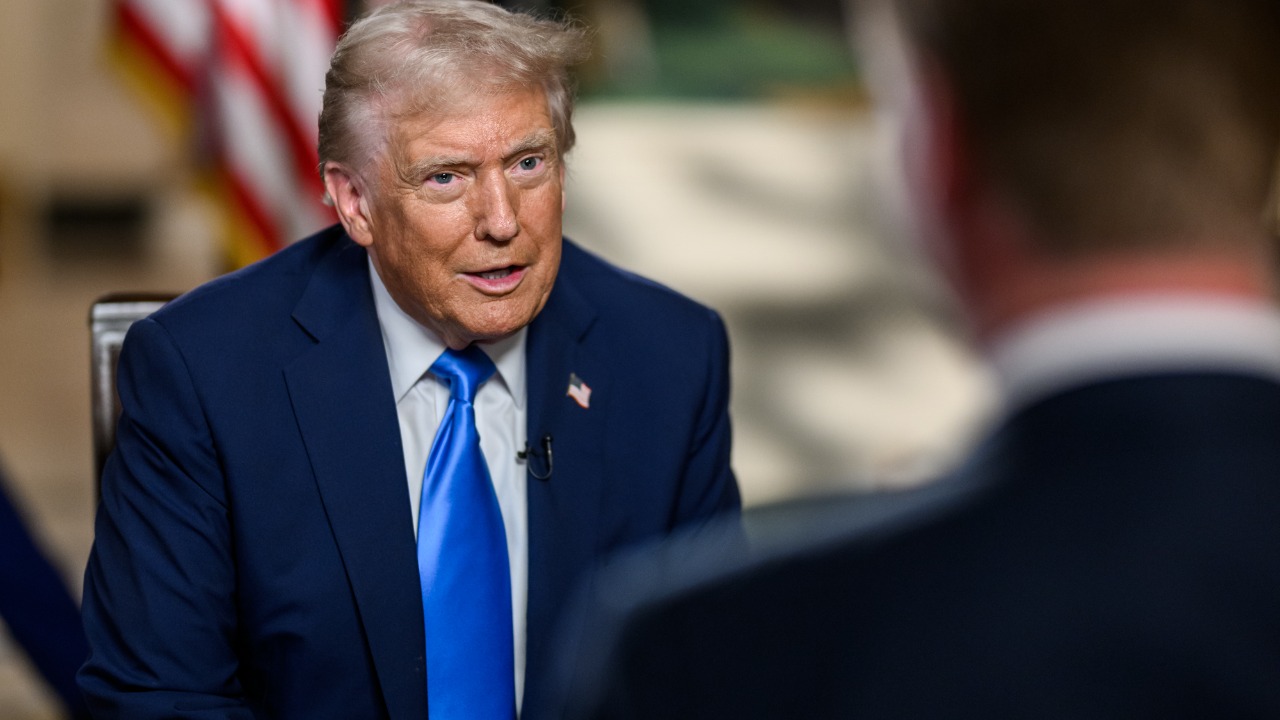
President Donald Trump used a high-profile NBC interview to signal that he sees interest rate cuts as all but inevitable, framing easier money as both an economic necessity and a political expectation. His comments, delivered as he promotes Kevin Warsh to lead the Federal Reserve, sharpen the tension between the White House’s growth agenda and the central bank’s formal independence. They also raise the stakes for households and markets that have been waiting to see whether borrowing costs will finally start to fall.
By insisting there is “not much” doubt that rates will be lowered, Trump is trying to shape the narrative around the next phase of monetary policy before the Fed itself has committed to a path. The message fits a longer pattern in which he publicly pressures central bankers, questions their judgment, and then claims credit when policy moves in his preferred direction.
The NBC sitdown and Trump’s confident call on rates
In his latest televised sitdown, Trump did not hedge his view of where borrowing costs are headed, telling NBC that there is “not much” doubt that interest rates will be cut. That phrasing goes beyond a wish for looser policy and reads as a near-certainty, even though the Federal Reserve has not yet announced any change in its current stance. The remark came as he discussed the broader economy and his own record, reinforcing his long-running argument that lower rates are essential to sustaining growth and keeping markets buoyant, a theme that has defined his public commentary on monetary policy since his first term as President.
The interview also served as a reminder that Trump, whose political identity is closely tied to stock market performance and job creation, sees rate decisions as central to his economic brand. By stating so bluntly that cuts are coming, he is effectively telling voters that he expects the central bank to align with his view, even as he acknowledges that the Fed is “in theory” an independent institution. His confidence in that NBC exchange, captured in his comment about there being “not much” doubt, set the tone for how he is now talking about the next phase of monetary policy.
Warsh, the Fed chair pick who “understands” lower rates
Trump’s confidence about easier money is closely tied to his choice of Kevin Warsh to lead the Federal Reserve. In the same media blitz, he stressed that Warsh “understands” his desire for lower rates and suggested that the two men are philosophically aligned on the need to ease borrowing costs. Trump described Warsh as someone who grasps that the President wants to see cuts and added that “But I think he wants to anyway,” implying that the nominee’s inclination toward looser policy is not simply a response to political pressure but a reflection of his own economic judgment.
That framing is crucial, because it allows Trump to argue that his pick respects the Fed’s formal independence while still being sympathetic to the White House’s priorities. He has said that as US President Donald Trump he expects his central bank chief to be attentive to growth and jobs, and he has presented Warsh as a candidate who can deliver that without overtly compromising the institution. In one account of his remarks, Trump emphasized that Warsh understands the need for lower rates and that this alignment will matter once the current probe against Jerome Powell is resolved, a point he made while discussing the Fed leadership transition.
How far Trump is willing to go to get his way
Trump has also been explicit about the limits he would place on any Fed nominee who did not share his dovish instincts. He has said that Kevin Warsh would have lost the central bank nod if he had pledged to raise rates, a striking admission that underscores how central monetary policy is to Trump’s personnel decisions. In other words, the President is not just looking for a competent technocrat, he is looking for someone who will not stand in the way of his push for cheaper credit, even if that means narrowing the field to candidates who are willing to lean in his direction.
That stance fits a broader pattern in which Trump has publicly scorned previous Fed leaders when they resisted his calls for easier money. He has repeatedly criticized Federal Reserve Chairman Jerome Powell for refusing to bend to his demands to lower rates, arguing that higher borrowing costs have held back growth and markets. In one detailed account of his thinking, Trump made clear that he would not have nominated Warsh to lead the Federal Reserve if Warsh had promised a rate hike, a line that appeared in summary of his and underscored how much he prioritizes alignment on interest rates.
The Fed’s current stance and what markets expect
Trump’s confident talk about cuts comes against a backdrop of a central bank that has, so far, held its ground. At its most recent policy meeting, The Federal Reserve kept its benchmark rate in a target range of 3.5% to 3.75%, opting to pause rather than tighten further. That decision reflected a judgment that inflation pressures have eased enough to justify patience, but not yet enough to declare victory or pivot decisively toward easing. For markets, the move reinforced the sense that the Fed is in a holding pattern, waiting for clearer data before committing to a new direction.
Even so, investors have been gaming out the odds of at least one rate cut later this year, especially if growth slows or inflation continues to drift lower. Analysts who track the Fed’s benchmark decisions have noted that futures markets are already pricing in the possibility of a reduction, potentially as early as the spring, and that expectations for at least one rate cut in 2026 are building. That context helps explain why Trump feels comfortable talking as if easier policy is a foregone conclusion, even though the central bank has not yet signaled such a move. The current 3.5% to 3.75% range, and the speculation about whether a cut could come as soon as March, were laid out in a recent analysis of the that highlighted how sensitive markets remain to every hint of a shift.
Trump’s evolving relationship with Fed independence
For all his pressure on the central bank, Trump still pays lip service to the idea that the Fed is not supposed to be a political arm of the White House. In his NBC interview, he described the Federal Reserve as “in theory” an “independent” institution, a carefully chosen phrase that both acknowledges the formal structure and hints at his skepticism about how it operates in practice. He has long argued that central bankers are too cautious and too insulated from the real economy, and he has suggested that their reluctance to cut rates more aggressively has hurt workers and businesses that rely on affordable credit.
At the same time, Trump has been clear that he sees room for presidential influence when he believes inflation is under control. He has pointed to low price pressures as a justification for pushing the Fed to ease, noting that “Now, there’ll be times if I see inflation on the horizon. But we don’t have that,” and citing a figure of 1.2% inflation as evidence that the central bank can safely lower borrowing costs. In that same discussion, he argued that rates are “way high in interest” and that the priority should be to “get down the interest rates,” comments that appeared in an account of his and in a separate excerpt where he stressed that with inflation at 1.2% there is room to cut, captured in another segment of the.
Powell, past frustrations, and the Warsh contrast
Trump’s push for lower rates under Warsh is also a reaction to his bruising experience with Jerome Powell. Over the years, he has made little secret of his frustration with Federal Reserve Chairman Jerome Powell, accusing him of ignoring presidential pleas for easier money and of tightening policy too aggressively. Those clashes have shaped Trump’s view of what he wants in a central bank chief, and they help explain why he is now so insistent that his new nominee share his instincts on interest rates from the outset.
In one wide-ranging conversation that touched on topics from Minneapolis to Joe Rogan, Trump returned to his grievances with Powell, saying that Powell’s refusal to lower rates when asked had been a persistent source of irritation. He contrasted that experience with his confidence in Warsh, whom he portrays as someone who understands the economy “better than almost everybody” and who will not repeat what he sees as Powell’s mistakes. That contrast between a resistant Powell and a more aligned Warsh was highlighted in a recent account of Trump’s remarks, which underscored how personal his approach to Fed policy has become.
Political stakes and what rate cuts would mean for households
Behind the institutional drama lies a simple political reality: lower rates are popular with many voters, especially those who carry credit card balances, have adjustable-rate mortgages, or are looking to buy homes and cars. If the Fed does cut, Trump will almost certainly claim that his pressure campaign and his choice of Kevin Warsh helped deliver relief, reinforcing his narrative that he fights for ordinary borrowers against cautious technocrats. That storyline is central to how he wants to be seen, as a leader who understands the economy at a granular level and is willing to challenge established norms to get results.
At the same time, Trump’s assertive rhetoric carries risks if the Fed ultimately moves more slowly than he predicts or if inflation flares up again after cuts. By telling NBC that there is “not much” doubt about lower rates, he has raised expectations that may be difficult to meet if data do not cooperate. Markets, households, and political opponents will all be watching to see whether his confident forecast aligns with reality, and whether the central bank under Warsh can balance the President’s demands with its own mandate. The stakes are high enough that even the basic biographical fact of who Donald Trump is, captured in a standard profile of the, now comes bundled with questions about how far he will go to reshape the Fed and the path of interest rates.
More From The Daily Overview
*This article was researched with the help of AI, with human editors creating the final content.

Grant Mercer covers market dynamics, business trends, and the economic forces driving growth across industries. His analysis connects macro movements with real-world implications for investors, entrepreneurs, and professionals. Through his work at The Daily Overview, Grant helps readers understand how markets function and where opportunities may emerge.

