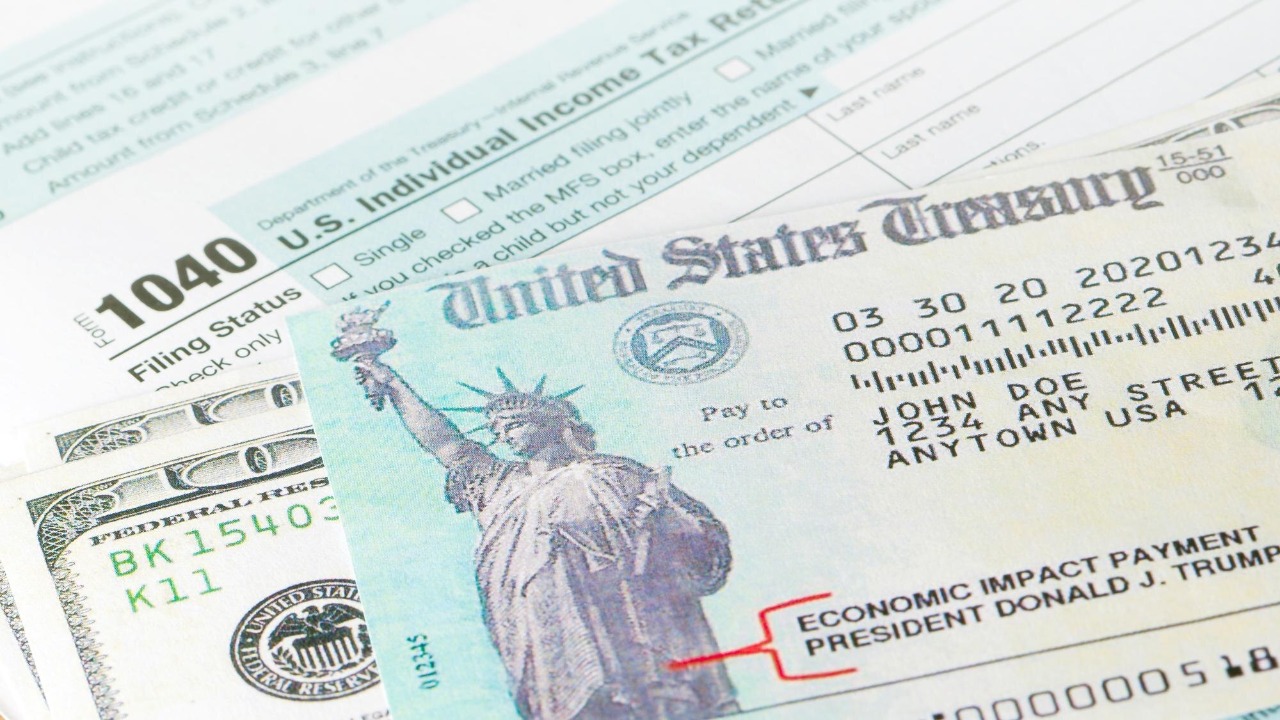
President Donald Trump is still talking about big money from tariffs, but his latest comments on stimulus checks are far more cautious than the sweeping “trillions” language that helped ignite viral rumors. Instead of promising instant windfalls, he is now framing potential $2,000 payments as a long‑term goal tied to future revenue and congressional action, leaving Americans caught between hopeful headlines and hard fiscal math.
As the holiday season collides with rising prices and lingering pandemic debt, the gap between what people think they have been promised and what Washington has actually approved is widening. I am seeing confusion fueled by misleading posts about “Direct Payments Approved” and “Dec deposits,” even as federal agencies and budget analysts stress that no automatic $2,000 stimulus is locked in for this year.
Trump’s tariff windfall pitch meets budget reality
Trump’s stimulus pitch rests on a simple political story: tariffs on foreign goods will generate enough cash to send Americans a sizable check. Supporters have circulated projections that tariffs could bring in $200 billion to $300 billion annually, a figure he has used to justify talk of a “tariff dividend” that could underwrite $2,000 checks. In public appearances, including a widely shared video where President Trump boasts that the United States is bringing in “trillions of dollars” from tariffs, the message is that trade policy alone can fund generous direct payments without raising taxes on households.
When I compare that rhetoric with the fine print, the story becomes more complicated. Budget analysts note that even if tariff revenue eventually reaches the $200 billion to $300 billion range, that money is already intertwined with broader federal spending and deficit pressures, not sitting in a separate pot marked “stimulus.” A detailed explainer on the proposal underscores that the so‑called tariff dividend checks are still a political concept, not a line item in law, and that any plan to send $2,000 to every adult would require Congress to authorize both the spending and the distribution mechanism, regardless of how much Trump says tariffs are bringing in.
What Trump has actually said about $2,000 checks
Trump’s own language on the payments has shifted from sweeping promises to more conditional phrasing. In a video explainer on the proposal, he told Americans that an influx of cash could be headed their way, highlighting a plan to offer $2,000 per person funded by tariffs and framed as a reward for enduring higher prices on imported goods. That early rollout leaned heavily on the idea that the money was already effectively collected from foreign producers, which made the checks sound like a straightforward rebate rather than a new federal program.
As scrutiny has grown, Trump has started to narrow his language and emphasize eligibility and timing instead of repeating the “trillions” line. In a detailed update, Donald Trump Gives Update on the plan and Outlines Who Is Eligible, with President Donald Trump stressing that any payments would be targeted and routed through the Treasury Department rather than appearing automatically in every bank account. That more measured tone, focused on who might qualify and how the checks would be delivered, marks a clear step back from the earlier suggestion that tariff revenue alone had already guaranteed a universal payout.
Rumors of “Dec” deposits and the IRS myth
While Trump has been recalibrating his message, social media has raced ahead with its own version of events. Viral posts claim that the Direct Payments ApprovedIRS has green‑lit automatic $2,000 transfers and that Millions will Receive Funds Starting DecemberDirect Payments Appro” has been lifted out of context to suggest a formal government program, even though the underlying proposal is still just that, a proposal, with no enacted statute or Treasury directive behind it.
Fact‑checkers have pushed back hard on the idea that a secret stimulus is already in motion. A detailed review of the claim concludes that There is no law, no official IRS announcement, and no Treasury program supporting the rumor of guaranteed December deposits. Another Fact check on whether the IRS approved a $2,000 direct deposit for Dec finds that tax authorities and the Treasury Department have released zero guidance on any such program, underscoring that the viral graphics are marketing spin, not federal policy.
Where the $2,000 “tariff dividend” really stands
Strip away the rumors and the core question remains: is a $2,000 tariff‑funded stimulus actually on the way, and if so, when? A detailed eligibility explainer asks bluntly, Are we getting a $2,000 stimulus check in 2025 and walks through the status of the Trump tariff dividend. The answer is that the idea is still being floated inside the administration and among allies on Capitol Hill, but it has not cleared the legislative hurdles that would turn it into a binding commitment, let alone a scheduled payment.
Separate reporting on how to check your $2000 tariff rebate eligibility underscores that the plan is still stuck in the realm of “is money coming” rather than “money is on the way.” Analysts note that the Congressional Budget Office has reviewed the concept of a tariff rebate worth $200 per month or a lump‑sum $2,000 payment, but the necessary legislation has not moved through Congress as of yet. That gap between political messaging and statutory reality is exactly why Trump’s more recent comments have shifted toward describing the checks as a goal that depends on lawmakers, not as a guaranteed dividend already funded by tariff “trillions.”
Trump’s latest update, timelines, and who might benefit
Trump’s most recent public update on the checks has focused less on the size of the pot and more on the mechanics of distribution. In a detailed breakdown of Is the Trump tariff dividend, reporters note that During a cabinet meeting held on a Tuesday, the President framed the checks as a “tariff rebate” that would likely be targeted to taxpayers below certain income thresholds. That framing aligns with his earlier promise to outline who is eligible, but it also implicitly acknowledges that not everyone will receive a payment and that the program would need to be carefully structured to avoid ballooning costs.
On timing, the administration has been even more guarded. A detailed Q&A on When Americans might see the $2,000 stimulus notes that The White House has not released an exact timeline and that officials describe the schedule as “still under discussion.” That kind of language is a far cry from the confident “trillions” rhetoric that suggested checks were imminent, and it reinforces the reality that even a fully fleshed‑out plan would take months to implement once Congress acts.
Scams, expectations, and why “Dec” is unlikely
The vacuum between Trump’s aspirational promises and the slow grind of legislation has created fertile ground for scammers. A detailed look at whether Dec will bring a $2k direct deposit concludes that a $2,000 stimulus has not been approved and that no federal agency or congressional leader has signed off on automatic payments. That same reporting warns that messages claiming guaranteed deposits are often tied to phishing attempts or identity‑theft schemes that ask people to “verify” bank details or Social Security numbers in order to “reserve” a check.
For ordinary People trying to budget for rent, groceries, or a car payment on a 2022 Honda Civic, the most important takeaway is that a surprise $2,000 deposit is highly unlikely to land in accounts this month and that any real program would probably not arrive until 2026 at the earliest. A separate breakdown of whether Latest stimulus chatter is real or fake stresses that people should treat unsolicited messages about guaranteed checks as red flags, especially when they come from unofficial accounts or ask for upfront fees. In that sense, Trump’s quieter, more conditional language on the tariff dividend may be doing the public a favor, dialing down expectations that “trillions” in tariff revenue have already been converted into cash that is just waiting to be wired out.
More From TheDailyOverview

Cole Whitaker focuses on the fundamentals of money management, helping readers make smarter decisions around income, spending, saving, and long-term financial stability. His writing emphasizes clarity, discipline, and practical systems that work in real life. At The Daily Overview, Cole breaks down personal finance topics into straightforward guidance readers can apply immediately.

