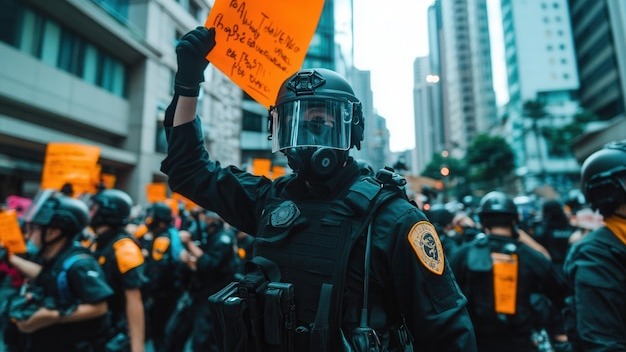
Protests that began after a federal immigration officer shot a man in Minneapolis have escalated into a national test of presidential power, as President Donald Trump threatens to invoke the Insurrection Act to send active-duty troops into Minnesota. The confrontation is no longer only about a deadly encounter on an icy city street, but about how far the White House is willing to go to confront dissent at home. I see a collision forming between a centuries-old emergency law, a furious public, and local leaders who insist they can police their own streets.
From ICE shooting to street unrest
The immediate spark for the unrest was a second immigration-related shooting in Minneapolis, when an Immigration and Customs Enforcement operation ended with a man fatally shot after what officials described as a confrontation during a traffic stop. According to detailed local accounts, an official has said the agent who killed the man, identified as Good, was injured, and that Good was killed after three shots were fired during a struggle that unfolded in a city still haunted by the killing of George Floyd on the same street in May 2020, a sequence that has been reconstructed in Good’s shooting. The fact that this latest killing involved ICE, in a city already synonymous with police violence, meant outrage was almost guaranteed.
Within hours, crowds gathered outside federal buildings and in north Minneapolis neighborhoods, chanting against immigration enforcement and demanding accountability from both local police and federal agents. Live coverage has described federal officers in tense face-offs with demonstrators, with lines of agents in tactical gear confronting residents who see the shootings as part of a broader pattern of abuse, a scene captured in rolling updates on the Minneapolis protests. I read those images as more than a clash over one incident; they are a referendum on how immigration enforcement is carried out in urban communities that already distrust law enforcement.
Trump’s Insurrection Act threat
Into this volatile mix stepped President Donald Trump, who has publicly warned that he is prepared to invoke the Insurrection Act if Minnesota officials do not, in his view, regain control of the streets. In a post on Truth Social, President Donald Trump said he would use the Insurrection Act to deploy the U.S. military if Minnesota politicians failed to stop what he called lawlessness, a threat that has been summarized in national live updates on Minnesota tensions. I see that message as both a warning to local leaders and a signal to his political base that he is willing to use extraordinary force in the name of order.
Trump has repeated the threat in multiple forums, framing it as a necessary step to protect federal officers and property in Minnesota if protests continue to target immigration enforcement. One detailed explainer notes that Trump has said he would invoke the Insurrection Act in Minnesota if officials there, in his words, do not let federal officers “do their job,” a formulation that underscores how he is tying the use of troops directly to support for ICE and other agencies, as laid out in an analysis of Trump’s threat. I read that linkage as deliberate, turning a legal question about domestic deployment of troops into a loyalty test over federal immigration crackdowns.
What the Insurrection Act actually allows
To understand the stakes, it helps to be clear about what the Insurrection Act is and what it is not. The law, first enacted in 1807, empowers a president to deploy the U.S. military on domestic soil to suppress civil disorder, insurrection, or rebellion, and legal analysts have stressed that The Insurrection Act is one of the few statutes that can pierce the usual limits on using active-duty troops for law enforcement, a point spelled out in primers on The Insurrection Act. I see that history as a reminder that this is not a routine tool, but a legal emergency brake that has been pulled only in moments of extreme crisis.
Past presidents have used the Insurrection Act to enforce desegregation orders or to respond to large-scale unrest when state authorities were either unable or unwilling to act, but it has rarely been invoked in the context of protests over federal law enforcement operations. Commentators tracking Trump’s rhetoric note that he has previously threatened to use the Insurrection Act elsewhere without ever doing so, and that he is now again raising the possibility in Minnesota as protests over ICE enforcement spread, a pattern that has been highlighted in coverage citing Reuters reporting. When I weigh that history, I see a president who treats the mere mention of the law as a political weapon, even if he ultimately stops short of signing the order.
On the ground in Minneapolis
While the legal debate plays out, the human cost in Minneapolis is already visible. City officials have confirmed that tear gas deployed by federal agents outside a federal building left Two children hospitalized, including an Infant who was taken to a medical center after exposure, an alarming detail that has been documented in local updates on the tear gas incident. When I look at those accounts, I see not just a clash between officers and protesters, but families caught in the crossfire of crowd control tactics that can have serious health consequences.
At the same time, federal officers and local police describe a tense, fast-moving environment in which they say some demonstrators have thrown objects and tried to breach security perimeters around ICE facilities. National live blogs have reported that President Donald Trump’s threat to use the Insurrection Act in Minnesota came after days of such confrontations, with What we know summaries noting that he framed the move as a response to attacks on officers and property, a narrative that appears in detailed timelines of What we know. I read that framing as an attempt to shift the focus from the original shooting to the behavior of protesters, a move that often precedes calls for harsher crackdowns.
State pushback and legal challenges
Minnesota leaders are not simply waiting to see whether Trump follows through on his threat. The State of Minnesota, along with Citi and other plaintiffs, has already gone to court to challenge a related federal initiative known as Operation Metro Surge, arguing that the law’s facially broad language gives the federal government sweeping powers to conduct aggressive enforcement operations in cities like Minneapolis, a claim laid out in legal filings summarized in the entry on Operation Metro Surge. I see that lawsuit as a sign that state officials are prepared to contest not only the presence of federal agents, but the statutory framework that underpins their deployment.
Inside the administration, some top officials are publicly backing Trump’s authority to go even further. Homeland Security Secretary Kristi Noem has said that Trump has the right to invoke the Insurrection Act in Minnesota, and she has discussed that option with him as protests over the ICE shooting continue, a stance that has been described in coverage of Noem’s comments. When I put that alongside the state’s legal challenge, I see a looming constitutional confrontation between a president eager to expand federal muscle and a state government that insists it can manage its own streets without troops.
More From TheDailyOverview

Silas Redman writes about the structure of modern banking, financial regulations, and the rules that govern money movement. His work examines how institutions, policies, and compliance frameworks affect individuals and businesses alike. At The Daily Overview, Silas aims to help readers better understand the systems operating behind everyday financial decisions.

