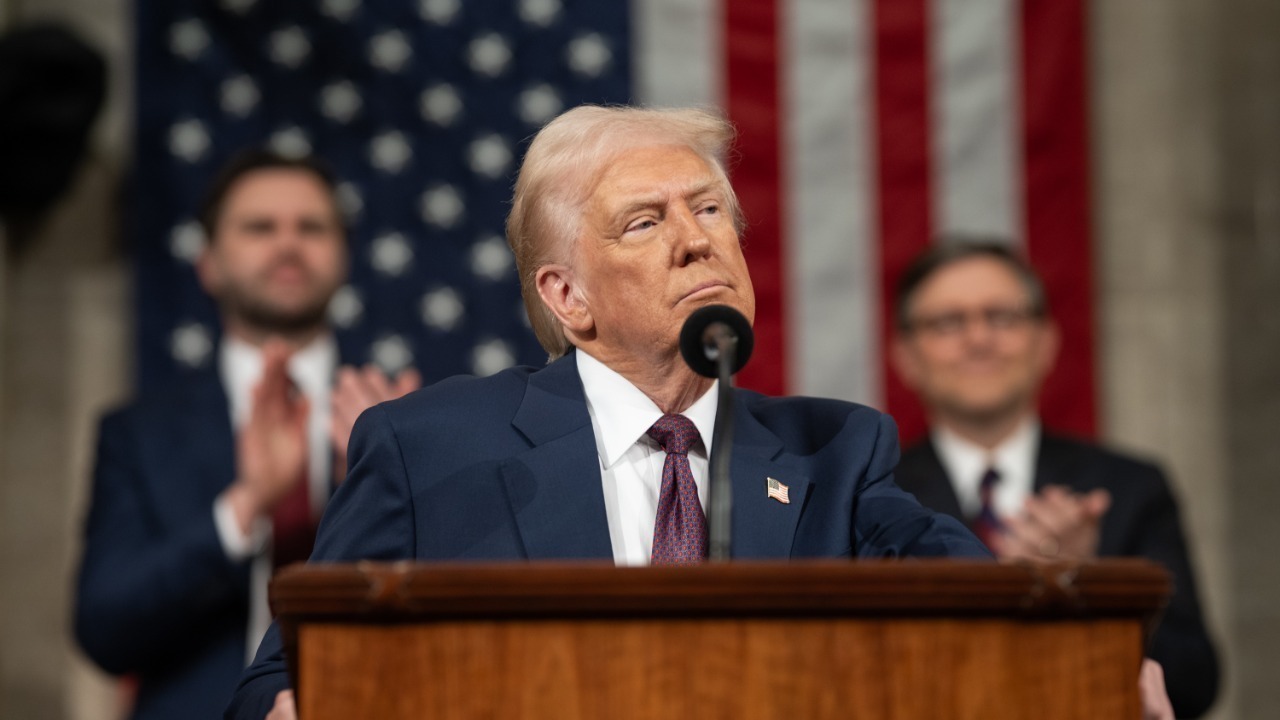
President Donald Trump is trying to turn his long-running feud with federal tax authorities into a multibillion-dollar payday, arguing that the government owes him $10 billion for supposedly wrecking his finances and good name. At 79, he is not just seeking personal vindication, but attempting to shift the costs of his legal and political battles onto the public. If he succeeds, the bill for his grievances would land squarely in the laps of American taxpayers.
The lawsuit is the latest expression of a familiar pattern: Trump casts neutral institutions as corrupt enemies, claims to be the real victim and then looks for ways to monetize the outrage. What he presents as justice for himself looks, on closer inspection, like an effort to turn the federal treasury into a personal reimbursement fund, echoing earlier fights over tax policy and post-election fundraising that left ordinary people paying the price.
The $10 billion gambit against the IRS
In his new lawsuit, President Donald Trump accuses the IRS and the Treasury Department of inflicting “reputational” and “financial” harm so severe that he is entitled to $10 billion in damages. The core claim is that federal tax authorities mishandled or unfairly targeted his returns, damaging his business empire and political standing, and that only an eye-watering cash award can make him whole. It is an extraordinary posture for a sitting president, effectively arguing that the government he leads should compensate him at a scale that would be life-changing even for a billionaire.
According to coverage of the filing, Trump’s complaint names the IRS and the Treasury Department for allegedly abusive conduct, framing routine enforcement and disclosure disputes as a coordinated assault on his character. There is, so far, no public evidence that the agencies did anything other than apply existing law, and the complaint appears to lean heavily on Trump’s own assertions about lost deals and tarnished branding rather than independently verifiable damage. That gap between rhetoric and proof is likely to be a central focus for any court asked to take the $10 billion figure seriously.
Why taxpayers, not bureaucrats, would pay the price
Trump has tried to sell this lawsuit as a way to hold faceless bureaucrats accountable, but any payout would come from the public purse, not from individual officials. Federal judgments and settlements are funded by taxpayers, which means a successful claim would require American households to underwrite Trump’s alleged losses. Reporting on the case has already noted that if the suit somehow prevailed, it would be ordinary Americans, not the IRS as an institution, who would be writing the check.
One detailed account of the filing stresses that, if successful, American taxpayers would ultimately be responsible for the “mammoth settlement,” a reality Which Trump appears to brush aside as he frames the case as a personal reckoning with hostile agencies. A related analysis notes that Trump, 79, is using what critics describe as “bonkers” reasoning to argue that forcing the public to cover his claimed injuries is somehow a blow for fairness, even as the same coverage underscores that Which Trump does not see as a problem. The structure of federal liability means there is no way to isolate the cost to the agencies he blames; the only pocket available is the public’s.
The $230 million bid to socialize his criminal defense
The lawsuit is not Trump’s only attempt to turn public money into a cushion for his legal troubles. Representative Zoe Lofgren has warned that Donald Trump is trying to compensate himself for his criminal cases using taxpayer funds, highlighting a proposal that would direct $230 million to cover his mounting legal bills. In her telling, the plan is not just aggressive, it is flatly unconstitutional, because it would convert the machinery of government into a personal defense fund for the president.
Lofgren has said bluntly that Donald Trump is “trying to rip off the taxpayers” by compensating himself $230 million for his criminal cases, describing the scheme as an attempt to launder private liability through public appropriations. A separate clip of her remarks repeats that Donald Trump is seeking $230 m and $230 million from the public, underscoring the scale of the proposed transfer. If Congress were to bless such a move, it would set a precedent that any future officeholder facing criminal exposure could seek retroactive indemnity from taxpayers, blurring the line between public service and private risk.
Recycling the “victim” script from the Big Lie
Trump’s legal offensive against the IRS fits neatly into a script he has used before: portray himself as the target of a corrupt system, then turn that narrative into a revenue stream. After the 2020 election, his team relentlessly pushed false claims of a stolen race, not just to contest the outcome but to raise money. The House committee that investigated the January 6 attack heard testimony that the so-called “election defense” effort became a lucrative fundraising operation built on misleading supporters about nonexistent legal funds.
Representative Zoe Lofgren, who served on that committee, said during a public hearing that “all elements of the plot relied on convincing his supporters about these false claims,” explaining that the Trump campaign was using the “big lie” to solicit donations from people who believed they were funding a legitimate legal fight. Her comments, captured in a Jan. 6 hearing, framed the fundraising as a “big ripoff” of Trump’s own base. The new IRS lawsuit echoes that pattern, inviting supporters to see him as a persecuted outsider even as he sits in the Oval Office, and to accept that extracting billions from the Treasury is a form of justice rather than a transfer from their pockets to his.
Legal reality check: reputational harm and a shaky foundation
For all the political theater, the legal foundation of Trump’s $10 billion claim looks fragile. Courts are generally skeptical of massive damages awards based on vague assertions of reputational harm, especially when the plaintiff is a public figure who has voluntarily courted controversy. To prevail, Trump would have to show not only that the IRS and Treasury violated specific legal duties, but that those violations directly caused quantifiable losses on the scale he alleges, a bar that is extraordinarily high.
His track record in related civil disputes does not help his case. Earlier litigation over his business practices produced a massive civil fraud penalty for exaggerating financial statements, only for an appeals court to later throw out that penalty after reviewing the underlying record. That reversal, reported in detail by exaggerating financial statements, underscores how volatile these kinds of high-dollar claims can be once they reach appellate judges. It also highlights a tension in Trump’s narrative: he alternates between insisting that his finances are robust and that he has been grievously damaged, depending on which story serves his immediate legal needs.
From tax cuts to personal claims: a pattern of skewed benefits
Trump’s attempt to tap the Treasury for personal compensation cannot be separated from his broader record on tax policy, which has consistently favored corporations and high earners. The Tax Cuts and Jobs Act reshaped the code in ways that delivered significant benefits to businesses, including lower corporate rates and new deductions, while offering more modest and temporary relief to many individual taxpayers. Official comparisons prepared by the IRS for businesses show how the law tilted toward corporate taxpayers, reinforcing the perception that the Trump era treated the tax code as a tool for rewarding capital.
The White House’s own Domestic Policy Council later touted the economic impact of those changes, arguing in a report that the tax cuts spurred investment and growth. Yet the distributional reality was that the largest, most durable gains flowed to corporations and wealthy households, while many middle-class families saw smaller or temporary benefits. Against that backdrop, Trump’s current effort to secure a $10 billion personal award looks less like an aberration and more like an extension of a governing philosophy that treats public resources as a lever for private advantage at the top.
Media narratives, “bonkers logic,” and the politics of persecution
Coverage of the lawsuit has zeroed in on the sheer audacity of Trump’s reasoning, with critics arguing that he is trying to turn accountability on its head. Instead of accepting that a president’s finances will attract scrutiny, he casts that scrutiny as an actionable wrong, then insists that the only remedy is a transfer of wealth from the public to himself. It is a kind of political jujitsu, flipping the normal relationship between citizen and state so that the most powerful officeholder in the country claims to be the aggrieved underdog.
Several analyses have described how Trump, 79, Uses Bonkers Logic to Defend Massive Taxpayer Ripoff, emphasizing that his age has not tempered his appetite for confrontational, grievance-driven politics. One widely shared piece notes that Trump, 79, is leaning into a narrative of persecution to justify a massive claim on public funds. Another version of that coverage, focused on how Trump, 79, Uses Bonkers Logic to Defend Massive Taxpayer Ripoff, underscores that the same framing is being repeated across outlets, with Trump portrayed as both architect and beneficiary of the outrage cycle. I think the dominant focus on the spectacle risks obscuring a more structural concern: if this logic takes hold, future leaders may feel emboldened to treat the Treasury as a personal litigation fund whenever they clash with independent agencies.
More From The Daily Overview
*This article was researched with the help of AI, with human editors creating the final content.

Grant Mercer covers market dynamics, business trends, and the economic forces driving growth across industries. His analysis connects macro movements with real-world implications for investors, entrepreneurs, and professionals. Through his work at The Daily Overview, Grant helps readers understand how markets function and where opportunities may emerge.

