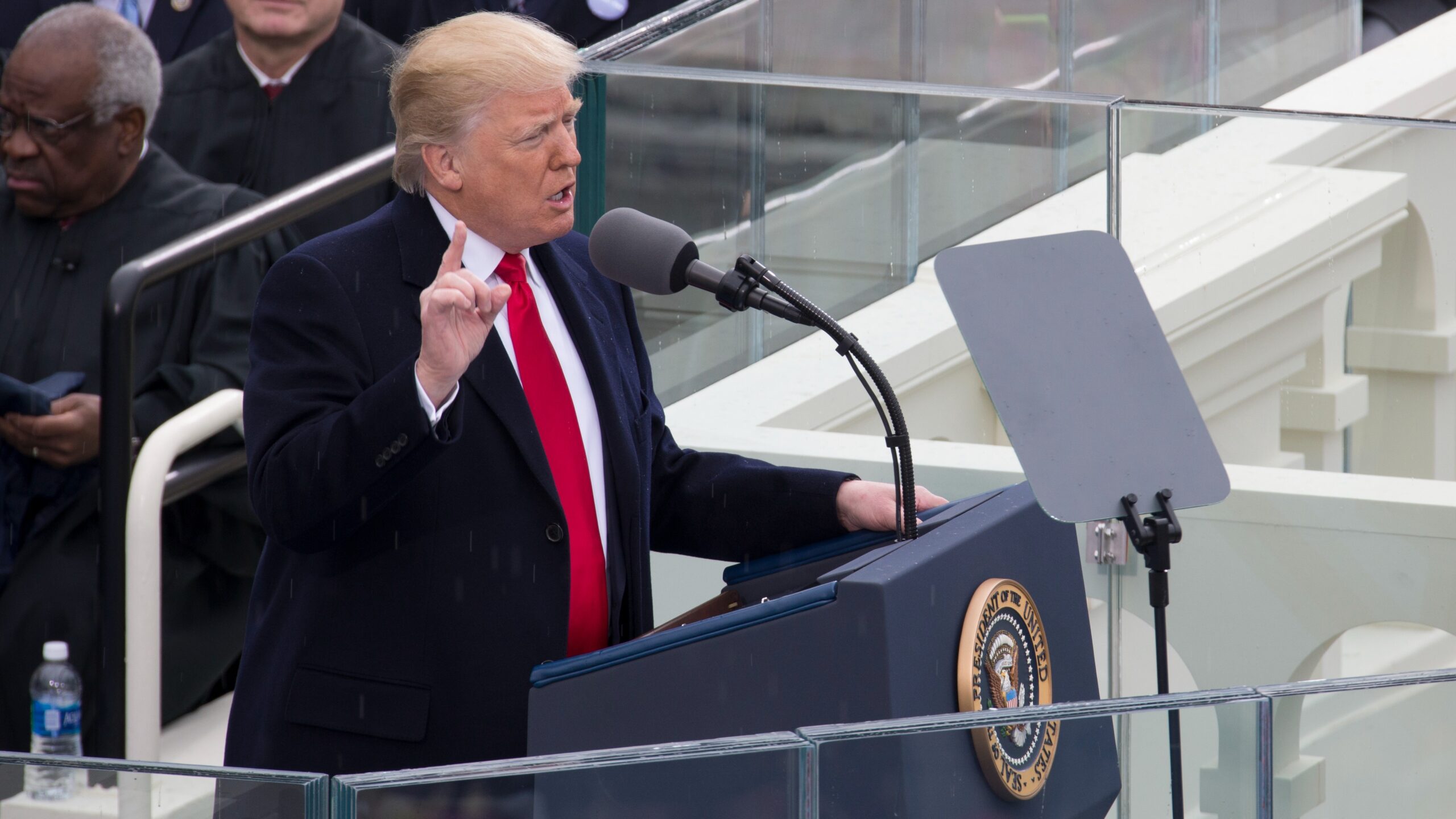
Donald Trump entered his second term promising to “end inflation” and “rapidly bring down costs,” casting himself as the president who would make everyday life cheaper. Instead, new estimates show the typical household shelled out roughly $2,120 more for goods and services in 2025, a gap that has turned a campaign slogan into a kitchen‑table liability. The numbers suggest not only that prices kept rising, but that policy choices in Washington helped keep the pressure on family budgets.
Behind the headline figure is a story of tariffs, corporate pricing power, and a White House that has celebrated victory over inflation even as grocery receipts and utility bills keep climbing. I see a widening disconnect between the confident declarations from President Trump and the lived experience of Working families who are still cutting back, taking on debt, or delaying big purchases to cope with higher costs.
The promise to ‘end inflation’ meets economic reality
When Donald Trump vowed to “end inflation,” he was offering something no modern leader can credibly guarantee: a permanent halt to price growth in a complex, global economy. Economists have stressed that low, stable inflation is actually a hallmark of a healthy system, not a problem that can be eradicated like a virus. By framing any price increase as a failure, the president set expectations that were almost certain to collide with reality, especially once his own policies began to influence costs.
That collision is now visible in household budgets. According to recent analysis from Sen Elizabeth Warren and her staff on the Senate Banking, Housing and Urban Affai panel, families paid an extra $2,120 in 2025 compared with the year before, including hundreds more on rent, utilities and other essentials. That figure lands on top of the $1,625 in higher costs that a separate report, highlighted by Common Dreams and written by Jake Johnson, says the average family absorbed during President Trump’s first year in office.
How tariffs and pricing power kept costs elevated
Inflation in Trump’s Second Term has not been driven only by abstract forces like supply chains or global energy markets. It has also been shaped by deliberate choices, especially a broad expansion of import duties. The president’s second‑term economic agenda has centered on higher tariffs on a wide range of goods, a strategy that Inflation analysts say has raised costs for businesses and, ultimately, consumers. According to the Harvard Business School Pricing Lab, cited in a year‑end review of the administration, the Trump administration’s tariffs are a key reason the costs of everyday household items have risen, even as headline inflation has drifted closer to the Federal Reserve’s preferred range.
Those higher import costs do not stay on corporate balance sheets for long. As one breakdown of the past year put it, the additional costs from tariffs tend to pass through from importers to consumers, a pattern that has shown up in retail prices for everything from electronics to clothing. A review of the Trump economy noted how it affects Americans: the tariff burden has filtered into store shelves and online marketplaces, with Earlier months of 2025 seeing retailers adjust price tags rather than absorb the hit. That pass‑through effect is consistent with the How higher trade barriers typically work, and it helps explain why, according to the Harvard Business School Pricing Lab, inflation remained close to a rate of 2 percent throughout 2025 even as President Trump claimed victory over rising prices in public remarks linked to Harvard Business School findings.
The $2,120 squeeze on family budgets
The $2,120 figure that has grabbed headlines is not a back‑of‑the‑envelope guess, it comes from a structured analysis of federal price data. Staff working for Sen Elizabeth Warren on the Senate Banking, Housing and Urban Affai committee compared what a typical basket of goods and services cost in 2024 with what families paid in 2025, then tallied the difference. Their Fortune‑shared findings show that households spent hundreds more on rent and utilities, roughly $150 extra on groceries, and significant additional sums on transportation and health care. That is on top of the $310 m in extra grocery spending that American families incurred in 2025 compared with the previous year, according to a separate review of federal data that found American families paid $310 more for groceries despite administration messaging that food costs were under control.
The grocery story alone illustrates how persistent the squeeze has been. Even as the White House touted progress, the latest federal data contradicted claims from the adm that supermarket prices had stabilized, with one breakdown noting that American households still paid $310 more for groceries in 2025 than in 2024. Layered on top of higher rent, car insurance and electricity, that extra $2,120 has forced many families to cut back on discretionary spending, delay replacing aging cars like a 2012 Honda Civic or a 2010 Ford Escape, or lean more heavily on credit cards and buy‑now‑pay‑later apps such as Affirm and Klarna to bridge the gap.
Strong GDP, weak affordability
Supporters of the president point to robust growth as evidence that his approach is working. Trump 2.0 has indeed presided over a period of solid economic expansion, with GDP up by 4.4% in the third quarter of 2025, a pace that would be the envy of many advanced economies. That performance, highlighted in recent coverage of GDP, suggests that businesses are investing and consumers are still spending despite higher prices. Yet growth on paper does not automatically translate into a sense of relief at the checkout line, especially when wage gains are uneven and much of the expansion is concentrated in corporate profits and asset markets.
That disconnect is fueling a political backlash. In Washington, the Joint Economic Committee, chaired by Democrats, has warned that American families spent over $1,600 more because of inflation during Trump’s first year, a figure that predates the $2,120 jump in 2025 and underscores how long the affordability problem has been building. A statement from Washington framed the issue bluntly, noting that Today, one year since President Trump began his term, the Joint Economic Committee is still hearing from households whose costs for basics like rent, groceries and electricity are shooting up, a concern detailed in a release tagged with Economy. The result is an economy that looks strong in aggregate but feels fragile on the ground, a tension that is increasingly central to the national debate.
Political messaging vs lived experience
Even as these numbers have emerged, President Trump has doubled down on his narrative that the inflation fight is over. In a recent social media post, Donald Trump promised to “rapidly bring down costs” and, more recently, claimed that “inflation is defeated,” a message amplified in a clip shared by Rep Julia Brownley that contrasted his words with stories from Working families still struggling to pay their bills. That post, which highlighted how Last week’s rhetoric diverged from reality, has become emblematic of a broader communications strategy that leans on optimism even when official data and independent research point in a different direction.
Critics at the state and federal level are seizing on that gap. In New York, Sen Kirsten Gillibrand has argued that Trump promised to lower costs. Instead, New York families are paying over $2,000 more for groceries, transportation, housing and other essentials, a figure she summarized by saying that is $2,000 m out of the pockets of ordinary residents. Her post, which concluded “That’s Trump’s economy,” captured the frustration of constituents who see little relief despite the president’s claims, and it drew on the same pattern documented in national reports that show Instead of falling, household costs have climbed. At the same time, As David A. Steinberg of John Hopkins University has noted, Simply asking people to think about inflation can heighten their anxiety about prices, a dynamic that helps explain why the president’s sweeping promises, amplified in coverage that quoted As David and Steinberg, have backfired as reality has failed to match the rhetoric.
More From TheDailyOverview
*This article was researched with the help of AI, with human editors creating the final content.

Grant Mercer covers market dynamics, business trends, and the economic forces driving growth across industries. His analysis connects macro movements with real-world implications for investors, entrepreneurs, and professionals. Through his work at The Daily Overview, Grant helps readers understand how markets function and where opportunities may emerge.

