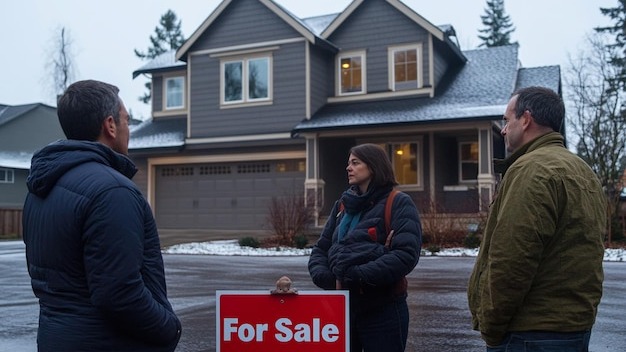
Homeowners across the United States are cutting asking prices by roughly $25,000 to get deals done, a sharp reversal from the bidding wars of just a few years ago. For anyone hoping to move in 2026, that shift is more than a headline, it is a signal that leverage is finally starting to tilt back toward buyers, even as affordability remains tight. The question now is how far this reset goes, and how movers can use it to their advantage without assuming a full scale crash that experts are not forecasting.
Price cuts of that size can reshape budgets, timelines, and even which cities are realistic targets. I see a market where national averages are flattening, but local stories are diverging fast, from cooling Sun Belt boomtowns to steady Northeastern hubs. Understanding that split will matter far more in 2026 than chasing a single national number.
Why sellers are suddenly trimming $25,000 off the top
The most immediate driver of those $25,000 reductions is simple: there are more homes for sale than buyers ready to pounce. Recent data show home sellers now outnumber buyers by the widest margin in more than a decade, a gap that highlights how weak existing home sales remained through 2025 and how far demand has fallen relative to supply as higher borrowing costs bit into budgets gap. With more listings sitting longer than expected, owners who once assumed they could name their price are now confronting a market that pushes back.
Those dynamics are showing up in the numbers. Analysts report that U.S. homeowners are now slashing prices by an average of $25,000 to lock down a deal, marking some of the steepest discounts buyers have seen in almost a decade as properties linger on the market longer than sellers anticipated discounts. Another report underscores that U.S. homeowners are now slashing prices by an average $25K to secure buyers, a pattern that directly affects Americans who hope to make a move in 2026 and are suddenly seeing room to negotiate that simply did not exist during the pandemic boom average $25K.
The Great Housing Reset and a cooler 2026 backdrop
Behind those individual price cuts is a broader shift that some analysts have started calling The Great Housing Reset. In its 2026 outlook, Redfin describes 2026 as the moment when The Great Housing Reset takes shape, with slow demand historically forcing sellers to cut prices while many owners wait for the market to recover before listing. A separate analysis refers to 2026 as The Great Housing Reset as well, noting that The Balanced Market Reality is emerging as Industry analysts see a shift away from the extreme seller dominance of the early 2020s Balanced Market Reality.
Forecasts for 2026 back up that idea of a cooler, more balanced landscape rather than a crash. One major research team, identified as J.P. Morgan Global Research, expects U.S. House prices to stall at 0% in 2026, with Key takeaways pointing to a slight improvement in demand as mortgage rates ease and incomes rise, thereby making homes more affordable even if nominal prices do not fall sharply nationwide House prices. Another forecast frames 2026 as a year when Home Sales To Remain in Low Gear as Balance Holds, with Home Prices Climb, but Not as Fast, which helps buyer incomes catch up and gradually restores some affordability without erasing the gains of the past decade Home Sales To.
Affordability, mortgage payments, and buyer leverage
For would-be movers, the more important story is not just list prices, but monthly payments. One forecast notes that Combined with continued income gains, the decline in mortgage rates should ease the squeeze on affordability, with the typical mortgage payment projected to fall even as nominal prices inch higher, a shift that could finally give buyers some breathing room after years of sticker shock Combined. Another outlook from leading housing economists stresses that Monthly payments ease, with the line Our estimates suggest this will be the first time we see monthly payments decline since 2020, as Mortgage rates drift lower and price growth is expected to slow in 2026 Monthly.
That easing coincides with a shift in negotiating power. Forecasters see 2026 as a housing market reset as buyers gain leverage, with Economists across the housing industry pointing out that First American chief economist Mark Fleming expects slower price appreciation to give households time to shore up finances and approach offers more strategically rather than rushing to waive contingencies Forecasters. Guidance on how much to offer in 2026 underscores that NAR Chief Economist Lawrence Yun told the Residential Economic Issues and Trends Foru that Realtor.com projects 22 of the 100 largest markets will see price declines, a sign that buyers in those metros can afford to be more assertive on price and terms than they could in 2021 or 2022 NAR.
Where prices may actually fall, and where they will not
Nationally, most experts are not calling for a broad price collapse, but they do see pockets of real softness. One forecast notes that Overall, home prices have mostly leveled off over the past two years as new construction has picked up, and there are already signs that some overheated markets could see prices fall in 2026 as supply catches up with demand Overall. In some markets, though, builders have ramped up construction so aggressively that they are expected to offer more incentives and discounts, which could push prices to change in 2026 in ways that diverge sharply from the national flatline builders.
Other projections are slightly more upbeat on prices but still modest. One national outlook says Home prices in 2026 are expected to rise only slightly, with some states seeing flat or even lower median home prices by state as local conditions diverge Home prices. Another forecast from Zillow economists states that in its Housing Market Predictions, Home values are forecast to rise 1.2% in 2026, with the number of major markets seeing price declines still limited even as sales and modest price growth define the year ahead Housing Market Predictions.
Sun Belt cool-down vs resilient Northeast hubs
The sharpest price adjustments are showing up in regions that soared during the pandemic. A key measure of U.S. home values, the national median listing price per square foot, fell 1.3% year over year to $220 in December, marking the fourth consecutive month of annual declines, with Regions Experiencing Price Declines The most significant softness in Sun Belt cities that saw rapid price surges earlier in the decade Regions Experiencing Price. Another analysis notes that West Coast and Sun Belt markets account for 16 of the 20 largest cities reporting price drops over the last three months, underscoring how quickly conditions have flipped in places that once felt untouchable for middle income buyers West Coast.
Within that broader Sun Belt story, specific metros stand out. Pandemic era hotspots like Cape Coral and nearby Sarasota in Florida, which saw intense investor interest and remote work migration, are now among the places where buyers are seeing more inventory and more frequent price cuts. By contrast, Northeastern hubs such as Hartford and Providence have held up better, with steadier demand and less speculative froth. Even with a brighter national outlook, one regional analysis stresses that Even with a brighter national outlook, it is important to remember that housing conditions will vary widely from one area to the next, so movers need to focus on local data rather than assuming national averages apply to their block Even.
More From TheDailyOverview
*This article was researched with the help of AI, with human editors creating the final content.

Elias Broderick specializes in residential and commercial real estate, with a focus on market cycles, property fundamentals, and investment strategy. His writing translates complex housing and development trends into clear insights for both new and experienced investors. At The Daily Overview, Elias explores how real estate fits into long-term wealth planning.

