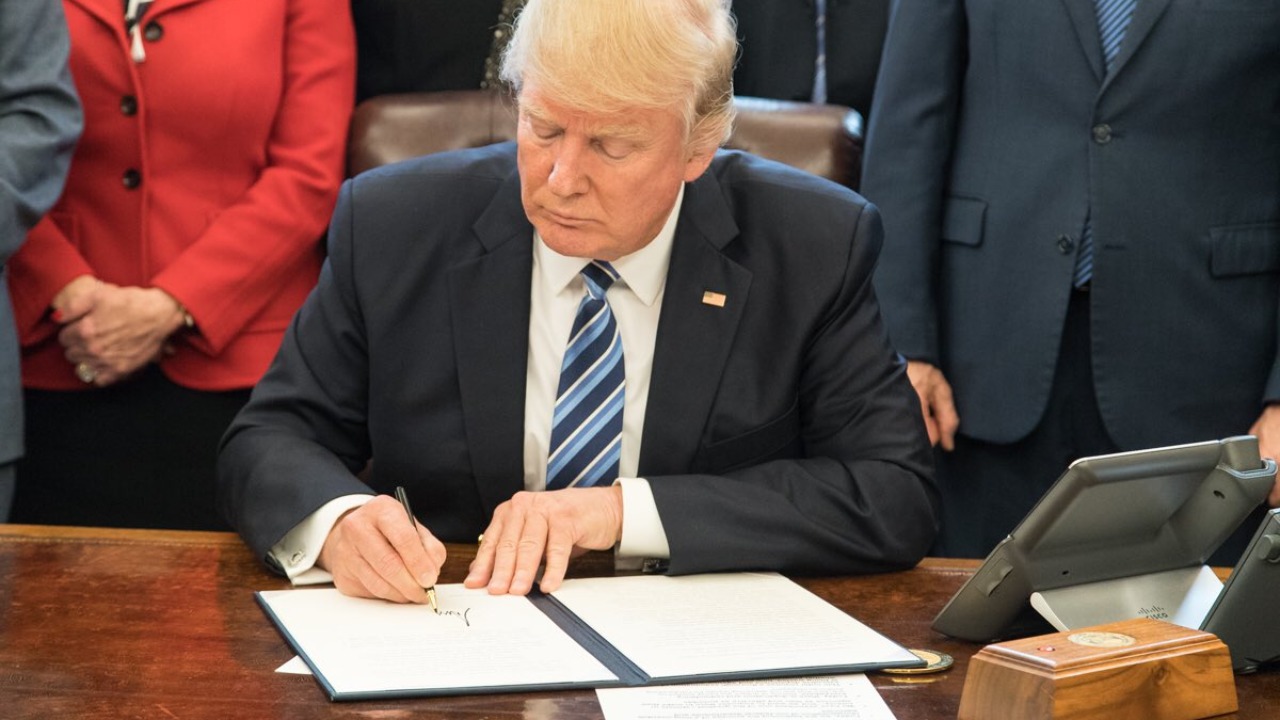
President Donald Trump has promised $2,000 relief checks funded by tariffs, pitching the idea as a simple way to put cash in every American’s pocket. The reality is far messier, with political resistance, budget math and basic program design all pointing to a future in which millions of people never see a dime. As the debate drags on, the gap between the sweeping promise and who would actually benefit is becoming impossible to ignore.
Instead of a straightforward fourth round of stimulus, what is on the table is a narrow, tariff-linked rebate that depends on Congress, complicated eligibility rules and revenue that may not materialize at the scale the White House suggests. I see a proposal that sounds universal on the campaign trail but looks increasingly selective, delayed and uncertain once you follow the details.
The big promise collides with stalled reality
Trump has framed his plan as a direct payment of $2,000 to American households, funded by higher import duties, a concept his team has described as a kind of “tariff dividend.” In political terms, it is a powerful message, especially for families still juggling rent, car payments on a 2021 Honda Civic or rising grocery bills. But as of late November, there is still no enacted law that would actually authorize those checks, and the federal machinery that delivered earlier pandemic payments is sitting idle for lack of congressional direction.
Reporting on federal relief efforts makes clear that, As of mid-November 2025, no new federal stimulus checks have been authorized by Congress and the IRS, despite the renewed rhetoric about $2,000 payments. That means there is no legal framework, no updated eligibility criteria and no operational plan for a fresh round of mass deposits. When I compare that hard stop with the confident language coming from the White House, the disconnect is striking: the promise is national, but the policy is still hypothetical.
Tariffs, revenue gaps and the limits of “free” money
The political appeal of Trump’s idea rests on the notion that foreign exporters will foot the bill, not American taxpayers. The administration has leaned heavily on the claim that higher duties on imports can be recycled into $2,000 checks without adding to the deficit. In practice, tariffs function as a tax on imported goods, which typically shows up in higher prices on everything from smartphones to washing machines, a cost that lands on consumers long before any rebate arrives.
Analysts who have looked at the numbers say the revenue picture does not match the rhetoric. Trump’s own advisers have acknowledged that his Tariffs may not cover them, with estimates showing that President Donald Trump’s levies would not raise enough money to fund recurring $2,000 payments at the scale implied by his speeches. One detailed breakdown of the proposal notes that President Donald Trump would need far more tariff revenue than current trade flows can realistically generate. When I weigh that against the rising cost of imported essentials, the plan looks less like free money and more like a reshuffling of who pays, and when.
Congressional skepticism and a proposal stuck on paper
Even if the tariff math worked, Trump cannot unilaterally mail out $2,000 checks. The Constitution gives the power of the purse to lawmakers, and any new federal payment program has to move through Capitol Hill. That is where the proposal is running into a wall, not only from Democrats who question the design, but also from Republicans who are wary of another large cash transfer program tied to the president’s trade agenda.
One widely shared explainer recorded on Nov 18, 2025, underscores that the program has no roll out, that it is a proposal, and that it cannot happen without Congress, with the video stressing that Congress and Congress including Republicans are basically not on board. The short clip, which has circulated heavily on social media, captures the core obstacle: without a bipartisan coalition willing to write and pass a bill, the $2,000 idea remains a talking point rather than a policy, a point that is laid out bluntly in Nov 18, 2025 commentary.
Who would actually qualify, and who gets left out
Even if Congress surprised skeptics and approved some version of Trump’s plan, the structure under discussion would not reach everyone. Early outlines describe a targeted “tariff dividend” that looks more like a tax credit than a universal check, with income thresholds and phaseouts that would exclude large segments of the middle class. In other words, the branding suggests a broad payout, but the fine print points to a narrower benefit.
Detailed reporting on eligibility asks Who would qualify for Trump’s $2000 tariff dividend payment and explains that, Based on Trump’s recent comments about the $2,000 tariff rebate, the administration is considering income caps that mirror earlier relief rounds, with some households potentially receiving only $200 or nothing at all. That analysis notes that people who were eligible for smaller payments in prior programs could again see reduced amounts, while others would be cut off entirely, a pattern laid out in a breakdown of $2,000 and $200 scenarios. When I map those thresholds onto real households, from dual-income renters in Phoenix to single parents in Atlanta, it is clear that millions who hear the promise will never see the full amount.
Republican resistance and a shrinking political coalition
The biggest surprise in this fight is not Democratic opposition, but the cool reception from Trump’s own party. Many GOP lawmakers built their careers on skepticism of direct cash payments and are now signaling that they see the tariff-funded checks as both fiscally risky and politically awkward. Their hesitation matters, because without unified Republican support, the proposal has little chance of clearing the House or surviving negotiations in the Senate.
Coverage from Capitol Hill notes that, in Nov 2025, GOP lawmakers are lukewarm at best about approving any $2,000 checks, casting doubt on whether Trump can secure the votes he needs. One detailed account of the internal debate describes how GOP skepticism has turned President Trump’s proposal for $2,000 payments to households, funded by tariffs, into a flashpoint inside the party. When I listen to those concerns, I hear a familiar tension: a populist promise colliding with a conservative instinct to limit federal spending, even when the money is framed as coming from foreign trade partners.
New roadblocks and what it means for families waiting on help
As the weeks pass, the political and procedural obstacles are piling up. Committees that would normally draft the legislative text have not scheduled markups, and key committee chairs are signaling that other priorities, from appropriations to defense policy, will come first. That slow-walk effectively sidelines the checks, regardless of how often they are mentioned in speeches or campaign rallies.
Reporting from Nov 20, 2025, describes how President Donald Trump’s proposal to send $2,000 stimulus checks to American households using revenue from tariffs has hit a new roadblock, with critics pointing to both the shaky revenue base and the president’s weakening authority on the Hill. One detailed account of those setbacks explains that American households are unlikely to see payments soon, if at all, given the combination of legal, fiscal and political hurdles. When I put that alongside the confirmation that, As of mid-November 2025, no new checks have been authorized, the pattern is clear: the headline promise of $2,000 for everyone is colliding with the hard limits of revenue, lawmaking and partisan politics, leaving millions of Americans on the outside looking in.
More From TheDailyOverview
- Dave Ramsey says these two simple questions show whether you’re rich or poor
- Retired But Want To Work? Try These 18 Jobs for Seniors That Pay Weekly
- IRS raises capital gains thresholds for 2026 and what’s new
- 12 ways to make $5,000 fast that actually work

Julian Harrow specializes in taxation, IRS rules, and compliance strategy. His work helps readers navigate complex tax codes, deadlines, and reporting requirements while identifying opportunities for efficiency and risk reduction. At The Daily Overview, Julian breaks down tax-related topics with precision and clarity, making a traditionally dense subject easier to understand.

