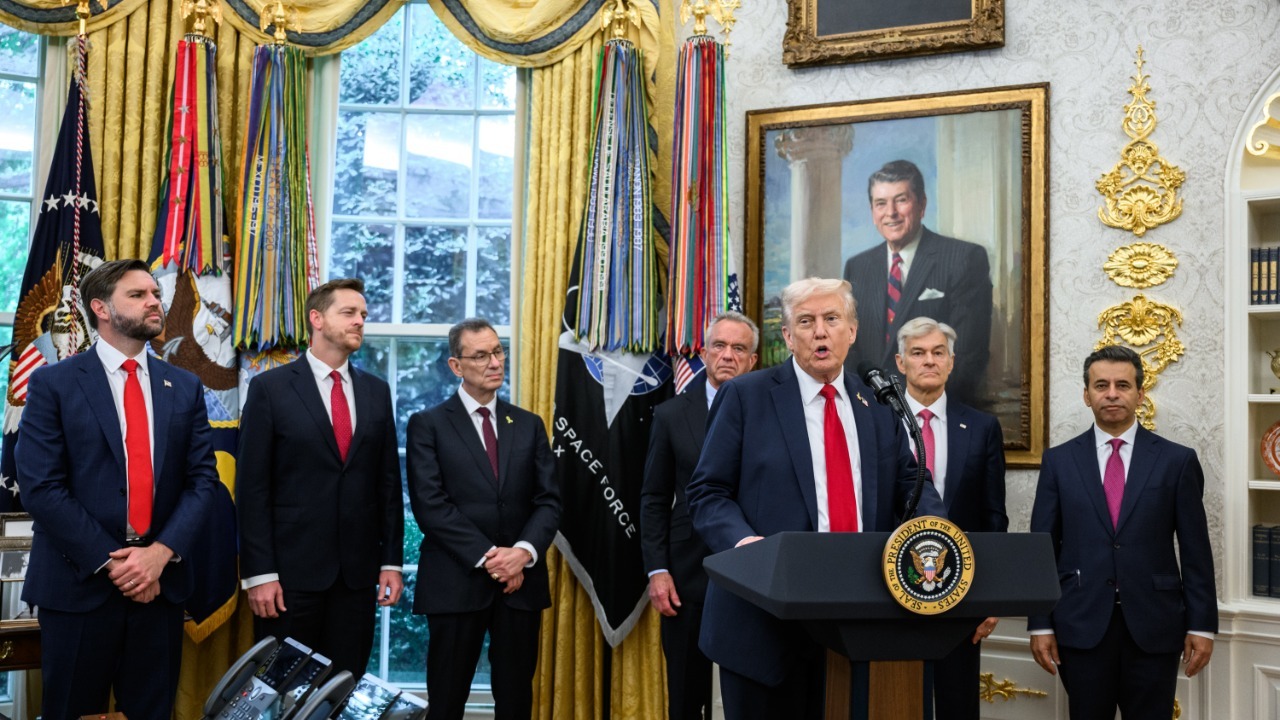
President Donald Trump is preparing to shrink the federal workforce on a scale that could reshape how government touches everyday life, with plans to cut or leave unfilled jobs affecting as many as 317,000 workers across agencies. The move lands on top of a broader second-term push to tighten legal immigration and pare back public services, creating a double squeeze on both government employees and the communities that depend on them.
Instead of a single headline-grabbing law, the impact is emerging through a series of decisions on hiring, visas and enforcement that together point to a leaner, more restrictive federal state. I see three fronts where the stakes are clearest: the direct loss of public-sector jobs, the parallel clampdown on foreign workers and the ripple effects on basic services like food assistance and economic enforcement.
Trump’s HR chief and the plan to shed 317,000 jobs
The clearest signal of the administration’s intent comes from its own human resources leadership, which has projected that the US government will shed 317,000 workers this year. That figure, tied directly to Trump’s personnel strategy, suggests a mix of attrition, buyouts and targeted cuts that could thin out entire offices rather than a symbolic trimming at the margins. The framing from Trump’s team is that a smaller federal payroll will mean a more efficient state, but for the people in those 317,000 positions, it is a blunt message that their roles are expendable in the current political calculus.
What stands out is how this plan is being presented as a matter-of-fact adjustment rather than a crisis, even as it represents one of the largest single-year contractions of the public workforce in modern memory. The projection, reported from WASHINGTON, is explicitly tied to Trump’s broader promise to “drain” and reorient the bureaucracy, and it is being treated inside the administration as a feature, not a bug. For agencies that already rely heavily on contractors and aging staff, the loss of 317,000 positions is not just a budget line, it is a structural change in how the federal government can function.
Visa crackdowns and the parallel squeeze on legal workers
At the same time that Trump’s HR chief is preparing to cut hundreds of thousands of government jobs, the administration is tightening the rules for foreign professionals who help power the private sector. Earlier this fall, a new presidential Proclamation targeted H‑1B visa holders, with the government’s own FAQ explaining that, on Friday, Sept. 19, 2025, President Donald J. Trump signed a Proclamation titled “Restriction on Entry of Certain H‑1B Nonimmigrants” and directed agencies to take action to implement this Proclamation. That move signaled that the White House is willing to use executive authority not only to shrink the public payroll but also to narrow who can legally work in the United States in high-skill roles.
Immigration lawyers quickly flagged how disruptive the new rules could be for employers and workers alike. One detailed analysis of what the order means for companies stressed that, starting September 21, 2025, U.S. employers must navigate new hurdles for H‑1B Workers, including tighter scrutiny of job roles and wage levels, which effectively raises the bar for hiring foreign talent. As I read it, the message to businesses is that the era of relatively predictable H‑1B sponsorship is over, replaced by a more restrictive regime that treats each petition as a potential loophole to be closed, a shift captured in guidance on What You Need to Know About the New Proclamation.
How H‑1B and green card changes hit Indian professionals
The impact of these immigration changes is not evenly distributed. Indian professionals, who make up a large share of H‑1B and employment-based green card applicants, are among those most exposed to the new rules. Reporting on Trump’s latest immigration policy change in oct highlighted how the administration’s decision affects both green card processing and H‑1B renewals for Indians, tightening pathways that had already been slowed by backlogs and prior rule changes. For workers who have built lives in the United States over years of renewals, the new policy is not an abstract debate, it is a direct threat to their ability to stay and work.
What I find striking is how these shifts compound existing uncertainty. Many Indian engineers and IT specialists already face multi-year waits for permanent residency, and the new restrictions add another layer of risk to career planning, family decisions and employer staffing. The video coverage of how Trump’s new immigration rule hits Indians underscores that this is not just about future applicants, it is about people already here on H‑1B visas who suddenly face a higher bar at their next renewal or status change, a reality laid out in detail in the Trump’s New Immigration Rule explainer.
A broader crackdown on legal immigration and its economic fallout
These targeted moves on H‑1B and green cards sit within a broader second-term pattern of tightening legal immigration channels. Reporting on the administration’s visa policies has described a crackdown that is keeping foreign workers, students and even some family-based immigrants out of the country, not through a single sweeping ban but through a dense web of rules, delays and heightened scrutiny. By Lauren Kaori Gurley, Adam Taylor, Danielle Abril and Federica Cocco have documented how The Trump administration’s approach has made it harder for companies to bring in specialized talent and for universities to attract international students, with knock-on effects for research labs, startups and regional economies that rely on those workers.
From my vantage point, the key connection is that the same White House that is comfortable cutting 317,000 government jobs is also comfortable constraining the pipeline of legal foreign labor, even when business groups warn of shortages. The visa crackdown described in that reporting shows how The Trump team is prioritizing ideological goals about sovereignty and control over the more technocratic arguments about growth and competitiveness, a tension that runs through the detailed account of the administration’s policies on legal immigration.
When “efficiency” means fewer services and more risk
The push to slim down government is not limited to payroll and visas. It is also reshaping how agencies deliver basic services, sometimes with unintended and costly side effects. Coverage of food assistance programs has shown how The Trump administration’s widespread efforts to arrest and deport immigrants have sent Immigration and Customs Enforce operations deeper into communities, while parallel “efficiency” goals in agriculture and nutrition programs have contributed to massive food waste even as hunger rises. In practice, that means fewer workers in inspection, logistics and outreach roles at the very moment when demand for help is growing.
To me, this is where the rhetoric of efficiency collides most sharply with reality. Cutting staff and tightening eligibility rules can look neat on a spreadsheet, but on the ground it can translate into crops left in fields, food banks scrambling to fill gaps and families losing access to benefits they previously relied on. The reporting on how these efficiency drives have produced both hunger and waste illustrates how a smaller workforce and more aggressive enforcement can combine to create perverse outcomes, a dynamic laid bare in the account of massive food waste tied to The Trump administration’s policies.
Signals from the courts and the labor market
Even outside the executive branch, the legal and employment landscape is shifting in ways that matter for workers caught in this transition. In one recent case, the Supreme Court declined on Monday to hear a bid by a former UBS bond strategist to revive a $2.6 m jury award in his employment dispute, leaving in place a lower court ruling that had wiped out the $2.6 million verdict. While the facts of that case are specific, it is a reminder that workers challenging employers, whether public or private, face an uphill battle in the current judicial climate.
For federal employees staring down the prospect of job cuts, and for immigrants navigating a harsher system, that legal backdrop matters. It suggests that once Trump’s policies are in place, the courts may not be a reliable backstop for those who lose out. The broader pattern of employment rulings, including the Supreme Court’s stance in the UBS strategist’s case, is captured in recent employment news that underscores how difficult it can be for individual workers to secure redress when jobs or rights are stripped away.
Why 317,000 cuts matter beyond Washington
When I step back from the individual policy threads, the throughline is clear: Trump is not just trimming government, he is redefining who gets to work in and with it. The projected loss of 317,000 federal positions, combined with tighter controls on H‑1B and green card pathways and a more punitive approach to public services, amounts to a deliberate narrowing of the state’s footprint in both employment and support. That may please those who see government as bloated, but it also means fewer inspectors on factory floors, fewer caseworkers processing benefits and fewer scientists in federal labs.
For workers, the message is that security is fragile, whether you are a career civil servant, a foreign engineer on an H‑1B visa or a contractor whose project depends on federal funding. For communities, the risk is that the invisible scaffolding of government, from food aid to visa processing to economic oversight, thins out until it fails under stress. The Trump administration’s own documents, from the H‑1B FAQ explaining the Proclamation to the HR chief’s projection of 317,000 job losses, show that this is not an accident. It is a choice about what kind of workforce, and what kind of government, the country will have.
More From TheDailyOverview
- Dave Ramsey says these two simple questions show whether you’re rich or poor
- Retired But Want To Work? Try These 18 Jobs for Seniors That Pay Weekly
- IRS raises capital gains thresholds for 2026 and what’s new
- 12 ways to make $5,000 fast that actually work

Grant Mercer covers market dynamics, business trends, and the economic forces driving growth across industries. His analysis connects macro movements with real-world implications for investors, entrepreneurs, and professionals. Through his work at The Daily Overview, Grant helps readers understand how markets function and where opportunities may emerge.

