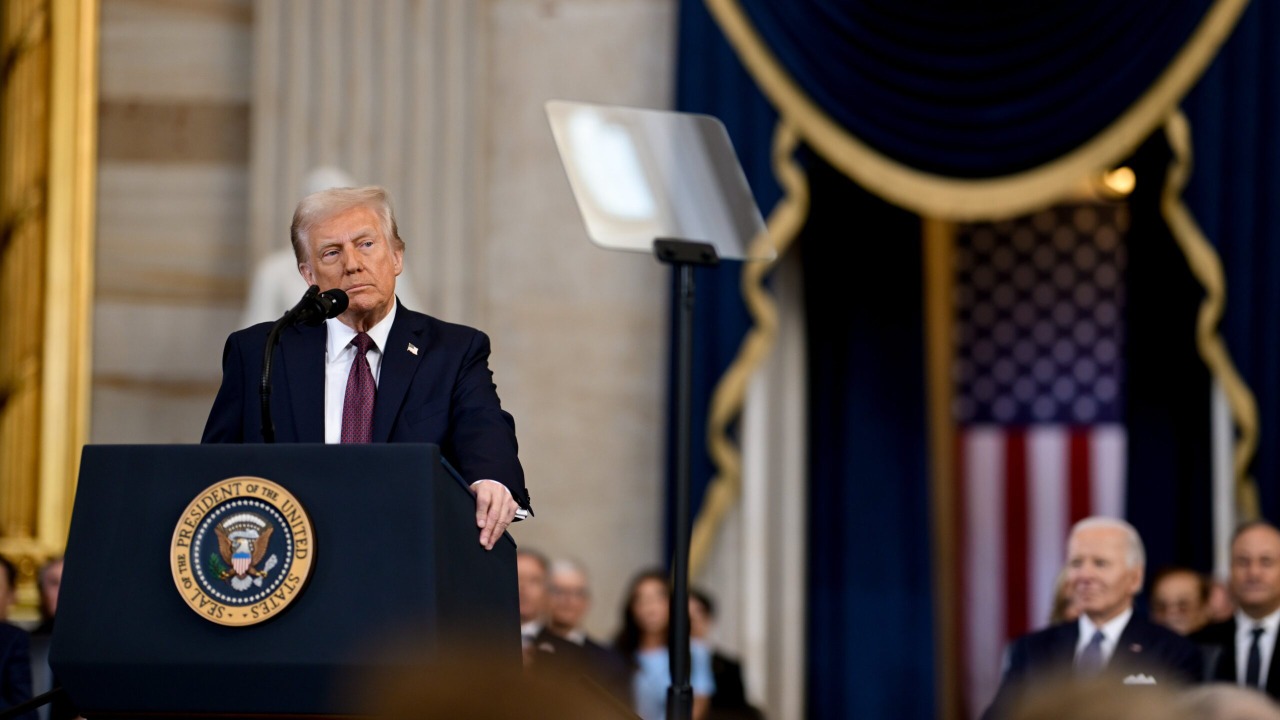
President Donald Trump has spent the past year trying to turn the federal research budget into a political battlefield, targeting everything from basic biomedical science to climate and technology programs. Instead of capitulating, judges and lawmakers have drawn unusually bright lines, signaling that science funding is not as easy to weaponize as the White House expected. The result is a rare institutional pushback that has kept money flowing to labs and universities even as the administration has searched for new ways to exert control.
What is emerging is less a clean victory for scientists than a grinding stalemate. Courts have blocked some of the most aggressive moves, Congress has rewritten others, and watchdogs have accused the administration of violating bedrock budget law. The fight has exposed how much of modern research depends on legal guardrails and bipartisan habits that are now being tested in real time.
Trump’s budget cuts collide with a pro‑science Congress
When the Trump administration rolled out its latest budget request, it came out swinging against federal research, proposing dramatic cuts to agencies that fund everything from space exploration to university labs. In that request, Trump targeted core science agencies and signaled that politically disfavored fields could be first on the chopping block. Yet on Capitol Hill, appropriators in both parties treated the proposal more as a statement of ideology than a binding roadmap, and they began assembling spending bills that quietly restored much of what the White House wanted to erase.
The clearest example came in the fight over space and physical science. President Trump had proposed cutting more than $6 billion from NASA and slashing related research at the National Science Foundation and the National Institute of Standards and Technology. Under the compromise minibus that cleared the Senate, those cuts were rejected and key programs the administration wanted to eliminate were kept alive, a sign that lawmakers were not willing to let a single year’s budget rewrite decades of investment in space and basic science.
Appropriations bills quietly rebuild the research pipeline
Beyond headline agencies, Congress has used the annual spending process to shore up less visible but strategically important research accounts. A three bill package for 2026 gives the NSF around $8.8 billion, which is a modest step down from last year but far from the deep reductions the administration sought. Another analysis of the Commerce, Justice, Science, notes that H.R. 2354 would provide a total of $9.0 billion to the same foundation, an increase over what the White House requested. The split between the request and the enacted numbers underscores how Congress has treated Trump’s science budgets as a floor, not a ceiling.
Health research has seen a similar pattern. The final 2026 package includes $47.2 billion in overall funding for NIH, a $400 m increase over the prior year, and $9.2 billion for the CDC, which holds steady despite White House pressure to trim public health spending. In education research, lawmakers went even further, giving the Institute of Education $790 m, far above the administration’s $261 m request, with the same bill specifying $790 million and $261 million in its detailed tables. That gap is a blunt message that Congress sees research on schools and learning as a priority even when the White House does not.
Courtrooms become a second front for research defenders
While appropriators were rewriting the numbers, judges were scrutinizing how the administration tried to execute its cuts. A federal Court upheld an injunction blocking the administration from slashing NIH research funding at major universities, finding that the Cuts were inconsistent with the Policy the agency had followed for years. In a related case, the Court of Appeals First Circuit sided with universities in California and Massachusetts after the administration tried to pull medical research grants midstream. That ruling, reported by The Center Square, framed the attempted cancellations as an overreach that threatened long term projects at institutions like the University of California and California State University.
Earlier, a separate judge had already concluded that the administration’s directives to terminate certain grants were unlawful. In that case, Today the judge ruled that the directives were “arbitrary and capricious” and therefore illegal, and noted that Termination letters sent to some grantees relied on vague accusations without backing up the claims. Sixteen state attorneys general also went to court, with State officials arguing that Sixteen of them had to sue to restore NIH grants after Trump officials abruptly canceled them. Together, these rulings have turned the judiciary into a key check on efforts to use grantmaking as a blunt political tool.
Executive orders test the legal limits of White House control
Unable to get Congress to sign off on sweeping cuts, the administration has leaned on executive power to reshape how grants are awarded. One directive gave senior political appointees veto power over funding calls, with the text specifying that any announcement of opportunities must be reviewed by a high level official or their designee before going out the door. That order, described in detail by Aug coverage, effectively inserts political gatekeepers into what had long been a technocratic process and, critics say, slows or slashes potentially cost saving research.
Experts in higher education and research policy have warned that this shift could mark the “end of an era” in which peer review, not ideology, determined which projects got funded. One analysis noted that the new research executive order runs directly counter to the core principle that funding decisions should be insulated from partisan values, even as the administration reserves the right to define what those values are. That critique, laid out in a Nov deep dive, captures a broader fear that the White House is trying to turn grantmaking into another culture war arena rather than a neutral engine of discovery.
Watchdogs, oversight bodies and a “gold standard” counter‑narrative
Even as the administration has tried to centralize control, other parts of the federal system have pushed back. A congressional watchdog found that Orders Trump signed in the early days of his return to office, along with related directives, illegally froze 1,800 NIH medical research grants in violation of the Impoundment Contr law that bars presidents from unilaterally withholding funds Congress has appropriated. Inspectors general, coordinated through CIGIE, have warned that if their community is not strong, it undermines the spine that has allowed them to act collectively over the past decade and a half. Their message is that independent oversight is not a bureaucratic luxury but a structural defense against politicized science cuts.
At the same time, the White House has tried to project a different image of its science agenda. In a document labeled Executive Orders, the president issued a directive titled “Restoring Gold Standard Science” that begins, “By the authority vested in me as President by the Constitution and the laws of the United States Code, it is hereby ordered.” The language promises to elevate scientific integrity, but in practice it sits uneasily alongside efforts to give appointees more say over grants, a tension that courts and inspectors general are now being asked to resolve.
More From The Daily Overview
*This article was researched with the help of AI, with human editors creating the final content.

Grant Mercer covers market dynamics, business trends, and the economic forces driving growth across industries. His analysis connects macro movements with real-world implications for investors, entrepreneurs, and professionals. Through his work at The Daily Overview, Grant helps readers understand how markets function and where opportunities may emerge.

