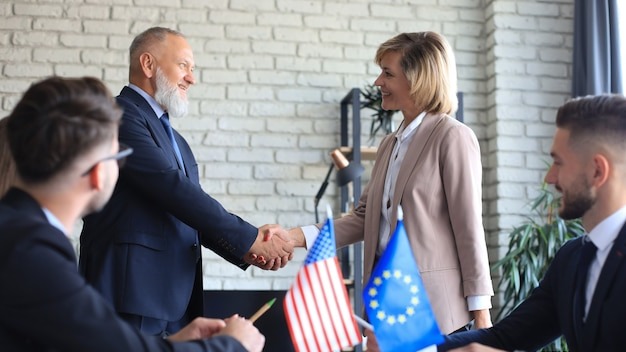
Europe is moving quickly to lock in new trade and energy partnerships that reduce its exposure to President Donald Trump’s tariffs and threats, and in the process it is sidelining Washington from some of the most consequential deals of the decade. From Latin America to the North Sea, European leaders are treating the current rift with the United States as a structural shift rather than a passing quarrel. The result is a strategic realignment in which Trump’s “America First” posture is pushing allies to look elsewhere for growth, security and leverage.
Instead of waiting for relations with the United States to thaw, Brussels is signing agreements that could reshape global supply chains and energy flows without the White House at the table. That is the real meaning of Europe’s latest “game‑changing” moves: they are less a snub for its own sake than a bet that the next phase of globalization will be built around new partners and new sectors where the United States, at least for now, is choosing not to lead.
Trump’s tariff brinkmanship and the collapse of trust
At the heart of Europe’s pivot is a collapse of trust in the reliability of the United States as a stable economic partner under Trump. European officials have watched a rolling series of tariff threats, including moves tied to Trump’s fixation on Greenland, turn trade policy into a tool of day‑to‑day political pressure. When President Donald Trump floated punitive import taxes linked to his ambitions over Greenland, lawmakers in Brussels responded by freezing work on a transatlantic trade accord and signaling that “business as usual” was, in their words, “impossible,” a stance captured in the decision to halt approval of a planned U.S. trade deal.
The rupture has spilled into the security realm as well. Former European Commission President José Manuel Barroso has warned that Europe and the United States are now at their “lowest moment” since NATO was created, a remarkable statement given the alliance’s Cold War history. Barroso linked that deterioration directly to Trump’s “America First” agenda and to episodes like the president’s goal of seizing Greenland, which have convinced many in Europe that the current White House is willing to weaponize both tariffs and security guarantees. In that context, the decision by European leaders to look for new partners is less about symbolism and more about hedging against a partner they now see as unpredictable.
Mercosur and India: Europe’s new trade bets
Europe’s most striking response has been to accelerate trade talks with partners that can offset lost opportunities with Washington. Earlier this month, European Commission President Ursula von der Leyen traveled to Asuncion, Paraguay, to sign the long‑delayed agreement between the European Union and Mercosur, the bloc that includes Argentina, Brazil, Paraguay and Uruguay. The Mercosur agreement would create a free‑trade area of 700 m people between the EU and those South American economies, a scale that instantly gives Europe an alternative growth engine at a moment when its relationship with Washington is fraying.
European leaders have framed that Latin American deal as part of a broader strategy to diversify away from U.S. dependence. The Mercosur pact sits alongside an ambitious negotiation with India that some in Brussels and New Delhi are already calling the “mother of all deals,” a phrase that reflects both its potential and its risks. Whether the agreement ultimately becomes a “growth‑enabling partnership or a strategically asymmetric deal” will depend on how the final terms balance market access, digital rules and security concerns, but the very fact that Europe and India are contemplating such a sweeping accord shows how far they are prepared to go to build a new economic axis that does not run through Washington, as described in analysis of the emerging India and EU partnership.
Energy security: offshore wind and the North Sea pivot
Trade is only one front where Europe is moving without the United States; energy security is another. Faced with volatile fossil fuel markets and geopolitical shocks, Several EU governments have turned the North Sea into a laboratory for large‑scale renewable power that can underpin both climate goals and industrial competitiveness. Energy Ministers from across the bloc have pledged to boost offshore wind capacity in the region, arguing that completing their shared ambitions could cut electricity costs by 30% by 2040 and reshape the way power is traded across borders, a commitment laid out when Ministers gathered to coordinate plans.
Industry has quickly lined up behind that push. Major developers and grid operators have welcomed a new offshore wind pact signed by 10 European countries, describing it as a foundation for reliable and cost‑competitive electricity that can support heavy industry and electric vehicles across the continent. By Razak Musah reported that the agreement commits governments and companies to coordinated grid planning and faster permitting, a level of integration that effectively creates a regional energy market centered on European technology and capital rather than U.S. liquefied natural gas or shale exports, a shift underscored in coverage of the Major offshore wind agreement.
Frozen transatlantic deals and Europe’s new leverage
While Europe signs new agreements elsewhere, its trade relationship with Washington is stuck in limbo. Members of the European Parliament have repeatedly blocked or delayed votes on a transatlantic pact in response to Trump’s tariff salvos and his Greenland rhetoric. In WASHINGTON, the mood has been one of frustration as European Parliament committees halted a vote amid President Trump’s Greenland and tariff threats, with critics warning that the import taxes would poison relations and supporters of engagement arguing that the bloc should keep channels open, a clash captured when the European Parliament halted progress.
Inside Brussels, Lawmakers are divided on whether to play hardball with Washington or to ratify a deal that might stabilize the relationship. Reporting by Max Griera has described how some see the frozen accord as leverage to push Trump to roll back tariffs, while others fear that waiting will only deepen economic damage. The debate has been sharpened by the memory of the Agreement on Reciprocal, Fair, and Balanced Trade, which was so controversial that, After the signing, French Prime Minister Francois Bayrou called it a “submission” and German Chancellor Friedrich Merz defended it as a necessary compromise, a split that still shapes how capitals view any new Lawmakers’ vote and is documented in accounts of the earlier Agreement on Reciprocal deal.
From symbolic clashes to structural separation
Trump’s approach has produced a series of symbolic confrontations that, taken together, are hardening into structural separation. European leaders have already had to respond to Trump’s threats of 100% tariffs and his talk of using economic pressure to secure a framework for Greenland, prompting them to insist that “a deal is a deal” and that commitments must mean something. Jorge Valero has described how those tensions escalated until European officials publicly warned that they would defend themselves “against any form of coercion,” even as they pressed ahead with The Mercosur agreement that links the EU with Argentina, Brazil, Paraguay and Uru in a vast free‑trade zone, a stance reflected in coverage of the Jorge Valero report and in accounts of how The Mercosur pact was finalized.
Even when Trump has backed down, the damage has lingered. At Davos in Switzerland, Trump ruled out using military force to acquire Greenland and tried to reassure investors that his tariff threats were a negotiating tactic, but European officials responded by suspending work on a trade agreement and warning that trust had been eroded. Members of the Committee on International Trade argued that the episode showed why Europe needed to reduce its vulnerability to unilateral moves from Washington, a view that has only been reinforced by commentary noting that Trump’s European allies have exposed his core weakness and that no one could convincingly claim he was playing a sophisticated game of strategy, as reflected in reports on the Davos fallout and in analysis of how Trump was outmaneuvered.
More From TheDailyOverview
*This article was researched with the help of AI, with human editors creating the final content.

Grant Mercer covers market dynamics, business trends, and the economic forces driving growth across industries. His analysis connects macro movements with real-world implications for investors, entrepreneurs, and professionals. Through his work at The Daily Overview, Grant helps readers understand how markets function and where opportunities may emerge.

