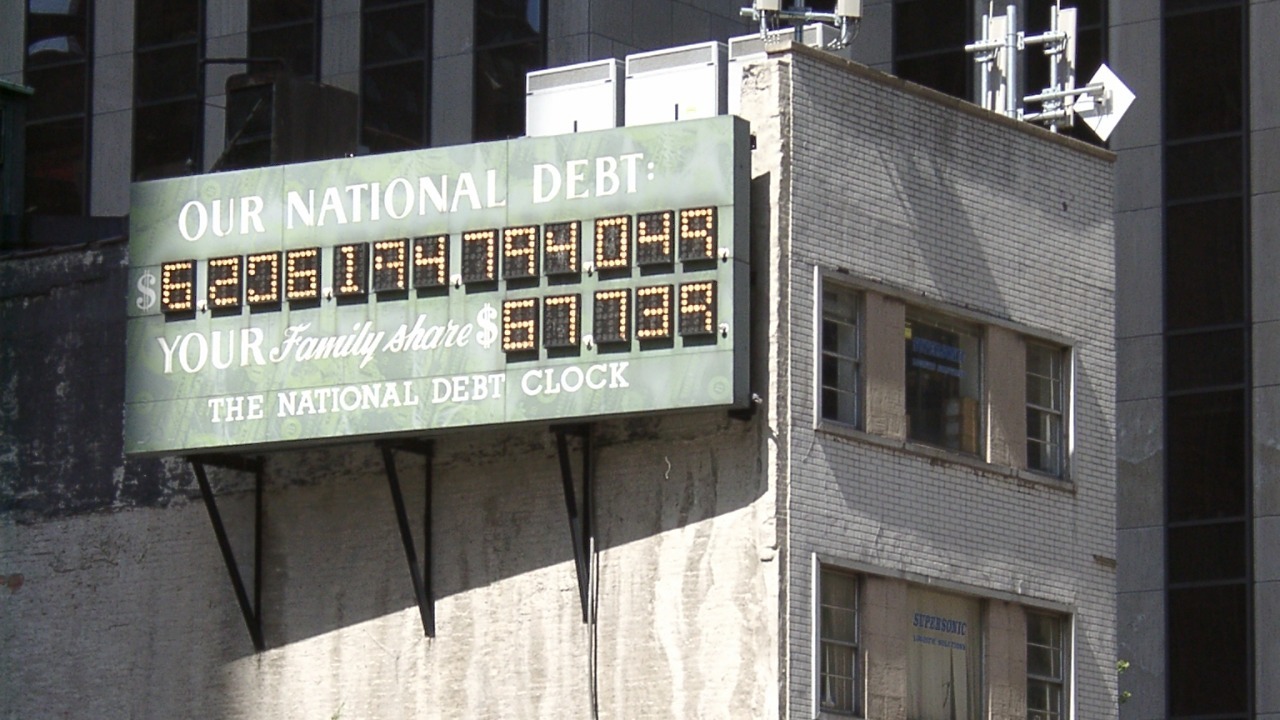
The United States has crossed a line that once seemed unthinkable: paying more than $1 trillion a year just to service its national debt. With total obligations now approaching $40 trillion and interest costs rising faster than tax revenues, the federal balance sheet is tilting toward a structural crisis rather than a passing rough patch. I see a pattern emerging in the data that suggests the current interest tab is not just painful, it is on track to overwhelm the rest of the budget unless policy or growth changes course in a dramatic way.
The numbers tell a stark story. The national debt has surged by trillions of dollars in a short span, while higher interest rates have turned what used to be a manageable line item into one of Washington’s largest bills. As interest payments crowd out other priorities, from defense to research, the question is no longer whether the debt matters, but how long the government can keep rolling it over before markets, voters, or both force a reckoning.
The debt pile is racing toward $40 trillion
Any discussion of a debt crisis has to start with the sheer size of the obligations. According to one live tracker of Current US Debt, the total U.S. national debt stands at $38.66 Trillion, a figure that would have been politically explosive a decade ago and now barely registers in daily debate. A separate official tally notes that, As of February 4, total gross national debt was $38.56 trillion, with that stockpile having grown by $2.35 trillion over the previous year. Those two snapshots, taken from different vantage points, converge on the same reality: the United States is adding debt at a pace that rivals the entire annual output of major economies.
The growth rate is just as alarming as the level. The same congressional analysis warns that, Assuming the average daily increase of the past three years continues, the total will hit $39 trillion by roughly August. Over the 12 months from mid January 2025 to mid January 2026, the federal government added roughly $2.25 trillion in new borrowing under President Donald Trump, a surge that one analysis of Over the period ties directly to policy choices layered on top of existing structural deficits. When I look at those figures, the conclusion is hard to escape: the debt is not just large, it is on a trajectory that makes stabilizing it vastly more difficult with each passing year.
Interest has quietly become one of Washington’s biggest bills
What turns a big debt into a crisis is the cost of carrying it. For the fiscal year of 2025, the federal government spent $1.22 trillion on interest alone, according to For the Treasury data, a sum that rivals or exceeds what Washington spends on many core programs. Early in the new fiscal year, Jan reports that Q1 of FY 2026 Interest Costs More than $270 Billion, putting the government on pace to match or exceed last year’s record. When I compare those figures to historical norms, it is clear that interest has shifted from a background cost of doing business to one of the central drivers of the deficit.
Projections suggest this is only the beginning. The Congressional Budget Office has already warned that Interest on the Debt will Grow Past the Trillion Next Year threshold and become the second largest federal expense after Social Security. Over the next decade, one detailed estimate finds that Over the coming years, interest payments will total $13.8 trillion, an all time high in both dollar terms and as a share of the economy. When I factor in that net interest as a share of federal outlays is forecast by the Congressional Budget Office to reach 13.85 percent, it becomes obvious that interest is crowding out the rest of the budget in a way that is hard to reverse.
Spending patterns show a structural, not cyclical, problem
Some optimists argue that once the current economic cycle turns, deficits will shrink on their own. The data on spending trends suggests otherwise. Jan notes that Both recent budget reports on the federal government’s finances reveal concerning spending trends in the new fiscal year, with outlays rising faster than the Congressional Budget Office had projected just a year earlier. In the first quarter alone, Jan’s Interest Spending Tracker shows that Interest as a Percent of Revenue and as a Percent of Total Spending has climbed well above its 50 year average of 12 percent, a sign that the government is devoting a historically large share of its tax base to past borrowing rather than current priorities.
Longer term projections from Jan’s Debt outlook reinforce that this is not a temporary spike. From 2025 to 2035, Federal debt is expected to swell as increases in mandatory spending and interest costs outpace the growth of revenues, even under relatively optimistic assumptions about economic growth and the size of the labor force. When I line up those projections with the current trajectory of $38.56 trillion in gross debt and the expectation that it will reach $39 trillion within months, the pattern looks less like a business cycle and more like a structural mismatch between what Washington promises and what it is willing to tax.
Markets and economists are gaming out a fiscal crisis
High and rising debt does not automatically trigger a meltdown, but it raises the odds that one shock will be enough to tip the system. One detailed scenario analysis warns that, Over time, high and rising debt could lead to a financial crisis if investors begin to doubt the government’s willingness or ability to stabilize its finances. Specifically, the same analysis warns that a loss of confidence could trigger a spike in interest rates, a plunge in asset prices, and a wave of Specifically business failures and foreclosures, a chain reaction that would hit households long before any formal default.
Even without a sudden crisis, the slow burn is already visible in the budget math. The Joint Economic Committee’s Debt Dashboard highlights that Interest and Net interest are on track to claim a rising share of federal outlays, with 13.85 percent already in sight and further increases likely if rates stay elevated. Another set of projections on Interest Payments Over Years show interest costs rising in dollar terms and as a share of the economy, with net interest projected to reach 22.2 percent of federal revenues by 2035. When I imagine markets digesting a world in which more than a fifth of every tax dollar goes to bondholders, it is not hard to see why analysts warn that the current path is flirting with a tipping point.
Debt service is squeezing out investment in America’s future
The most immediate casualty of a runaway interest bill is not some abstract notion of “fiscal space,” it is the concrete programs that shape long term growth. One analysis of the national debt’s impact on ordinary Americans warns that there is already Less Room for in Infrastructure, Research, and the Next Generation Growing up in an economy where interest is the fastest growing part of the federal budget. Another essay on the long term budget outlook notes that an ever larger share of federal tax revenues is being devoted to benefits and interest, Beyond growth in productive investment and leaving policymakers less able to respond to crises ranging from wars to financial meltdowns.
When I connect those structural warnings to the current numbers, the trade offs become painfully clear. The Treasury’s $1.22 trillion interest bill for 2025 is money that cannot be spent on modernizing highways, expanding broadband, or funding basic science that might power the next generation of industries. The fact that Q1 of FY 2026 already saw more than $270 Billion in interest, as Jan’s tracker shows, means that every quarter Washington delays reform, it locks in a higher baseline of unavoidable payments. Over the next decade, the projected $13.8 trillion in interest outlays will act like a parallel budget, one that delivers no new services to citizens yet dictates what is left for everything else.
Tech leaders are sounding the alarm, but growth alone will not fix this
The scale of the problem has started to draw attention far beyond the usual budget hawks. In a recent public conversation, Elon Musk warned that the United States is “1,000% going to go bankrupt” if it continues on its current path, a comment captured in a Feb report that underscored his concern about the cost of servicing the debt. In another exchange, Musk replied that he was particularly worried about waste and fraud in federal spending, even as he argued that artificial intelligence and robotics could eventually boost productivity enough to ease the burden. A separate account of his comments notes that he also warned the cost of servicing the debt is becoming a heavy burden and that “the interest payments on national debt exce…” in his words, are already crowding out other priorities, as captured in a Feb summary.
I take Musk’s warnings seriously, but the official projections suggest that growth alone will not be enough to outrun the math. The Congressional Budget Office’s latest outlook on Congressional Budget Office shows that even under baseline assumptions, interest on the Debt will Grow Past the Trillion Next Year mark and keep climbing as a share of GDP. The Peterson foundation’s tracker of monthly interest costs similarly concludes that rising debt and relatively high interest rates will continue to put upward pressure on the federal interest bill, with net interest projected to reach 22.2 percent of revenues by 2035. In that context, even a technology driven productivity boom would need to be paired with concrete fiscal reforms to prevent the interest tab from swallowing the gains.
What it would take to make the interest bill sustainable
If the current path is unsustainable, the natural question is what a sustainable one would look like. The Committee for a Responsible Federal Budget has sketched out what a fiscal crisis might entail and what it would take to avoid it, warning that Over time, high and rising debt will force either abrupt tax hikes, sudden spending cuts, or a painful combination of both if policymakers do not act earlier. The same analysis stresses that avoiding the worst case scenario requires gradual, credible adjustments that reassure investors and households long before a panic sets in. That means confronting the drivers of long term spending, including health and retirement programs, while also being honest about the revenue needed to support an aging population.
More From The Daily Overview
*This article was researched with the help of AI, with human editors creating the final content.

Grant Mercer covers market dynamics, business trends, and the economic forces driving growth across industries. His analysis connects macro movements with real-world implications for investors, entrepreneurs, and professionals. Through his work at The Daily Overview, Grant helps readers understand how markets function and where opportunities may emerge.

