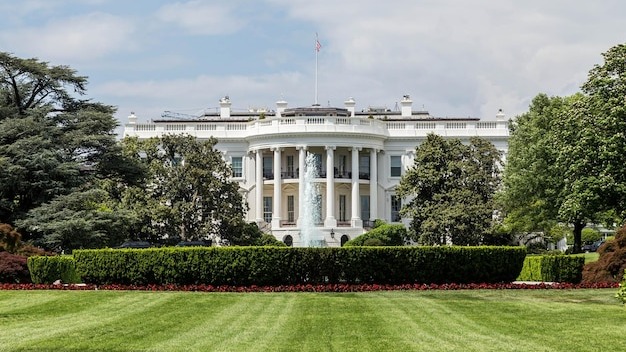
The Trump administration proposed banning investors who own more than 100 single-family homes from purchasing additional properties, sending a memo to congressional leaders with specifics that go well beyond the executive order signed in January 2026. The plan targets federal financing channels and government-sponsored enterprises like Fannie Mae and Freddie Mac, aiming to cut off the pipeline that large institutional buyers have used to compete with ordinary families for starter homes. If enacted through legislation, the ban could affect hundreds of investment firms and reshape how Wall Street participates in the single-family housing market.
What the Executive Order Actually Does
The executive order, formally issued as a presidential action on stopping Wall Street from competing with ordinary homebuyers, directs the Treasury Department to define “large institutional investor” and “single-family home” within 30 days. That definitional work is the order’s real engine: until Treasury draws those lines, no agency can enforce a ban. The order separately instructs USDA, HUD, VA, GSA, and FHFA to issue guidance within 60 days that would prevent federal programs and government-sponsored enterprises from approving, insuring, or guaranteeing support for large institutional investors purchasing single-family homes.
An accompanying White House release lays out the administration’s framing that President Donald Trump is seeking to stop Wall Street from crowding out families in the housing market. That policy summary describes first-look periods during which owner-occupants and non-profits would get priority access to properties before investors can bid, new disclosure requirements for property owners, and anti-circumvention rules meant to keep firms from using shell entities to dodge the restrictions. It also highlights a review role for the Department of Justice and the Federal Trade Commission, though the administration has not set a public deadline for when those agencies must report back on potential antitrust or consumer protection issues.
The 100-Home Threshold and Its Limits
The administration’s memo to Congress proposed setting the ban at investors who own more than 100 single-family properties, a figure that could reach hundreds of firms that have accumulated portfolios across multiple metropolitan areas. The threshold matters because it determines who counts as “large.” A company with 99 homes would remain free to keep buying, and the line would not automatically adjust for regional price differences or market concentration. Proposed carve-outs for build-to-rent projects and substantial rehabilitation work would further narrow the universe of covered entities, allowing companies to continue acquiring properties as long as they can show they are adding new supply or significantly upgrading deteriorated homes.
That exemption structure reveals a tension at the heart of the plan. Institutional investors moved into the single-family rental space in force after the 2007–2009 foreclosure crisis, often buying foreclosed homes in bulk, according to a Government Accountability Office review of the sector. Since then, their strategies have shifted toward smaller-scale acquisitions, mergers, and build-to-rent developments that can be tailored to local demand. The GAO also underscored significant data gaps in tracking who owns single-family rentals and how ownership is structured, which means regulators may struggle to verify whether firms are genuinely renovating and building or simply relabeling routine purchases to fit within the exemptions.
Federal Financing as the Enforcement Lever
The executive order’s enforcement mechanism runs through federal financing rather than a direct legal prohibition on purchases. The text published in the official presidential record and the related Federal Register notice direct the Secretary of Housing and Urban Development to require owners and managing agents to comply with new conditions to the maximum extent permitted by law. FHFA, which oversees Fannie Mae and Freddie Mac, has already experimented with limits on how many financed properties small investors can hold and has wound down single-family rental pilots that expanded the government-sponsored enterprises’ role in the rental market, signaling a broader pullback from directly supporting investor-driven acquisitions.
Relying on financing restrictions rather than outright bans, however, creates a structural gap. Large institutional investors often purchase homes using cash, private credit facilities, or securitized debt that does not rely on FHA insurance or GSE guarantees, meaning they could continue buying even if federal channels shut. The guidance could instead fall heaviest on mid-size landlords and aspiring small investors who depend on conventional, federally linked mortgages to grow their portfolios. That dynamic risks fragmenting the rental market rather than opening it up to first-time buyers, because smaller operators may lack both the capital and the economies of scale to maintain, upgrade, or weather-proof aging housing stock at the same pace as large institutional owners, potentially undermining the administration’s quality and affordability goals.
Congressional Track and Broader Affordability Push
A parallel legislative effort, H.R. 7221 in the 119th Congress, would go further than the executive order by amending the Investment Company Act of 1940 to prohibit certain large private funds and registered investment companies from purchasing or holding single-family homes at all. The bill adopts the same “Main Street homebuyers” framing as the order but would operate through statutory changes that do not depend on the same kind of agency-by-agency rulemaking. If Congress were to pass such a measure, it could harden the 100-home threshold or replace it with a different metric tied to assets under management, market share, or geographic concentration, offering a more durable but also more rigid framework than the executive branch alone can provide.
The investor crackdown fits into a broader housing affordability push that the administration has tied to its public messaging, including remarks at the World Economic Forum in Davos and domestic events highlighting cost-of-living pressures. In that context, the White House has promoted the order as part of a package in which President Trump seeks to block large investors from buying or holding single-family homes through federal channels, while encouraging construction and rehabilitation that add net new units. Yet the policy confronts a basic math problem: institutional investors still own a relatively small share of the total single-family stock nationwide. As an Associated Press analysis has noted, even an aggressive crackdown on large landlords would touch only a slice of all transactions, and its impact on prices or availability will hinge on how Treasury handles shell companies, joint ventures, and fund-of-funds that can obscure who ultimately controls a property.
Why the Details Still Missing Will Matter Most
The most consequential decisions have not yet been made. Treasury’s definitions of “large institutional investor” and “single-family home” will determine whether the policy primarily targets publicly traded landlords, private equity-backed funds, regional firms, or a mix of all three. A narrow definition that keys off direct ownership could leave out investors who spread their holdings across multiple subsidiaries or special-purpose vehicles, while a broader standard that aggregates affiliated entities may face legal challenges from firms arguing that it sweeps in passive investors or minority partners. How Treasury chooses to treat build-to-rent subdivisions, small multifamily properties that resemble single-family homes, and homes purchased for short-term rental platforms will also shape whether the rules meaningfully ease pressure on starter-home inventories.
Equally important is how agencies translate the order’s broad directives into concrete underwriting and program rules. HUD, USDA, VA, GSA, and FHFA must decide what documentation investors must provide, how to verify ownership across complex corporate structures, and what penalties to impose for misrepresentation or evasion. Their choices will determine whether the policy functions as a bright-line ban or a more flexible risk-management tool that can be adjusted as market conditions change. Combined with potential legislation in Congress, those technical decisions will decide whether the administration’s effort to wall off the starter-home market from large investors becomes a durable shift in housing finance or a symbolic gesture that ambitious firms can route around with creative structuring and ample private capital.
More From The Daily Overview
*This article was researched with the help of AI, with human editors creating the final content.

Grant Mercer covers market dynamics, business trends, and the economic forces driving growth across industries. His analysis connects macro movements with real-world implications for investors, entrepreneurs, and professionals. Through his work at The Daily Overview, Grant helps readers understand how markets function and where opportunities may emerge.