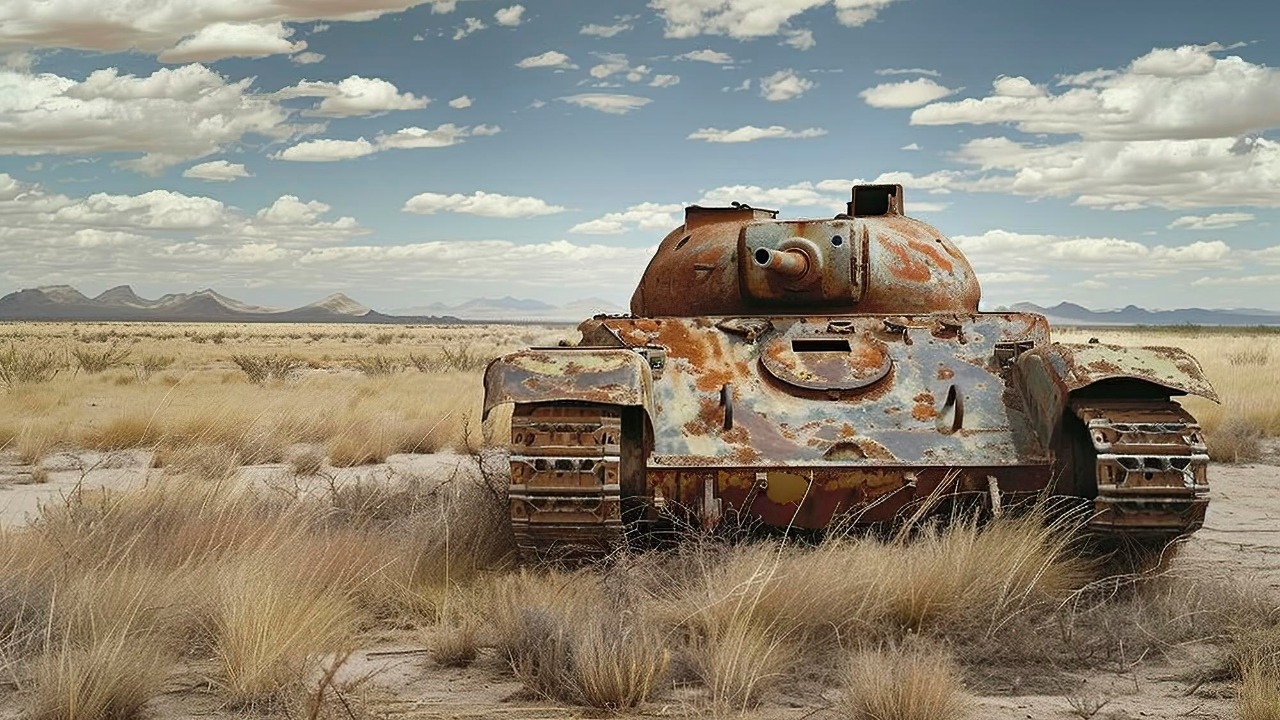
Deep in the high desert of Northern California, thousands of armored vehicles sit in neat, sunbaked rows, their combined value easily stretching into the hundreds of billions of dollars. What looks like a graveyard of war machines is in fact one of the United States military’s most important insurance policies, a vast reserve of combat power kept in limbo between past wars and future crises. I want to unpack why so much steel has been parked in the sand, how it got there, and what it tells us about the way the Army plans for the next conflict.
The remote desert where tanks go to wait
The story starts with geography. The U.S. military chose a remote corner of Northern California because the high desert climate is dry, isolated, and forgiving to metal, rubber, and electronics that might otherwise rot in humidity or salt air. Nearly a mile above sea level, the landscape around the depot is sparse and windswept, with long sightlines and very little development, which makes it ideal for sprawling rows of parked armor that need security and space more than they need daily human traffic.
In this environment, more than 26,000 armored vehicles, trucks, and other military hardware are stored in various states of readiness, forming a kind of mechanical city on the desert floor. Aerial images show the depot’s footprint stretching across the plain, with tanks, armored carriers, and support vehicles lined up in geometric patterns that are visible from space. The isolation of this part of Northern California is not an accident, it is a deliberate choice to keep a massive stockpile out of the way yet instantly accessible to the Army when needed.
Inside Sierra Army Depot’s hidden sprawl
The facility at the heart of this story is Sierra Army Depot, a vast logistics and storage complex that has quietly become one of the most important depots in the United States. From the air, the base looks like a patchwork of warehouses, rail spurs, and endless parking grids, each one filled with armored silhouettes that hint at past conflicts and future contingencies. The depot’s mission is not glamorous, but it is central to how the Army manages the life cycle of its equipment, from brand new deliveries to battle-worn returns.
Officially, Sierra Army Depot is the primary storage, maintenance, and redistribution hub for a wide range of Army materiel, including armored vehicles and other heavy systems. The base handles everything from receiving tanks back from overseas deployments to preparing them for long term storage or eventual disposal. Its infrastructure, including rail links and large maintenance bays, allows technicians to strip, repair, and reconfigure vehicles before they are either mothballed in the desert grid or shipped onward to units that need them.
How thousands of Abrams ended up parked in rows
Among the most striking sights at Sierra Army Depot are the rows of M1 Abrams main battle tanks, the iconic centerpiece of U.S. armored forces for decades. There are hundreds of Abrams in storage here, some tucked into hangars for more intensive work, but most parked outside in the open desert air. The tanks are arranged in long, orderly lines, each one representing a significant investment in armor, electronics, and firepower that is currently sitting idle rather than rolling with an active unit.
Reporting from Oct describes how There are hundreds of Abrams at Sierra Army Depot, with Some of the oldest tanks stored for potential cannibalization or future refurbishment. Many of these vehicles have cycled through multiple upgrades and deployments, then been pulled from front line units as newer variants arrived. Instead of being scrapped immediately, they are preserved in this desert staging ground, where they can be tapped for parts, converted to training platforms, or, if needed, brought back into service after a thorough overhaul.
From Cold War surplus to 20,000 “abandoned” vehicles
The sheer scale of the parked fleet is a legacy of Cold War production and decades of sustained procurement that outpaced immediate battlefield needs. As the Army modernized and conflicts shifted, older models and surplus vehicles accumulated faster than they could be retired or sold. Over time, that backlog turned Sierra Army Depot into a kind of mechanical archive, where generations of armored technology sit side by side, waiting for a new purpose or a final decision on their fate.
One detailed account invites readers to Explore the history behind the depot, describing how more than 20,000 U.S. military vehicles, including tanks and Humvees, came to be stored in this high desert complex. Another narrative explains that deep in California’s high desert, row after row of Army tanks, Humvees, and armored carriers now sit baking in the sun at what has become one of the largest such depots in the United States. The word “abandoned” captures the visual drama, but in practice these vehicles are cataloged, tracked, and held in reserve rather than simply left to decay.
Why the desert climate is a perfect parking lot
The choice of a desert environment is not just about cheap land, it is a technical solution to the problem of preserving complex machinery over long periods. Metal rusts, seals dry out, and electronics corrode when exposed to moisture and salt, which is why the Army prefers a high, dry plateau where temperature swings are predictable and rainfall is limited. The thin air and low humidity slow down corrosion, while the open space allows for easy access by maintenance crews and security patrols.
Climate data from the region show that During the winter months of December and January, average lows drop to near freezing, around 34 degrees Fahrenheit, while summer highs climb sharply during the mid summer months. This vast expanse of desert, despite the heat, does not cause significant deterioration to the stored vehicles when they are properly prepared and sealed. The environment, in other words, acts as a natural preservation chamber, allowing the Army to park thousands of tanks and other systems for years without the kind of damage they would suffer in wetter climates.
Not a junkyard: readiness, cannibalization, and upgrades
From a distance, the depot can look like a scrapyard, but up close it functions more like a carefully managed warehouse. Vehicles are sorted by type, condition, and potential future use, with some kept in near ready status and others designated as parts donors. Technicians periodically inspect and service the stored equipment, focusing on sealing openings, protecting sensitive components, and preventing small problems from turning into catastrophic failures over time.
Imagery and on the ground reports describe Thousands of tanks in various states of readiness at Sierra Army Depot, CA, some of which can be reactivated relatively quickly while others are clearly being stripped for components. When the United States decided to send a limited number of Abrams to Ukraine, for example, observers pointed out that the depot’s rows of stored tanks represented a deep pool of potential hulls and parts. The visual of so many parked vehicles can be misleading, because behind that stillness is an active logistics system that feeds modernization programs and supports allies.
How much is really sitting in the sand?
Putting a precise dollar figure on the hardware stored in the California desert is difficult, but even conservative estimates quickly climb into the tens or hundreds of billions. A single modern M1 Abrams can cost several million dollars depending on configuration, and that is before counting specialized support vehicles, armored personnel carriers, and the vast fleet of Humvees and trucks. When thousands of such systems are parked together, the total value rivals the defense budgets of entire nations.
Some analyses of the depot’s inventory note that earlier production runs of Abrams and other armored vehicles have been cycled into storage as newer variants entered service, creating a layered stockpile that includes both cutting edge and obsolete models. One detailed breakdown of the tank fleet explains that the United States has produced up to 8,100 tanks of this type, a figure that helps explain how so many could end up in long term storage without depleting active units. When I look at the aerial views of the depot, I see not just idle steel, but a physical ledger of decades of procurement decisions and shifting strategic priorities.
The Army’s modernization gamble
Parking thousands of tanks in the desert is not just about storage, it is also about making room for new technology. The Army has been explicit that it plans to abandon some obsolete systems in order to modernize, trading heavy, maintenance intensive platforms for more agile, networked, and survivable equipment. That shift requires a place to send older vehicles once they are no longer central to frontline doctrine, and Sierra Army Depot has become one of the main destinations.
In public discussions of its future force, The Army has outlined a plan to retire or repurpose legacy systems so that funding and attention can move to next generation platforms, a strategy that is explored in detail in The Army modernization briefings. Video tours of the storage yards, such as one walk through of US Tanks in storage, show rows of vehicles that are unlikely to return to frontline service but still hold value as training tools, test beds, or sources of spare parts. The gamble is that by accepting a visible surplus of parked armor today, the Army can free itself to invest in the capabilities it believes will matter most in the next war.
What the tank boneyard reveals about U.S. power
Seen from a satellite view, the California tank fields are a stark visual representation of American military scale. Few other countries could afford to build, then park, such a vast fleet of armored vehicles, let alone maintain them in a state where they could be reactivated or repurposed. The depot’s existence signals both the depth of U.S. industrial capacity and the political choice to keep a large strategic reserve rather than scrapping everything that is not immediately needed.
At the same time, the rows of idle tanks raise hard questions about efficiency, priorities, and the environmental footprint of maintaining so much heavy metal in perpetuity. The site is so large that it is easily visible in mapping tools, with satellite imagery capturing the precise grid of parked armor that has fascinated analysts and casual observers alike. When I look at those images, I see more than a boneyard, I see a snapshot of how the United States balances past investments, present readiness, and future ambitions, all condensed into miles of steel waiting patiently in the California sun.
More From TheDailyOverview

Grant Mercer covers market dynamics, business trends, and the economic forces driving growth across industries. His analysis connects macro movements with real-world implications for investors, entrepreneurs, and professionals. Through his work at The Daily Overview, Grant helps readers understand how markets function and where opportunities may emerge.

