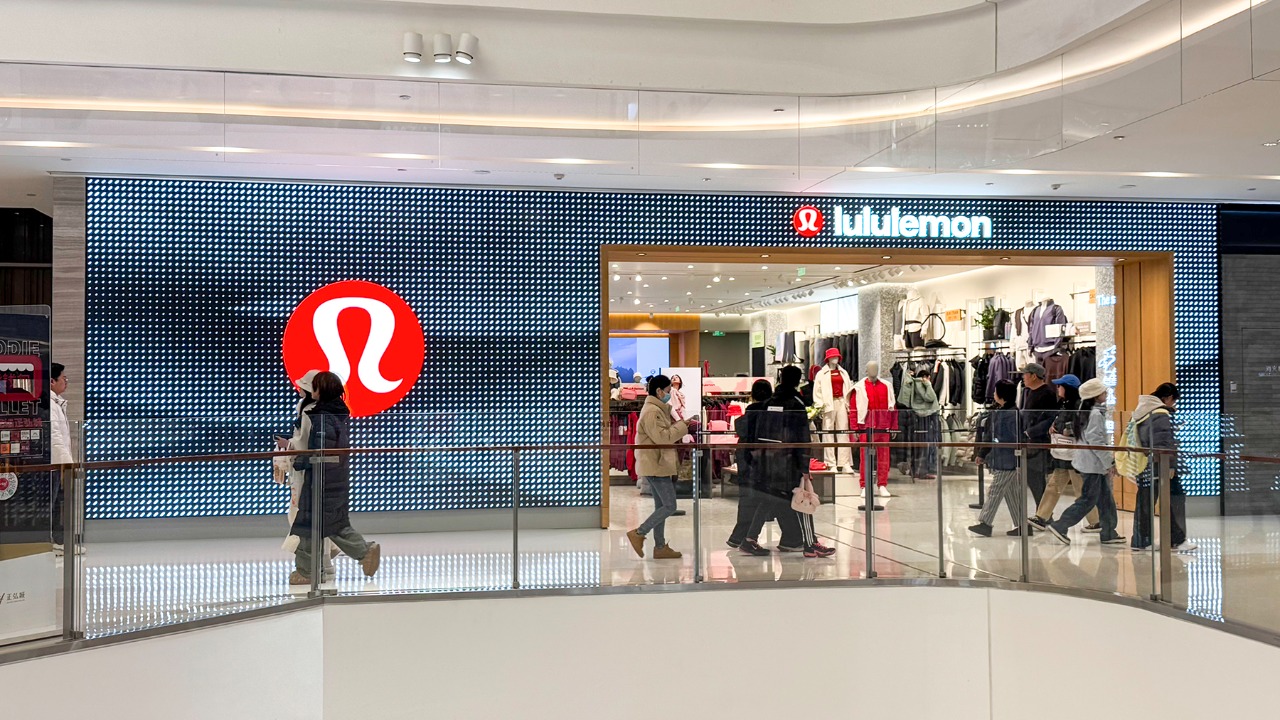
Lululemon built its brand on the promise that premium yoga pants and a wellness lifestyle could justify triple-digit price tags. That promise is fracturing. With its core North American business shrinking, a CEO departure, a founder waging a proxy fight, and nimbler competitors circling, the athleisure giant faces the most serious challenge to its identity since it went public.
The Numbers Behind the Stumble
The clearest sign of trouble sits in Lululemon’s own financial disclosures. For the fiscal year ended February 2, 2025, the company reported that Americas comparable sales fell 1%, even as international net revenue surged 34%. That gap between a stalling home market and booming overseas growth told a story the headline revenue numbers obscured. The brand’s relevance where it matters most was already slipping. Three-quarters of Lululemon’s revenues come from the Americas, according to reporting by The Economist, making any domestic weakness an existential concern rather than a regional hiccup.
By the third quarter of fiscal 2025, the decline had deepened. According to the company’s own earnings release, Americas comparable sales decreased 5% year over year, Americas net revenue fell 2%, gross margin compressed by 290 basis points, and operating margin dropped 350 basis points. Diluted earnings per share slid to $2.59 from $2.87 in the prior-year period. Management pointed to inflation and consumer caution as factors behind U.S. traffic softness, while also flagging tariff-related cost pressures, as described in coverage by the Financial Times. Blaming macroeconomic headwinds is fair, but it does not fully explain why competitors selling similar products at lower prices are gaining ground in the same environment, especially when equity analysts tracking the stock through market data services have repeatedly highlighted Lululemon’s historically rich valuation as contingent on continued North American growth.
A CEO Exit and a Founder’s Revolt
Leadership transitions rarely happen in a vacuum, and Lululemon’s timing speaks volumes. CEO Calvin McDonald will step down at the end of January 2026, then serve as a senior advisor through March 31, 2026. Board chair Marti Morfitt is stepping into the role of Executive Chair, while CFO Meghan Frank and Chief Commercial Officer Andre Maestrini are both mentioned in the succession plan. The absence of an immediate permanent replacement suggests the board is buying time, not executing a long-planned handoff. McDonald had warned investors earlier in 2025 about softening consumer demand, but the speed of deterioration in the Americas business appears to have accelerated the timeline for change at the top, even as broader consumer-spending trends tracked by macro policy analysts show a mixed but not catastrophic backdrop.
Compounding the governance uncertainty, founder Chip Wilson has launched a formal challenge. Wilson submitted notice to nominate three director candidates for the 2026 annual meeting, and the company has signaled it will file proxy materials in response. SEC filings from entities affiliated with Wilson confirm the founder’s dissatisfaction with the board’s direction and strategy. A proxy fight during a CEO transition is a particularly destabilizing combination. It forces management to split its attention between defending board seats and stabilizing a business that is losing share in its largest market. The risk disclosures in Lululemon’s latest annual 10-K report already flag competition, brand perception, and product quality as material threats, and Wilson’s campaign effectively argues the current board has failed to address those very risks.
Upstarts and Dupes Erode the Moat
Lululemon’s premium pricing depends on the perception that its products are meaningfully better than alternatives. That perception is under siege from two directions. On the retail front, brands like Vuori and Alo Yoga are aggressively expanding their physical store footprints. Real estate broker Brian Kampf, who has helped lease stores to Vuori, Alo, and Lululemon in Texas and California, told Reuters reporters that the upstarts are strategically targeting openings around existing Lululemon locations. That is not coincidence; it is a deliberate land grab designed to intercept Lululemon’s core customer at the point of purchase, offering similar aesthetics and performance claims at slightly lower prices and with the novelty of a “new” brand.
The threat from below is equally corrosive. Lululemon filed a federal lawsuit accusing Costco of selling lookalike versions of its Scuba, Define, and ABC product lines, seeking an injunction and damages over alleged trade dress violations. The suit is a tacit admission that the “dupe” phenomenon has moved beyond social media jokes and into a material brand-dilution problem. When shoppers can buy garments that mimic Lululemon’s silhouettes and fabrics for a fraction of the price at a warehouse club, it chips away at the mystique that once made the brand’s leggings a status symbol. Even if Lululemon prevails in court, the proliferation of copycats normalizes the idea that high-performance athleisure is a commodity, not a luxury, eroding the pricing power that underpins its margins.
Can the Brand Recenter Itself?
For all the turbulence, Lululemon is not a broken company. The same disclosures that reveal the Americas slowdown also show robust international momentum, with double-digit growth in markets where the brand is still in its early innings. The company’s balance sheet remains healthy, and its direct-to-consumer channel gives it rich data on customer behavior. Those advantages offer a foundation for a reset (if leadership can confront some uncomfortable truths). The core issue is not merely traffic softness or tariffs; it is a perception that the brand has drifted from the technical, community-rooted ethos that differentiated it from generic activewear. As competition intensifies, simply layering on more colorways and collaborations may no longer be enough to justify premium prices.
Re-centering the brand will likely require a sharper focus on product innovation and fit, areas that long-time customers once evangelized without prompting. It may also demand a more disciplined approach to inventory and discounting; frequent markdowns risk training consumers to wait for sales, undermining the aura of scarcity. The governance battle could, paradoxically, help if it forces a more candid conversation about strategy and capital allocation. But that outcome depends on whether the proxy contest yields constructive change or devolves into a distraction. Investors already parsing earnings calls and valuation metrics through financial-market dashboards will be watching for evidence that management can stabilize North America without sacrificing the profitable growth still available overseas.
The Stakes for the Next Chapter
What happens at Lululemon over the next 18 months will reverberate well beyond yoga studios. The company became a template for how to turn a niche athletic category into a mass-market lifestyle, inspiring a wave of imitators across apparel and consumer goods. If Lululemon can navigate a CEO handover, fend off a founder-led board challenge, and reassert its relevance in a crowded field, it will reinforce the idea that strong brands can adapt without losing their essence. If it stumbles, the episode will serve as a cautionary tale about the limits of premium pricing in an era when information, and imitation, spreads instantly.
For now, the brand sits at an inflection point. Its own filings acknowledge the risks, its founder is publicly questioning the board’s stewardship, and its competitors are encircling its stores and copying its styles. The next leadership team will inherit not just a profitable global business, but also a fragile social contract with consumers who have more choices than ever. Whether Lululemon’s next act looks like a renewed ascent or a slow fade will depend on how convincingly it can persuade those customers that its logo still stands for something they cannot easily find, or cheaply copy, anywhere else.
More From The Daily Overview
*This article was researched with the help of AI, with human editors creating the final content.

Grant Mercer covers market dynamics, business trends, and the economic forces driving growth across industries. His analysis connects macro movements with real-world implications for investors, entrepreneurs, and professionals. Through his work at The Daily Overview, Grant helps readers understand how markets function and where opportunities may emerge.

