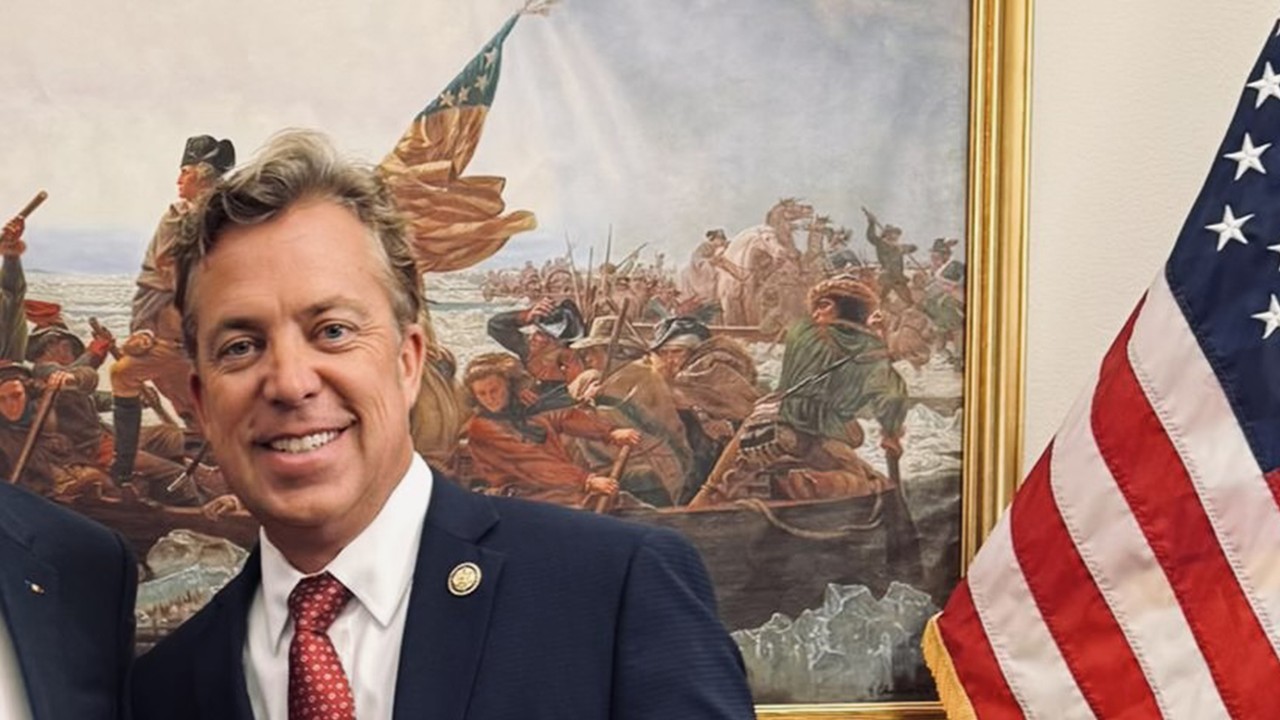
Andy Ogles had the president’s endorsement, a seat on two committees, and a Freedom Caucus membership that made him one of the loudest conservatives in the House. He lost anyway, to a retired state agriculture commissioner running on the slogan “Hire a Farmer.” Between those two facts sits a super PAC that was ten months old on election day and that spent more money in Tennessee’s 5th District than both campaigns combined.
The Number the Filings Put on It
The figure is not an estimate. Federal Election Commission filings for the Invest in Tomorrow Coalition PAC show $1,344,174 spent supporting Charlie Hatcher and $655,826 spent opposing Ogles in the 2026 cycle. That is exactly $2,000,000 aimed at a single House primary.
The independent expenditure disclosures record all of it as advertising for radio, television, newspaper or print, and nearly all of it landed in the final three weeks. The single largest transaction, $376,799 on July 16, went to boosting Hatcher. Two more rounds followed on July 28 and July 29, each one splitting its money between building him up and tearing Ogles down.
Set that against what the candidates themselves could spend. Hatcher went into the primary with $186,563 in cash on hand. Ogles, an incumbent with two terms behind him, was in the same range. The outside committee did not merely supplement a campaign. It was the campaign, in dollar terms, and the two men whose names were on the ballot were the smaller players in their own race.
One Ripple Executive Supplied Nearly Nine of Every Ten Dollars
The committee’s receipts explain where that money came from, and the answer is close to a single person. Chris Larsen, listed in the filings at a California address with his employer recorded as Ripple Inc. and his occupation as executive chairman, gave the PAC $250,000 in February, another $250,000 in March, $500,000 in May, and then $5 million on June 30. That comes to $6 million.
The committee itself reported total receipts of $6,780,352 for the period running from January 1 through June 30, every dollar of it from itemized individual contributions. Larsen’s $6 million is roughly 88 percent of that. The rest of the donor list reads like a clean energy industry directory: a Lime Rock New Energy managing director at $200,000 across two checks, Summit Ridge Energy at $100,000, TPE Development at $75,000, Orange Solar Development and SolarREIT at $50,000 each, and NextPower’s president at $25,000. Thomas Matzzie, chief executive of CleanChoice Energy, appears on the list for $50,000 and also chairs the group.
The committee registered with the FEC on January 29 of this year as an independent expenditure only committee, listing a Richmond, Virginia mailing address. It finished June with $5,131,619 still in the bank, which is the number that should worry every Republican on its list.
The One Big Beautiful Bill Created the Target List
None of this was personal to Tennessee. The committee’s stated purpose is to punish members of Congress who moved against renewable energy tax credits, and Ogles was one of the House Freedom Caucus members who pushed leadership for a faster phaseout of those credits during negotiations over the One Big Beautiful Bill. He voted for the party’s signature legislation and helped make one of its provisions more aggressive, and that provision is what put a target on him.
Matzzie made the logic explicit after the result came in. “We will continue to punish members of either party who want to play politics with American jobs, energy security, and utility prices,” he said in a statement reported Friday. “The entire map is in play and we will take this fight across the country through November.” South Carolina Representative Ralph Norman, now running in the special election to succeed the late Senator Lindsey Graham, is among the other names the group has gone after.
The Ads Never Mentioned Solar Panels
The most instructive detail of the whole operation is what the advertising did not say. The spots did not attack Ogles over energy policy or defend renewable tax credits. They cast him as a showhorse and presented Hatcher as the more conservative, more serious worker of the two. A Republican primary electorate that would have rejected a clean energy pitch on sight was instead handed an argument about character and seriousness, funded by donors whose interest in the race had nothing to do with either.
That is a repeatable model, and it is cheap relative to a general election. Two million dollars is a rounding error in a competitive Senate race. In a low turnout August primary in a redrawn district, it was decisive enough that the losing side named it as the cause within hours.
A Tele-Rally and $810,000 Were Not Enough
Ogles was not abandoned. President Donald Trump endorsed him in October, before the district lines changed, and returned near the end of early voting with a tele-rally paid for by the Freedom Caucus Fund and the Ogles campaign. That fund put more than $810,000 into media buys and robocalls supporting Ogles or opposing Hatcher after May 15. Ogles had spent his career positioning himself as close to the administration as a backbencher can get, including nominating Trump for a Nobel Peace Prize in 2025 and filing a constitutional amendment that would have allowed a president to serve three terms.
Hatcher took 53.2 percent to Ogles’ 46.8 percent when the Associated Press called the race at 9:10 p.m., a margin of more than six points against a sitting member with a presidential endorsement. Official certified totals have not yet been posted to the Tennessee Secretary of State’s results page, so the percentages remain unofficial. Ogles called Hatcher to concede and offered to help with the transition. The Freedom Caucus Fund was less gracious, posting that Ogles lost because a super PAC bankrolled by California Democrats spent $2 million to raid a Republican primary, and warning that the group’s goal is to break the president’s majority in the House.
The District Ogles Was Running In Did Not Exist in April
The map underneath the race had shifted too. Tennessee legislators redrew the 5th District in May with the aim of securing Republican wins across the state’s congressional delegation, and the version Ogles was defending stretched from the wealthy suburbs of Williamson County across rural West Tennessee farmland and into low income neighborhoods in Memphis. His old base in Maury County, where he served as county mayor, was a much smaller share of it. An incumbent with a presidential endorsement was effectively introducing himself to a large block of voters for the first time, against an opponent whose name recognition came from running the state’s agriculture department and whose entire pitch was rural competence.
Hatcher now faces Columbia Mayor Chaz Molder in November. Molder won the Democratic primary with 41.2 percent, has the backing of the Democratic Congressional Campaign Committee, raised $2.6 million this cycle and held close to $1.5 million going into August. Hatcher had $186,563. Whether the donors who spent $2 million to install him as the nominee stay interested now that the intraparty scalp has been taken is the question the rest of the Republican conference is going to be asking, and the $5.1 million still sitting in that committee’s account is the reason it matters.
This article was produced with AI assistance and reviewed prior to publication.

Elias Broderick specializes in residential and commercial real estate, with a focus on market cycles, property fundamentals, and investment strategy. His writing translates complex housing and development trends into clear insights for both new and experienced investors. At The Daily Overview, Elias explores how real estate fits into long-term wealth planning.